






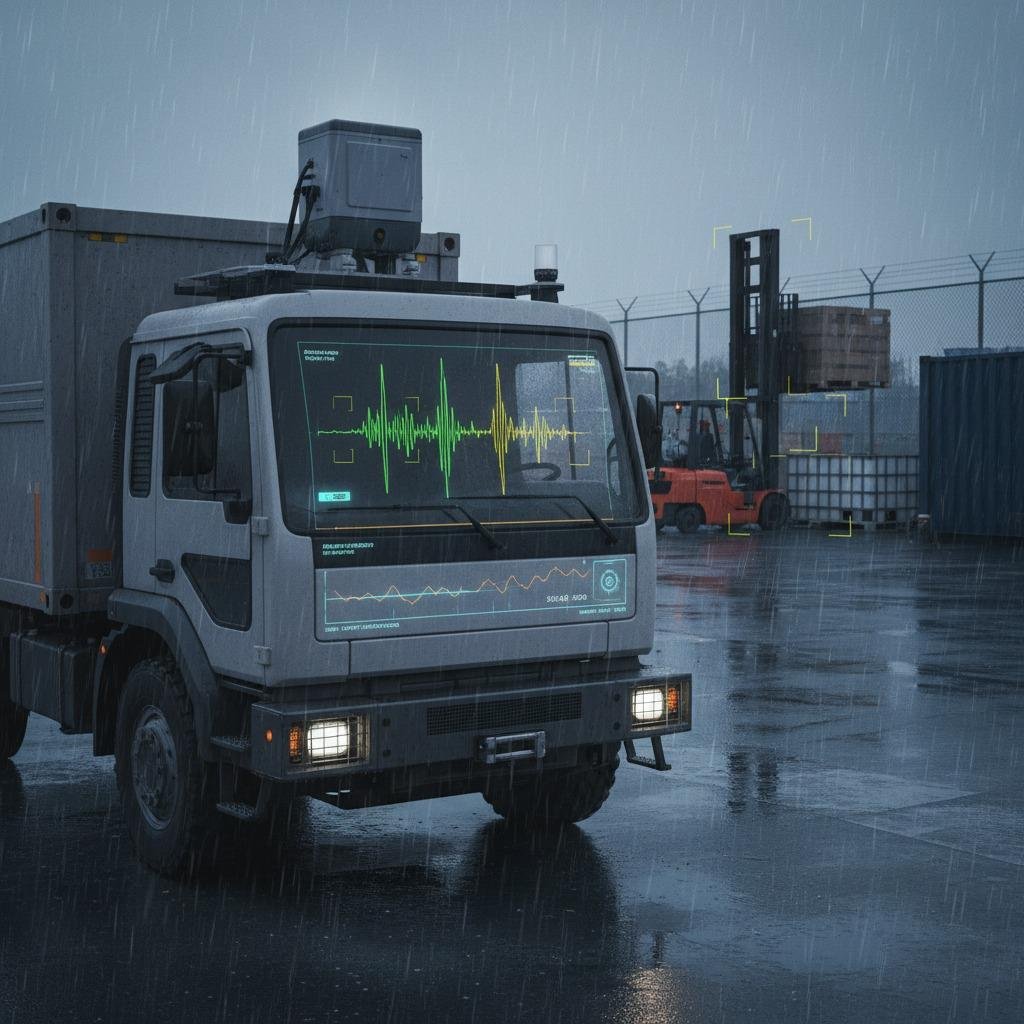
Why adaptive threshold tuning matters in radar and sensing workflows
Adaptive threshold tuning via AI is becoming a practical topic for engineering teams because the old way of setting fixed detection thresholds often breaks down when conditions change. Rain, dust, vibration, multipath reflections, shifting backgrounds, and changing target profiles can all push a conventional system into either missed detections or too many false alarms. For teams building radar, sensor fusion, or machine-vision products, that is not just an algorithm problem; it affects field reliability, operator trust, and the cost of downstream processing.

The core decision here is simple: should thresholding remain a hand-tuned rule set, or should it respond dynamically to changing signal conditions using learned models? In many applications, the answer is increasingly the second option. But the useful question is not whether AI can help. It is where it helps, what kind of data it needs, and how much control engineers want to keep over the final decision path.
What adaptive threshold tuning via AI actually does
Traditional thresholding usually compares a signal value against a preset cutoff. That works when the noise floor is stable and the target is predictable. In real systems, neither assumption holds for long.
Adaptive threshold tuning via AI uses data-driven models to estimate how thresholds should shift as the scene changes. Depending on the application, the model may look at raw signals, extracted features, spatial context, temporal history, or outputs from earlier detection stages. The result is a threshold that is less rigid and more responsive to operating conditions.
In radar and sensing, this is often paired with feature learning for radar signals, because raw waveforms alone do not always expose the patterns needed for robust detection. When clutter increases or target signatures become weak, the model can learn which characteristics matter most and adjust its decision boundary accordingly.
Where the approach tends to pay off
Some use cases benefit more than others. The strongest fit is usually in systems that face variable environments and cannot tolerate a flood of false positives.
Radar and automotive sensing
Radar systems in vehicles or industrial equipment have to deal with moving backgrounds, reflective surfaces, and changing weather. A neural network for clutter reduction can help separate meaningful returns from environmental noise before thresholding takes place. That does not eliminate traditional signal processing, but it can reduce the burden on the later stages.
Inspection and automation systems
In manufacturing inspection, lighting changes, surface variation, and product mix can all make fixed thresholds unreliable. Real-time semantic segmentation may be useful when the system must understand object boundaries or scene context before deciding what is defect, background, or acceptable variation. Here, the threshold is not just a number; it is part of a broader classification pipeline.
Classification-heavy platforms
When the end goal is not simply detection but decision-making, deep learning-based target classification can help sort between classes that would otherwise overlap in raw amplitude or intensity space. This is particularly relevant when the sensing task involves similar-looking returns with subtle structural differences.
Key implementation choices engineers should watch
There is a practical tradeoff in every AI-assisted thresholding scheme: the more adaptive the system becomes, the more data discipline it requires. Models trained on one environment may look excellent in the lab and disappoint in the field. That is a familiar story, and it is worth stating plainly.
Start by defining what the threshold is supposed to optimize. Is the goal fewer false alarms, higher recall, better class separation, or a balance of all three? Without that answer, teams often build a model that improves one metric while quietly harming another.
Next, consider latency. Real-time semantic segmentation and similar context-heavy methods can add computational load. If the platform has limited processing headroom, the architecture may need simplification, pruning, or an edge-friendly inference path. In embedded systems, that matters as much as accuracy.
Finally, keep a human in the loop where the risk profile demands it. Some industrial buyers prefer a hybrid setup: AI suggests an adaptive threshold, but rule-based checks still guard against unstable outputs. That approach can be less elegant on paper and more reliable in production.
Common mistakes when adopting AI-driven thresholding
One common mistake is assuming the model will automatically generalize across sensors, sites, or product variants. Another is feeding it too little edge-case data. If the only training examples come from clean, controlled conditions, the threshold may drift in exactly the wrong direction when clutter or interference appears.
Teams also sometimes overestimate how much raw accuracy matters versus operational behavior. A system that performs well on a test set but thrashes in live conditions is not ready, even if its benchmark score looks respectable. For buyers, that is the difference between a demo and a deployable product.
How to evaluate a solution before committing
Ask vendors or internal teams how the model handles changing background conditions, how it is validated across scenarios, and whether the thresholding logic can be inspected. Black-box behavior may be acceptable in some consumer applications, but industrial engineers usually need at least some visibility into why decisions changed.
It is also sensible to ask how the model is updated. If the system needs frequent retraining, who owns the data pipeline? If the model adapts online, how are drift and runaway behavior contained? These are not edge cases. They are the real questions that decide whether the technology remains useful after deployment.
Practical takeaway for sourcing and product teams
Adaptive threshold tuning via AI is most useful when the sensing environment is unstable and decision quality matters more than a fixed rule ever could. It is not a magic replacement for signal processing, and it should not be treated that way. But when paired with the right data, sensible validation, and realistic latency targets, it can make detection systems noticeably more dependable.
If you are evaluating a platform, focus on the operating environment first, the model architecture second, and the benchmark score last. That order tends to save time, and occasionally it saves a program from a very expensive wrong turn.
FAQ
Is AI threshold tuning only for radar?
No. It is also relevant to inspection systems, optical sensing, industrial automation, and any application where the noise floor or scene context changes often.
Does AI replace traditional thresholding?
Usually not. In many deployments, AI augments classical methods rather than replacing them entirely.
What makes a deployment succeed?
Representative training data, clear performance targets, and a validation plan that reflects real operating conditions. Without those, even a promising model can underperform.
Next step
If your team is weighing whether to adopt adaptive thresholding, start with one real use case and test it against the messiest conditions you can reproduce. That is where the gaps usually show up, and where the useful design decisions begin.