





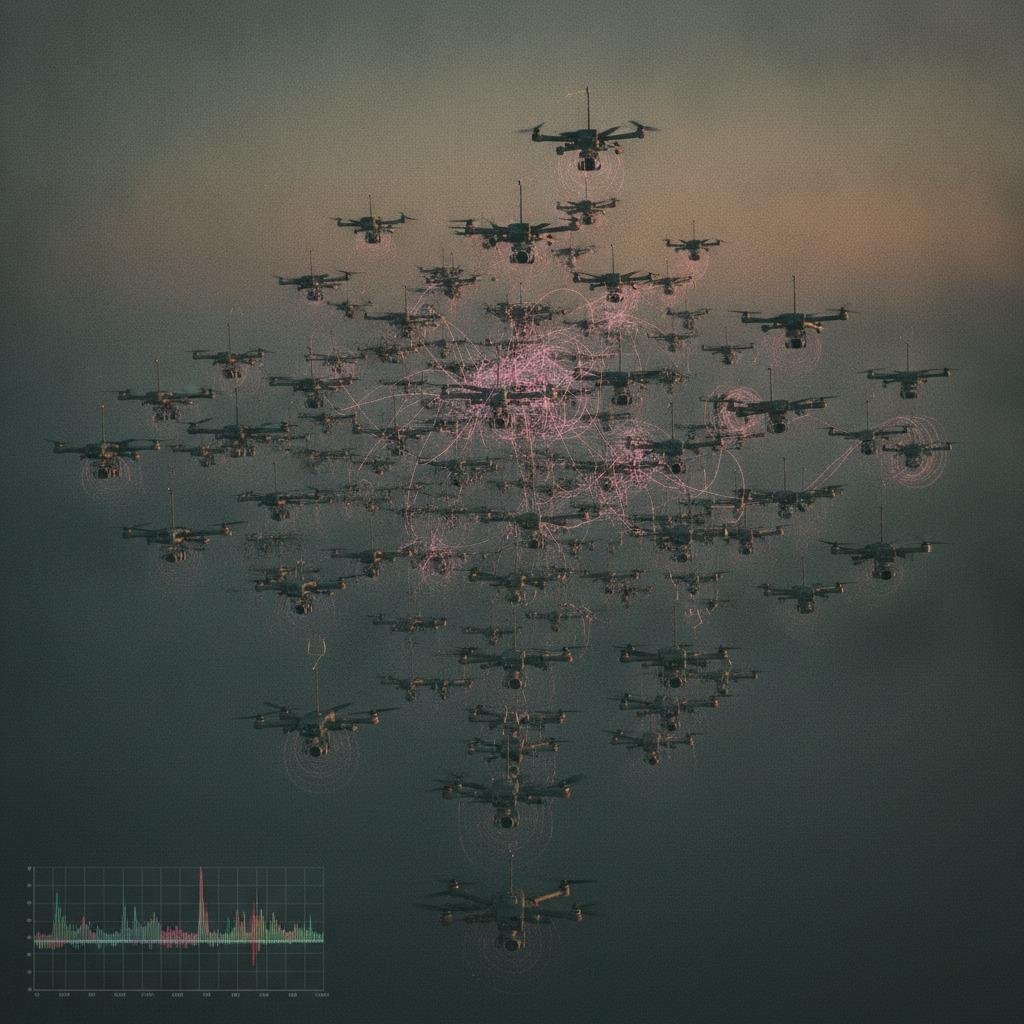
The Self-Induced RF Bottleneck in Dense UAV Swarms
When flight test teams scale a coordinated unmanned aerial vehicle cluster from four nodes to forty, the primary point of failure is rarely aerodynamics or battery density. It is mutual radio frequency saturation. Static channel assignments collapse when nodes maneuver into tight formations, where co-site desensitization, harmonic leakage, and packet collisions choke both control links and payload sensor returns. Achieving resilient, autonomous operation demands dynamic spectrum allocation for drone swarms, shifting RF management from rigid ground-planned frequency tables to real-time, onboard autonomous negotiation.
For systems engineers and defense payload integrators, this transition is not purely an algorithmic challenge. It is an architecture problem that sits at the intersection of size, weight, power, and cost (SWaP-C) constraints, software-defined radio (SDR) front-end linearity, and latency tolerances. When multiple craft share overlapping operating volumes, their onboard radar altimeters, synthetic aperture radars (SAR), and telemetry radios inevitably compete for identical or adjacent spectral windows. If your communications stack cannot reallocate bands on the fly, your swarm will effectively jam itself before any electronic adversary gets the chance.
Where Static Spectrum Plans Fail
Traditional operations rely on pre-mission coordination: Blue force assets take frequency band A, radar payloads stay within band B, and guard bands buffer the margins. In dense, decentralized swarm operations, this model breaks down under three distinct physical pressures:
- Dynamic Geometry: As distance between nodes drops during tight-formation maneuvers or target saturation passes, inverse-square path loss causes received power from friendly adjacent transmitters to completely overwhelm receiver front-ends, blowing past low-noise amplifier (LNA) dynamic ranges.
- Radar and Telemetry Cross-Talk: Modern radar frequency planning in swarm operation cannot remain fixed when multi-static radar nodes must interleave pulses with high-bandwidth video or telemetry downlinks. Without synchronized coordination, pulsed radar signals blind onboard C2 receivers.
- Environmental Contention: Non-cooperative environments introduce unmapped commercial signals, industrial noise, or active electronic counter-measures (ECM), rendering pre-assigned bands useless within seconds of arrival on station.
The Architecture of Onboard Spectrum Allocation
Solving this requires an adaptive loop executed across the swarm fabric: sense, arbitrate, allocate, and verify. Each step introduces distinct engineering trade-offs that system architects must balance.
1. Distributed Sensing and Situational Awareness
Before an agent can hop to an unoccupied slice of spectrum, it must verify the noise floor. Building true electromagnetic spectrum situational awareness across an airframe network requires distributed, low-power RF energy detection and cyclic feature extraction. Rather than relying on a dedicated, heavy spectrum analyzer payload on every drone, modern nodes utilize their existing SDR transceivers during dwell-time gaps to sample wideband noise floors and transmit lightweight spectral maps across the mesh.
2. Autonomous Decision-Making
Once spectral occupancy data is aggregated, nodes must settle on transmission windows without relying on a vulnerable central ground hub. Cognitive frequency selection algorithms—frequently built on decentralized Q-learning or lightweight graph-coloring models—evaluate clear channels, determine required bandwidth per mission phase, and preemptively claim transmission frequencies. This cognitive frequency selection must run within milliwatt-scale embedded processing envelopes without competing with flight-control compute cycles.
3. Mesh Arbitration and Deconfliction
Negotiating who transmits, at what power, and in which band requires robust spectrum deconfliction among UAVs. If two nodes independently observe a clean frequency block and claim it simultaneously, local packet loss spikes. Swarm architectures address this through decentralized consensus protocols or hybrid TDMA/FDMA schemes that negotiate short-term spectrum leases over a low-bandwidth, frequency-hopping control channel.
Practical Comparison: Spectrum Management Strategies
Selecting an RF architecture depends heavily on node density and mission environment. The table below outlines how common spectrum approaches compare across critical operational metrics.
| Allocation Method | Network Scalability | Compute & SWaP Overhead | Resilience to Electronic Interference | Suitability for Radar Coexistence |
|---|---|---|---|---|
| Static Fixed Channeling | Poor (<10 nodes) | Minimal (Static lookup) | Very Low (Single interferer disables link) | Inadequate (Requires extreme guard bands) |
| Centralized Master-Node Allocation | Moderate (10–30 nodes) | Low on edge nodes; High on master node | Fragile (Single point of failure/jamming target) | Moderate (Requires ground orchestration) |
| Decentralized Dynamic Spectrum Allocation | High (>100 nodes) | Moderate (Requires onboard edge processing & SDRs) | High (Autonomous re-routing & frequency agility) | High (Enables cooperative multi-static interleaving) |
Hardware Traps to Avoid During Integration
Algorithms look clean in simulation environments like MATLAB or NS-3, but hardware integration reveals physical realities that math libraries routinely overlook. Keep these practical warnings in mind during procurement and prototype builds:
Overlooking front-end filtering limits: A software layer might demand that Node A transmit telemetry at 2.412 GHz while Node B operates a radar payload at 2.437 GHz twenty meters away. If your RF front-ends use wideband filters without tunable preselectors, the close-in adjacent channel power will saturate the receiver mixer regardless of how clever your cognitive software is.
Underestimating sensing latencies: If your spectrum sensing engine requires 40 milliseconds to sweep and process an FFT block, but your frequency-hopping control layer hops every 10 milliseconds, your algorithms will consistently base allocation decisions on outdated reality.
Excessive control plane traffic: A decentralized consensus algorithm that burns 30% of your total swarm data throughput just trading spectral maps defeats its own purpose. Ensure that spectrum deconfliction among UAVs operates on compressed delta-state matrices rather than raw spectrum waterfall data.
Frequently Asked Questions
How does dynamic spectrum allocation affect radar frequency planning in swarm operation?
Dynamic spectrum allocation coordinates radar pulse repetition intervals (PRI) and operating bands alongside data communications. Instead of reserving fixed, wide swaths of spectrum exclusively for radar, systems allocate dynamic notches where radars transmit without blinding nearby C2 nodes, allowing cooperative radar frequency planning in swarm operation across moving formations.
Can legacy analog RF links participate in cognitive allocation networks?
Directly, no. Analog and fixed-frequency radios lack the agile baseband processing required for on-the-fly tuning. However, integrators sometimes bridge legacy payloads by routing them through an onboard software-defined transponder that downconverts, buffers, and re-transmits data over dynamic swarm-allocated links.
What is the minimum processing baseline required for onboard cognitive frequency selection?
Systems do not require high-power server GPUs. Modern heterogenous system-on-chips (SoCs) combining low-power ARM cores with small FPGA fabrics can easily run real-time FFT processing, energy detection, and heuristic allocation engines inside an active power envelope of under 10 watts.
Next Steps for Systems Designers
Transitioning from bench prototypes to fieldable swarm communications starts with characterizing your platform's analog constraints before deploying dynamic code. Map the out-of-band emissions and dynamic range limits of your intended radio payloads on an anechoic range, identify your worst-case node separation distances, and establish clear SWaP boundaries for onboard processing.