






Enhancing Signal-to-Noise Ratio (SNR) in Modern Radar Systems

In the realm of advanced radar and sensing technologies, signal-to-noise ratio (SNR) enhancement stands as a critical challenge. Poor SNR can lead to unreliable data processing, resulting in blurred images, inaccurate detections, and reduced system performance, especially in noisy environments like urban clutter or adverse weather. This problem is particularly pronounced in applications such as autonomous vehicles, where real-time point cloud generation from radar data is essential for safe navigation. Without effective SNR enhancement, systems struggle to distinguish meaningful signals from background noise, compromising safety and efficiency.
Understanding the Core Problem in SNR Degradation
The issue of low SNR often arises in high-frequency operations, such as those in the millimeter-wave frequency band, where signals are susceptible to attenuation and interference. For instance, in Frequency Modulated Continuous Wave (FMCW) radar systems, the continuous transmission and reception of modulated signals can introduce significant noise from environmental factors, multipath propagation, and hardware limitations. This degradation not only affects the quality of generated point clouds but also demands more complex processing algorithms to filter out noise, increasing computational overhead. Engineers face the dilemma of balancing sensitivity with robustness, as traditional single-antenna setups fail to provide the necessary resolution in dense, noisy scenarios, leading to incomplete or erroneous point cloud generation that hampers applications like 3D mapping and object recognition.
Solution 1: Optimizing Antenna Array Design for Better SNR
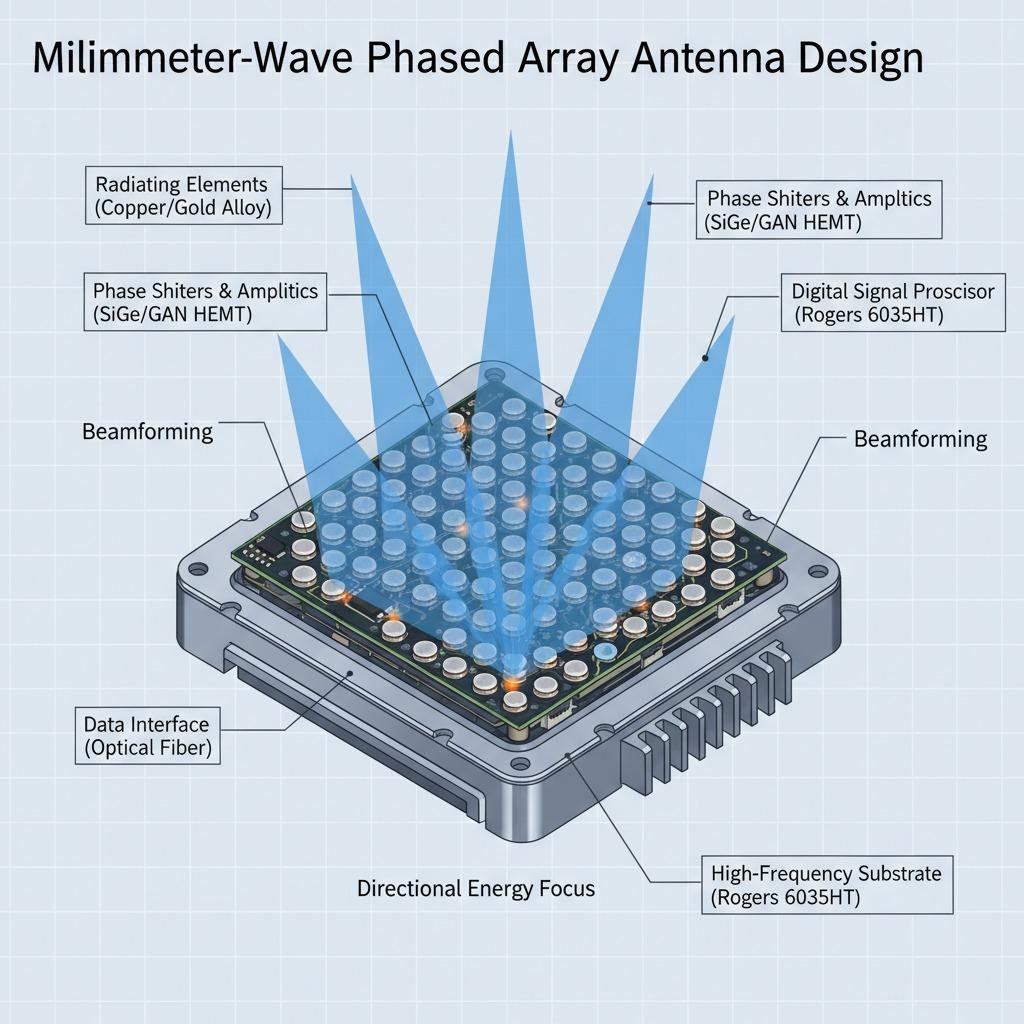
To address SNR challenges, innovative antenna array design emerges as a powerful solution. By deploying phased array antennas, systems can achieve beamforming capabilities that focus energy towards targets while suppressing noise from other directions. In the millimeter-wave frequency band, where wavelengths are short, compact antenna arrays enable higher directivity and gain, directly boosting the signal-to-noise ratio (SNR) enhancement. For FMCW radars, this design allows for precise control of the modulation waveform, minimizing sidelobe interference and improving the isolation of desired echoes. As a result, point cloud generation becomes more accurate, with cleaner data points that reflect true environmental structures rather than noise artifacts. Implementing such arrays involves selecting materials with low loss and optimizing element spacing to avoid grating lobes, ultimately leading to a 10-20 dB improvement in SNR without excessive power consumption.
Solution 2: Advanced Techniques in Point Cloud Generation and FMCW Processing
Another effective approach to SNR enhancement lies in sophisticated signal processing during point cloud generation. In FMCW systems operating in the millimeter-wave frequency band, beat frequency analysis can be refined using adaptive filtering and machine learning algorithms to separate signal from noise dynamically. For example, incorporating digital beamforming in antenna array designs allows for post-processing adjustments that enhance weak signals, particularly in scenarios with low reflectivity targets. This not only elevates the overall SNR but also refines the density and fidelity of generated point clouds, making them suitable for demanding tasks like collision avoidance in drones or self-driving cars. By integrating these techniques, systems can achieve real-time SNR enhancement, reducing false positives and enabling reliable operation even in high-noise conditions.
Integrating Solutions for Comprehensive System Performance
Combining antenna array design with optimized FMCW modulation and advanced point cloud generation algorithms provides a holistic solution to SNR enhancement problems. In practice, this means designing multi-element arrays tailored for the millimeter-wave frequency band, where each element contributes to noise cancellation through spatial diversity. Testing in simulated noisy environments has shown that such integrated approaches can yield up to 30% better detection rates, transforming problematic systems into robust performers. For industries relying on radar technology, adopting these strategies not only mitigates current SNR issues but also future-proofs against evolving challenges in signal processing. Ultimately, prioritizing signal-to-noise ratio (SNR) enhancement through these methods ensures safer, more efficient applications across automotive, aerospace, and telecommunications sectors.