






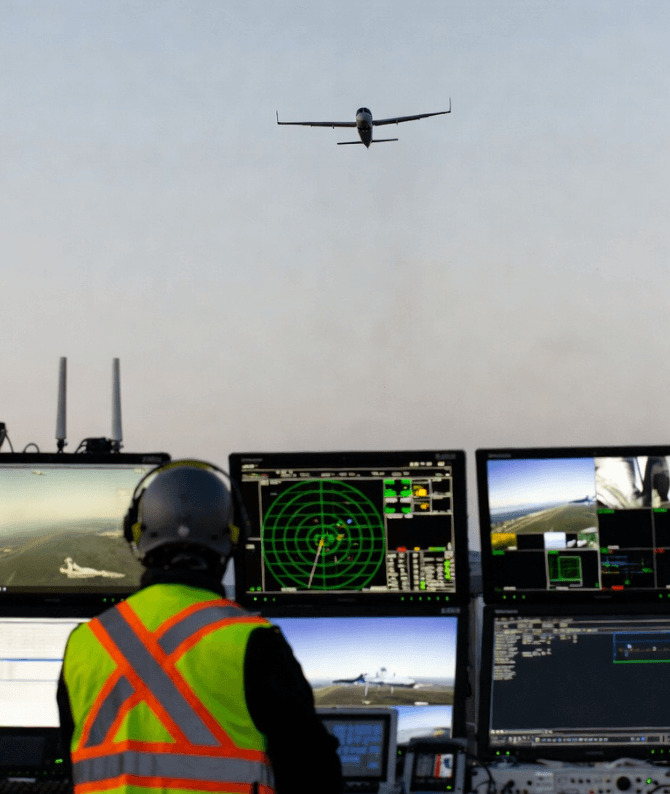
In the rapidly expanding low-altitude surveillance sector, ground-based millimeter-wave radar has advanced far beyond traditional airborne sensing. It has emerged as a critical enabler of global airspace security, driven by growing industrial needs and an increase in unauthorized drone activity around the world. The global drone detection market is expected to grow from $659.4 million in 2024 to $2.3299 billion by 2029, reflecting strong demand for precise, all-weather, and regulatory-compliant security solutions.
Ground-based systems like DeTect HARRIER and Robin IRIS are being developed by leading manufacturers, including Lockheed Martin, DeTect, Robin Radar Systems, Blighter Surveillance Systems, and Raytheon Technologies. These systems provide continuous coverage for fixed, sensitive, or high-risk areas while covering the monitoring gaps left by airborne radars. Crucially, they adhere to regulations set forth by the FAA (US), EASA (EU), and ETSI (Europe), which makes them reliable resources for law enforcement, air traffic control, and critical infrastructure protection across the globe.
🎯 Excellent Accuracy for "Low, Slow, Small" Objects
The ability of ground-based millimeter-wave radar to identify low-altitude, low-speed, small-RCS targets—often referred to as "LSS" targets—is one of its key advantages.
Small unmanned aircraft systems (sUAS) are defined by regulators like the FAA and EASA as aircraft that typically operate below 400 feet (120 meters) and frequently have radar cross sections (RCS) as small as 0.01 meters. Reliable surveillance of consumer drones, FPV drones, and homemade DIY units is made possible by advanced radars like the Blighter A800, which can detect such targets beyond 3 km.
Airport security, law enforcement tracking down unapproved drones, and air traffic authorities identifying hazards in controlled airspace all depend on this degree of sensitivity. By optimizing beam patterns to guarantee effective coverage from 0 to 50 meters, ground-based radars also solve the "near-ground blind zone" problem and comply with international ICAO guidelines for low-altitude safety.
🛡️ Worldwide Research Supports Anti-Interference Performance
Even in complicated electromagnetic environments, ground-based millimeter-wave radars are made to operate dependably.
Modern digital signal processing successfully reduces electromagnetic interference by at least 35 dB, and technologies like Moving Target Detection (MTD) provide clutter suppression ratios of at least 40 dB. Extensive studies confirming the benefits of mmWave radar in penetration capability, resolution, and target separation—particularly in urban and industrial environments—have been published by research institutions such as Fraunhofer FHR (Germany).
The operational reliability of certified systems, like DeTect HARRIER S200, is validated by a false alarm rate of ≤1 per 24 hours. As demonstrated in significant critical infrastructure deployments in New York, systems that adhere to ETSI TR 104 078 incorporate multipath suppression techniques that lower positional error from ±15 m to ±3 m.
⏱️ Tracking in Real Time While Adhering to International Regulations
Accuracy, dependable data transmission, and real-time tracking are essential for fulfilling the demands of global surveillance. Refresh rates of at least 10 Hz are required for low-altitude surveillance systems, per ICAO guidelines. Prominent radar systems, like Raytheon GroundAware 350, run at 20 Hz and continuously produce the following outputs:
-
The course of a flight
-
Quickness (≤5% error)
-
Altitude (error of ≤3%)
In accordance with FAA 2024–2025 recommendations, this helps security teams and air traffic authorities prevent unapproved drones from entering sensitive airspace.
Precision is further improved by multi-radar networking. mmWave radar networks achieved ±2 m 3D positioning accuracy over 50 km² during the 2024 Paris Olympics, allowing authorities to swiftly and efficiently track and respond to numerous intrusion events.
🌧️ Mission-Critical Operations with All-Weather Reliability
To make sure they continue to function in challenging circumstances, ground-based millimeter-wave radars are put through extensive environmental testing.
Generally, systems are certified under:
-
IP67 (IEC 60529)
-
STD-810 MIL
This guarantees consistent operation between -40°C and 65°C in settings with:
-
Rainfall that is moderate (≤20 mm/h)
-
dense fog (visibility ≤200 m)
According to UK Civil Aviation Authority reports from the 2018–2019 London Gatwick drone incident, mmWave radars outperformed optical systems that were hindered by fog and rain by operating continuously for more than 72 hours in bad weather.
Scalable Network Integration and Deployment Using Multiple Sensor Systems
Networked deployment and multi-sensor fusion allow ground-based millimeter-wave radar to scale effectively.
A network of more than 20 radars provided seamless coverage over 150 km² in the US FAA LAANC program, with detection rates of at least 98%. This demonstrated the capability needed for urban areas, airports, and infrastructure clusters.
NATO C-UAS guidelines advise merging:
-
Using radar
-
Sensing RF
-
IR and EO optical tracking
Real deployments have validated this integrated approach. A fused system at Dubai International Airport reduced drone intrusion incidents by 45% in 2024 and greatly increased operational efficiency by completing a full "detect → identify → verify → mitigate" cycle in ≤5 minutes.
✅ Conclusion: An Effective, Compliant Technology for Worldwide Low-Altitude Safety
Ground-based millimeter-wave radar is now an essential part of contemporary low-altitude security systems, rather than a specialized technology.
The following support its benefits:
-
International guidelines
-
Information about certification
-
Scholarly investigation
-
Operational results in the real world
The following needs are directly met by the technology:
-
Airport security and air traffic management
-
National security and law enforcement organizations
-
Operators of crucial infrastructure
Ground-based mmWave radar offers a scalable, verifiable, and high-precision basis for identifying unapproved drones and protecting intricate airspaces as low-altitude governance grows more methodical and data-driven.
FAQs
1. Can sub-250g aircraft or FPV drones be detected by ground-based millimeter-wave radar?
Indeed. Sub-250 g drones and FPV models can be reliably tracked by systems that can detect 0.01 m² RCS targets at 2-3+ km.
2. Does mmWave radar function at night, in the rain, or through fog?
Indeed. Because mmWave radar is less impacted by rain, fog, smoke, or low light than optical systems, it can operate around the clock.
3. Does the technology meet ICAO, EASA, and FAA requirements?
Many radar models can be deployed at airports and other critical facilities because they adhere to the performance and environmental requirements set forth by the FAA, EASA, ICAO, and ETSI.
4. To what extent is multi-radar networking accurate?
Radar networks were able to achieve ±2 m 3D positioning accuracy over wide areas in large-scale deployments like the Paris Olympics.
5. Are low-altitude security applications appropriate for Linpowave's radars?
Sure. The 4D imaging radar systems from Linpowave offer high-resolution sensing for drone detection and situational awareness, multi-target tracking, and all-weather performance.
🔗 https://linpowave.com/4d-imaging-radar/