






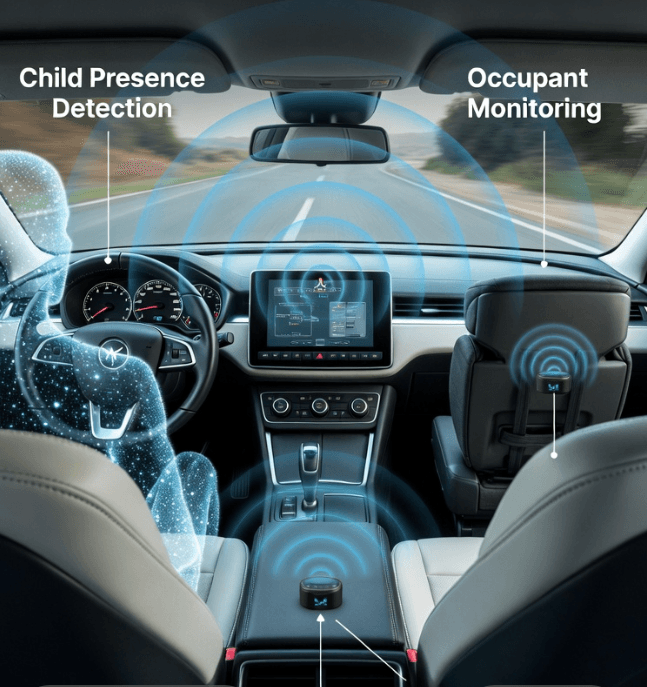
The need for intelligent and secure in-cabin environments is rising quickly as automotive technology develops. In-cabin millimeter-wave radar, or "In-Cabin Radar," is becoming more and more necessary due to regulations, rather than just a comfort feature. Conventional solutions like pressure sensors and cameras frequently have drawbacks like high false-positive rates, lighting sensitivity, and privacy issues. Millimeter-wave radar has become a leading technology for cabin monitoring due to its high penetration (e.g., through blankets), non-contact detection, and privacy-preserving capabilities. Regulatory frameworks like Euro NCAP, which now incorporates Seat Belt Reminder (SBR/SOD) and Child Presence Detection (CPD) into its active safety scoring system, acknowledge this trend.
Principal Uses
-
Identification of Child Presence (CPD)
In-cabin radar can detect micro-movement signals, like chest displacement as small as 4 mm, to determine whether a child has been abandoned in the vehicle. According to regulatory requirements, the system must function for a predetermined amount of time after the car is turned off and offer multi-level alerts through external, auditory, and visual notifications. Children left in cars have a much lower chance of suffering heat-related injuries thanks to this feature. -
Seat Belt Reminder and Seat Occupancy Detection (SOD/SBR)
By precisely differentiating between adults and children, the radar improves occupant protection in collisions and optimizes airbag deployment strategies. By providing real-time alerts for unbuckled passengers, integrated seat belt reminder systems can increase overall cabin safety. High detection accuracy is maintained in complicated cabin environments with the aid of sophisticated algorithms. -
System for detecting intrusions (IDS)
Radar provides round-the-clock security while protecting occupant privacy by monitoring unusual in-cabin movements, such as unauthorized entry or window breakage, when the vehicle is turned off. It does this by operating in a low-power mode (~15 mW). -
Keeping an eye on vital signs
In order to track driver fatigue, evaluate passenger health, or enable customized intelligent cabin services, in-cabin radar can extract real-time physiological data, such as heart rate and respiration. TinyML and edge AI methods decrease false alarms and increase monitoring accuracy.
Architecture of Technical Systems
The intricate system of in-cabin radar integrates both hardware and software:
-
Hardware Layer: for signal acquisition and initial processing, RFICs, microcontrollers (MCU), and digital signal processors (DSP).
-
Signal Chain: For algorithmic analysis, 1D, 2D, or 3D raw data are produced using frequency-modulated continuous wave (FMCW) technology.
-
Algorithm Layer: To identify occupants, track vital signs, and initiate alerts, machine learning models analyze point clouds and heatmaps. Robustness in complicated cabin scenarios is enhanced by training on real-world data.
-
Communication Layer: To enable integration with vehicle safety systems, results are sent to central controllers via the CAN bus or other vehicle networks.
Crucial Measures of Performance
Field of view (FoV), antenna topology, distance resolution, angular resolution, angle accuracy, regulatory compliance, and channel density are examples of critical metrics.
-
Distance Resolution: Centimeter-level accuracy is possible with high-frequency radar, depending on sweep bandwidth.
-
Wavelength and antenna channels determine the angular resolution; multi-channel designs enhance occupant localization.
-
Regulatory Compliance: To guarantee legal deployment in production vehicles, systems must adhere to regional spectrum regulations.
Trends and Pathways in Technology
-
24 GHz Doppler Radar: Inexpensive, useful for basic vital sign monitoring, but does not provide accurate distance data.
-
60 GHz FMCW Radar: A popular solution that enables real-time edge AI processing and high-resolution 3D/4D point cloud imaging.
-
UWB Radar: Low-cost, reusable hardware with a lower angular resolution that can be used in applications that don't require as much precision.
Variability in real-life physiological signals and environmental interference (such as obstruction, reflection, and electronic noise) are challenges. Signal processing, optimized antenna design, and improved AI algorithms are all part of the solutions.
Among the upcoming development trends are:
-
Edge AI Processing: For low-latency real-time detection, directly install neural networks on radar SoCs.
-
Multi-Modal Fusion: For L3+ intelligent cabin applications, integrate camera semantic data with radar micro-motion detection to increase detection precision and dependability.
-
Heart Rate Variability Analysis: Personalized intelligent cabin services are made possible by extending monitoring to evaluate health conditions, emotional states, and levels of fatigue.
Summarization
Antenna layout, channel density, artificial intelligence algorithms, and regulatory requirements must all be balanced for in-cabin radar design, which is a challenging systems engineering task. Millimeter-wave radar provides strong technological support for automotive safety through continuous optimization and multi-modal integration, which enable it to play a crucial role in child presence detection, vital sign monitoring, and intelligent cabin experiences.