






Spatial awareness is becoming a fundamental feature of contemporary systems as industrial automation and smart systems continue to advance. Industries are calling for more accurate, dependable, and sustainable sensing solutions, from personnel sensing in smart buildings and chemical storage tank liquid level monitoring to logistics optimization in intelligent warehouses.
However, in complex environments, traditional sensing technologies frequently fail. Steam, dust, and temperature changes can affect ultrasonic sensors; photoelectric sensors can malfunction in dim or bright lighting; and changes in the dielectric characteristics of liquids can cause capacitive sensors to lose accuracy. Continuous, reliable monitoring is difficult in many industrial situations because of these constraints.
Millimeter-wave radar (mmWave) offers a new solution. As a high-precision, non-contact sensing technology, mmWave radar is being used in industrial liquid level monitoring, smart indoor environments, and intelligent logistics. Leading mmWave radar manufacturer Linpowave is spearheading the development of mmWave technology from a single-point sensor to system-level spatial awareness capabilities, with numerous successful applications.
Non-Contact mmWave Radar for Industrial Use in Liquid Level Monitoring
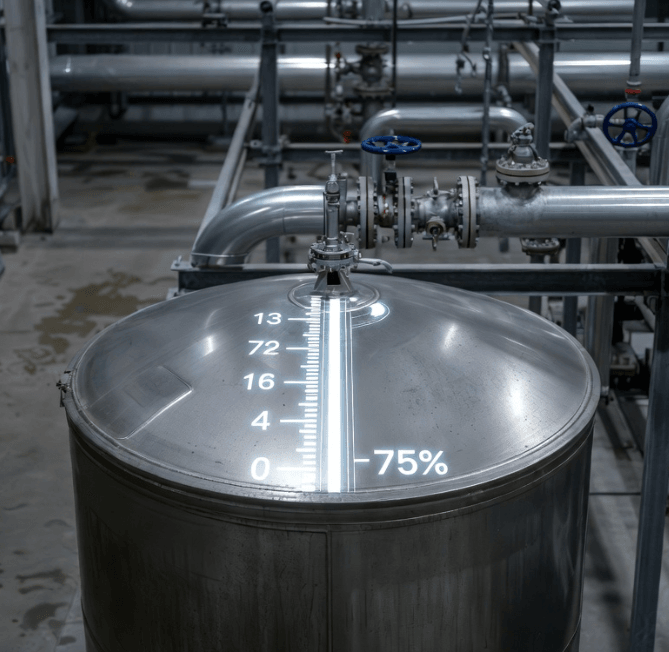
One of the most basic yet environmentally sensitive industrial automation applications is liquid level monitoring. Conventional sensors must come into direct contact with liquids, which can cause clogging, scaling, and corrosion, raising maintenance costs and decreasing long-term dependability.
The non-contact mmWave radar liquid level monitoring systems from Linpowave have the following obvious benefits:
-
77GHz high-frequency radar for enhanced resistance to interference
Higher resolution and better environmental penetration are offered by 77GHz radar in comparison to 24GHz or ultrasonic solutions; measurements are stable even in steam, dust, rain, or fog. -
Measurement that is entirely non-contact for corrosive and hot liquids
Radar can be installed on the side or top of tanks without coming into contact with the liquid, preventing clogging and corrosion and greatly lowering maintenance requirements. -
Adaptable engineering design for a range of tank configurations
Suitable for the chemical, food, and pharmaceutical industries, it supports multiple installation angles, blind spot optimization, and automatic calibration. -
Demonstrated stability over time
Linpowave radar outperformed conventional sensors in several petrochemical and food processing projects, achieving >99.8% long-term operational stability.
These features make non-contact millimeter-wave radar for liquid level monitoring the next big thing in industrial sensing. Discover the industrial liquid level solutions offered by Linpowave.
Smart Indoor Systems and Buildings: Juggling Safety, Intelligence, and Privacy
The need for indoor spatial awareness has increased dramatically with the development of smart buildings, automated security systems, and intelligent lighting. Although cameras offer visual data, there are privacy concerns and performance issues when there is low light or occlusion.
A more dependable and secure substitute is provided by Linpowave's spatial awareness radar:
-
Privacy preservation without taking pictures
Naturally complying with privacy regulations, the radar only outputs target positions and motion data; it does not gather facial or visual information. -
Robust multi-target identification for intricate interior settings
Radar is useful in offices, conference rooms, hotels, and other indoor environments because it can track multiple people at once and distinguish between stationary and moving states. -
dependable in dimly lit and obscured areas
In situations where cameras frequently malfunction, such as at night, in the presence of smoke, backlighting, or obstruction, millimeter-wave radar maintains stable perception. -
thorough integration with HVAC and smart lighting systems
Radar transitions buildings from "automation" to "active spatial intelligence" by providing real-time occupancy and activity data for intelligent HVAC airflow, zone-specific energy savings, automatic lighting adjustments, and anomaly detection.
Spatial awareness radar is becoming the mainstay of indoor systems and smart buildings by utilizing these capabilities. Examine Linpowave's solutions for smart buildings.
Intelligent Transportation and Material Management: mmWave Radar Increasing Productivity
In cold-chain management, automated logistics, and intelligent warehouses, real-time spatial awareness is essential for productivity and security. Pallets, robots, AGVs, and forklifts all travel quickly in shared areas, and any sensing error could lead to safety incidents or a loss of efficiency.
Clear benefits are offered by Linpowave's smart warehouse mmWave radar:
-
Tracking dynamic targets with high accuracy
supports complex path planning and obstacle avoidance by providing real-time monitoring of forklifts, robots, people, and goods. -
Strong performance in challenging circumstances
surpasses cameras and LiDAR systems in maintaining steady operation in low temperature, high humidity, or dusty storage conditions. -
smooth interaction with robotic, AGV, and WMS systems
Robotic platforms and mainstream warehouse management can be quickly integrated thanks to standardized interfaces and SDKs. -
Extensive coverage and multi-radar cooperation
Large warehouse areas can be continuously covered by combining several radar units, making it appropriate for large-scale logistics facilities.
Modern warehouses are starting to use millimeter-wave radar as their spatial infrastructure.
Linpowave's Capabilities for System-Level Spatial Awareness
Linpowave's uniqueness goes beyond radar hardware to include spatial awareness at the system level:
-
Development of the entire stack, from chip to algorithm to module, guarantees cost, performance, and dependability at their best.
-
Industrial-grade production capacity: Supports large-scale deployment through industrial and automotive-grade testing.
-
Scenario-specific algorithm optimization: Custom algorithms for liquid level monitoring, indoor perception, and logistics scenarios.
-
High cost-performance ratio and sustainable delivery: Balances performance, cost, and reliability for scalable applications.
Conclusion: Intelligent Systems of the Future: mmWave Radar
Smart building spatial awareness, intelligent logistics, and industrial liquid level monitoring are just a few examples of how mmWave radar is revolutionizing how systems perceive and engage with their surroundings. It is a key component of contemporary smart systems due to its non-contact, high-precision, all-weather capabilities.
The uses of mmWave radar will keep growing as technology advances and costs come down. Linpowave is dedicated to advancing mmWave radar from sensor-level solutions to system-level spatial awareness, which will serve as the fundamental "senses" of smart spaces and smart industries.
Spatial awareness will eventually encompass both "seeing" and "understanding." This new era will be driven primarily by millimeter-wave radar.