






The Real-World Dilemma: When Factory Floor Noise Kills Proximity Reliability
Anyone who has spent time commissioning automated guided vehicles (AGVs), overhead gantry loaders, or robotic cells knows that clean benchtop test data rarely survives the factory floor. Plant environments are chaotic soups of acoustic shockwaves, wideband electromagnetic interference, drifting thermal boundaries, and reflective metallic clutter. If your design team relies on a single sensing modality to clear safety envelopes or verify workpiece presence, you have likely run into false stops or, far worse, missed detections. Achieving true noise-robust proximity detection has become a primary design headache for engineers tasked with keeping cycle times tight without sacrificing mechanical safety.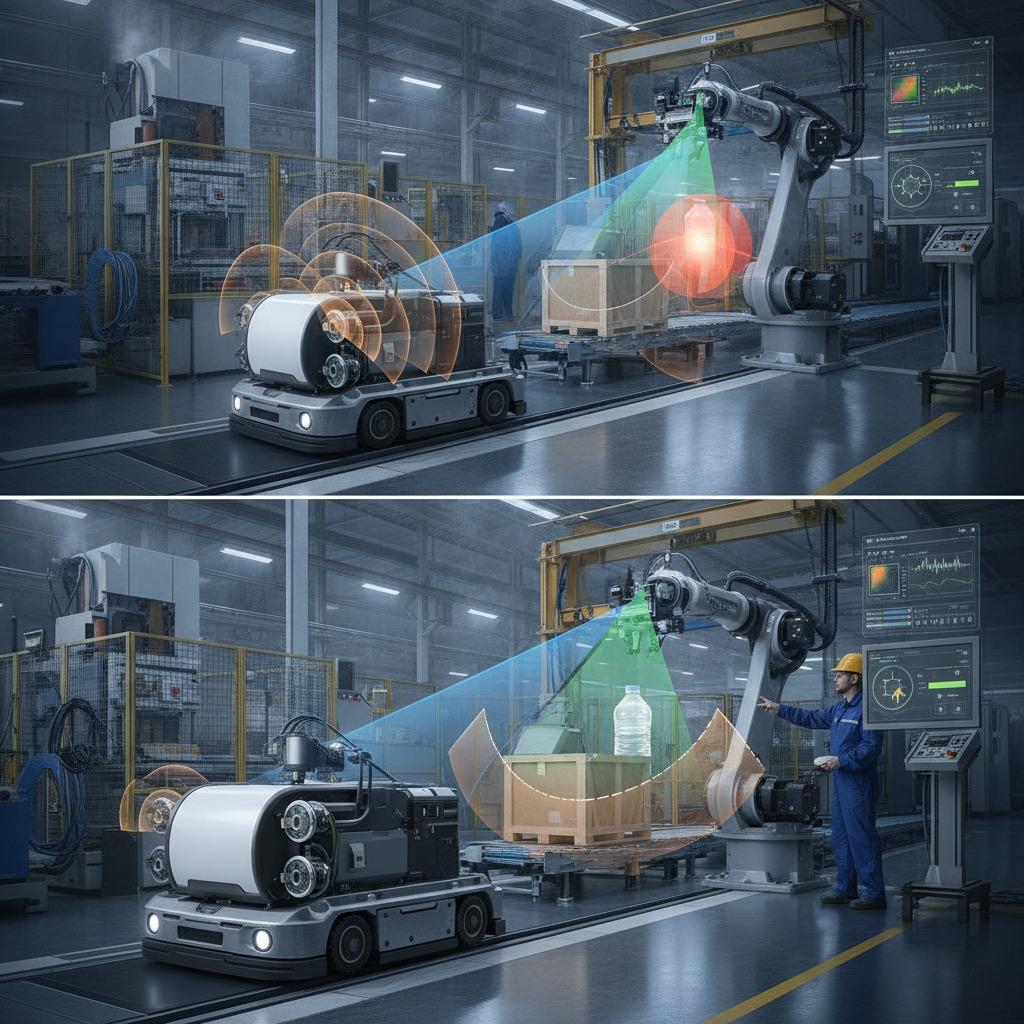
The cost of getting this wrong is steep. A nuisance trip on a high-speed transfer line can cost thousands of dollars per minute in lost throughput. Conversely, de-sensitizing a threshold to suppress acoustic spikes from adjacent pneumatic presses invites collision risks. To solve this, system architects are pivoting away from single-transducer configurations and re-evaluating physical sensing boundaries.
Why Single-Modality Sensors Break Down Under Stress
Engineers usually reach for one of two workhorses: ultrasonic transducers or millimeter-wave (mmWave) radar. Both are capable in isolation, but each carries physical blind spots that software filtering alone cannot fix.
Ultrasonic sensors are cost-effective and handle high-dielectric and optically clear targets (such as glass panels or polished steel) with remarkable ease. However, they rely on mechanical wave propagation through air. When high-velocity blow-offs, air knives, or heavy acoustic machinery operate nearby, the ambient sound pressure level often overwhelms the transducer membrane. Thermal layers and strong cross-drafts also bend the acoustic wavefront, creating phantom distance jumps or signal dropouts.
Radar, particularly 60 GHz and 77 GHz FMCW modules, cuts through atmospheric acoustic clatter, airborne dust, and steam without flinching. But radar has its own Achilles' heel: low-reflectivity dielectric targets like dry plastics, foam packaging, and thin clothing can produce weak return echoes. Furthermore, in dense metallic enclosures, radar multipath reflections create ghost targets that demand heavy DSP filtering, which introduces processing latency.
The Multi-Physics Approach: Fusing Radar and Acoustics
Rather than forcing a single sensor to handle edge cases outside its physical physics envelope, engineering teams are increasingly turning to ultrasonic-radar complementary sensing. This approach pairs electromagnetic wave propagation with acoustic time-of-flight, neutralizing the environmental failure modes of each individual system.
When implemented effectively, multi-physics sensing integration relies on physical disparity. If an air knife vents near an AGV, the acoustic channel might saturate, but the radar channel registers no Doppler shift or RF return variation. Conversely, if a low-RCS (radar cross-section) operator in heavy dry gear steps into a blind spot where radar returns are marginal, the acoustic sensor picks up the physical boundary cleanly.
Moving a step further, radar-acoustic sensor fusion allows teams to execute decision-level or feature-level signal pairing directly at the edge controller. Instead of simply OR-gating or AND-gating raw digital trigger outputs, the system dynamically weights confidence scores. When the ambient acoustic floor spikes, the fusion engine down-weights the ultrasonic channel while relying on radar tracking. Once ambient acoustic levels stabilize, both channels cross-verify target coordinates to maintain millimeter-range accuracy.
In specialty safety and defense-adjacent applications, acoustic event localization with radar adds another layer of defense. In these setups, passive acoustic microphone arrays listen for anomalous physical impacts, sudden gas leaks, or tool-breakage transients, while an active radar head instantly swings tracking beams toward the localized origin point. This confirms whether a structural shift or foreign obstacle accompanied the acoustic spike.
Implementation Realities: Hardware Sourcing and Architecture Trade-offs
Adopting multi-physics hardware is not as simple as dropping two off-the-shelf breakout boards into a chassis. System architects must navigate several integration trade-offs:
1. Enclosure and Packaging Constraints: Radar modules can sit behind hermetically sealed plastic radomes (typically polycarbonate or PBT with well-characterized dielectric loss). Ultrasonic transducers, however, generally need direct acoustic coupling to the surrounding air, making them vulnerable to oil mist, slurry ingress, and direct washdown chemicals. Sourcing IP67-rated membranes that do not heavily attenuate high-frequency acoustic signals is a frequent bottleneck.
2. Microcontroller Overhead: Running fast Fourier transforms (FFTs) for radar range-Doppler maps alongside acoustic threshold analysis requires sensible processing headroom. Moving from a modest Cortex-M4 to a dual-core Cortex-M7 or an entry-level edge NPU increases bill-of-materials (BOM) cost and thermal dissipation. Sourcing managers must evaluate whether the reduction in unplanned downtime justifies the higher board-level investment.
3. Mutual Interference and Calibration: While radar RF does not distort acoustic pulses, the mechanical ringing of high-power piezoelectric transducers can sometimes couple mechanically into radar PCB mounting brackets, introducing microphonic phase noise into the radar IF stage. Isolating the acoustic sensor housing with elastomeric dampeners is a simple, often overlooked mechanical fix.
Frequently Asked Questions
Can software filtering make a standard ultrasonic sensor noise-robust?
Digital bandpass filters, median filtering, and adaptive gain control can suppress minor constant-frequency machine drone. However, broad-spectrum impulsive noise—such as metal-on-metal stamping or compressed air exhaust—often falls directly into the 40 kHz to 200 kHz operating bands of industrial ultrasonic transceivers. Software can reject sporadic spikes by holding previous states, but this introduces latency that many dynamic safety loops cannot tolerate.
What is the typical latency penalty of radar-acoustic sensor fusion?
When executing feature-level fusion on a local embedded microcontroller, latency typically ranges between 15 and 50 milliseconds. Decision-level fusion (combining discrete processed states) is faster—often sub-10 milliseconds—but discards subtle raw signal correlations that help eliminate multipath ghost reflections.
How do environmental factors like humidity affect this setup?
Relative humidity and barometric pressure alter the speed of sound in air, introducing systematic measurement drift in ultrasonic sensors (up to several percent over extreme shifts). Radar propagation velocity is virtually unaffected by atmospheric pressure and humidity changes. A common fusion strategy uses the radar return as a live calibration baseline to correct the ultrasonic channel's speed-of-sound parameters on the fly.
Next Steps for Engineering Teams
If your current proximity sensor deployment suffers from unpredictable trips or environmental sensitivity, begin by logging raw sensor data alongside machine cycle telemetry. Determine whether your failures are caused by atmospheric acoustic shocks, low target reflectivity, or physical path deflection. Mapping these failure modes will reveal whether your application requires firmware-level threshold tuning or a transition toward integrated complementary sensing.