






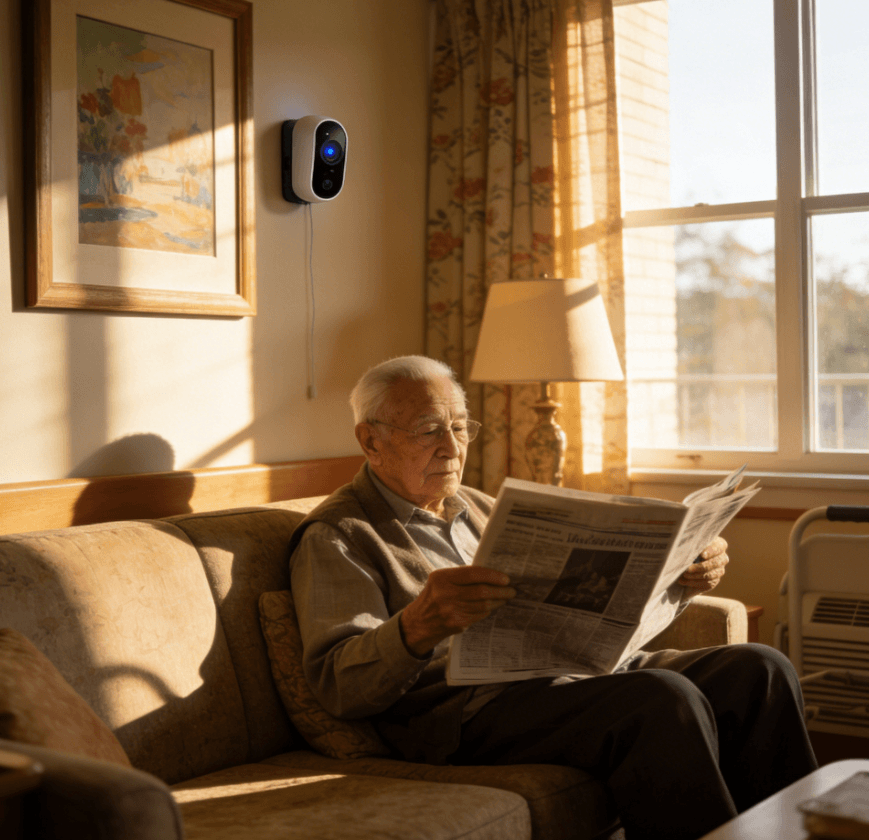
Sensing technology in healthcare, eldercare, and commercial security is no longer judged solely on its detection ability. Systems are increasingly being evaluated based on their ability to run continuously while maintaining privacy, user trust, and regulatory compliance.
As data protection frameworks evolve, image-based and identity-linked sensing solutions become increasingly limited. Cameras and wearables continue to be useful in a variety of settings, but they present structural challenges in terms of personal data exposure, user acceptance, and long-term operational risk.
Non-contact millimeter-wave (mmWave) radar, particularly in the 60 GHz band, provides a unique sensing foundation. Rather than attempting to manage privacy risks after data collection, radar-based systems are intended to prevent sensitive data from being generated in the first place.
Sensing without personal information
FMCW or Doppler principles are used with 60 GHz mmWave radar. It doesn't record images, audio, or biometric information. Instead, it uses reflected radio signals to measure subtle physical motion.
Micro-scale displacement is used to infer breathing, heartbeats, posture transitions, and presence, rather than visual or identity-based features. Signal processing is done locally on the device, and the system only outputs motion-based parameters like respiration rate, heart rate, and activity status.
Privacy is not enforced on the system level by masking or anonymization layers. It is part of the sensing mechanism itself.
In accordance with long-term compliance requirements
Privacy concerns are not secondary in settings such as hospital rooms, nursing homes, assisted living facilities, and nighttime care spaces. They define the system's boundaries.
Radar-based sensing naturally meets these requirements:
-
There is no visible surveillance.
-
No wearable devices.
-
No identity-related data storage
Because sensitive personal data is never created, regulatory complexity is minimized. Consent management, image retention policies, and secondary data usage concerns are all addressed. This allows for continuous monitoring in areas where cameras are either restricted or socially unacceptable.
Moving from micro-motion to actionable system signals
Monitoring the vital signs
The displacement sensitivity of 60 GHz radar is millimeter and sub-millimeter. Respiration is detected by periodic chest movement, which is typically measured in centimeters. The heart rate is derived from much smaller vibrations caused by cardiac motion.
Radar systems use phase demodulation and frequency-domain analysis to continuously estimate respiration and heart rate without requiring physical contact, which makes long-term monitoring possible in clinical support and eldercare settings where wearables are impractical or poorly tolerated.
Detecting falls without using visual surveillance
There is no need for visual interpretation when detecting falls. It is dependent on detecting physically consistent motion patterns.
By tracking range, velocity, angle, and elevation over time, mmWave radar detects posture transitions and sequences like rapid vertical displacement followed by abnormal stillness. This method works reliably in bathrooms, bedrooms, and other areas where visual monitoring is limited.
Abnormal behavior and presence
Radar systems can detect extended periods of inactivity, irregular movement rhythms, and unexpected presence patterns. Processing can be done entirely on the device, allowing for local decision-making and reducing exposure to external data pathways.
Why GHz is Important at the System Level
The decision to use 60 GHz was based on system priorities rather than raw frequency performance.
Radar has high spatial resolution at short distances in this band, making it ideal for indoor and near-field applications. It works well through clothing, bedding, and other non-metallic obstructions and is unaffected by lighting, smoke, dust, or fog.
Low power consumption enables embedded and battery-powered designs. MIMO architectures allow for the simultaneous monitoring of multiple people or pets, making them suitable for real-world deployments in healthcare and commercial settings.
Radar as the foundation for trust.
Millimeter-wave radar is not intended to be a replacement for all cameras and wearables. Instead, it establishes a sensing baseline that keeps personal boundaries in privacy-sensitive areas.
Where semantic interpretation is required, radar can coexist with other sensors in a layered architecture. Wearables may complement fixed sensing in situations where user participation is acceptable. The fundamental shift is from feature-driven sensing to trust-driven system design.
Building systems that can withstand
As sensing systems transition from pilots to long-term infrastructure, technical capability alone is insufficient. Systems must be user-friendly, regulatory-compliant, and long-lasting.
Millimeter-wave radar allows for continuous monitoring without exposing personal data, making it suitable for deployments that balance safety, reliability, and respect. It may not be the most visible sensing technology, but it is often the most long-lasting.
Linpowave offers 60 GHz mmWave radar modules that are optimized for edge processing, system integration, and scalable deployment in healthcare, eldercare, and commercial security applications. These systems are designed to detect activity not only reliably but also consistently.
Commonly Asked Questions:
Can non-contact mmWave radar be used in environments where privacy is important?
Yes, mmWave radar does not collect images, audio, or identifiable personal characteristics. It detects physical motion and presence using reflected radio signals, making it appropriate for environments where visual monitoring is limited or unacceptable.
Is it necessary for people to wear or carry any kind of device when using 60GHz radar?
No. All sensing is done without making any contact. The system does not require users to wear, charge, or interact with any devices in order to function.
How reliable is mmWave radar at monitoring vital signs?
The 60 GHz radar can continuously detect respiration and heart rate by measuring micro-scale chest motion and cardiac-induced vibration. The accuracy is appropriate for clinical support, elderly care monitoring, and long-term observation.
Is mmWave radar affected by lighting, smoke, or obstructions?
No. Radar performance is unaffected by lighting conditions and remains constant in darkness, smoke, dust, or light obstructions such as clothing or bedding.
Is it possible to detect falls using radar without visual confirmation?
Yes. Fall detection uses motion dynamics rather than visual interpretation. Radar systems identify characteristic patterns such as rapid vertical displacement followed by abnormal stillness.
Is mmWave radar suitable for continuous, long-term operation?
Yes. 60 GHz radar modules are designed for continuous operation with low power consumption and minimal maintenance.
Can multiple people or pets be monitored at the same time?
Yes. MIMO-based radar architectures support simultaneous detection and tracking of multiple targets.
Does radar sensing fully replace cameras and wearables?
Not in all cases. In privacy-sensitive areas, radar performs best as a baseline sensing layer. In other cases, it can supplement cameras or wearables in a multi-sensor system.
Where is non-contact mmWave radar most commonly deployed?
Typical deployments include hospital rooms, nursing homes, assisted living facilities, bathrooms, bedrooms, and commercial spaces where privacy, dependability, and user acceptance are paramount.