






Why resource-aware computational offloading matters now
Resource-aware computational offloading is becoming a practical design choice anywhere engineers need fast decisions without overloading a device, a gateway, or a remote cloud link. The basic problem is familiar: modern systems collect more data than a small processor can comfortably handle, yet the response still has to arrive on time. If the computation is pushed too far away, latency grows; if it stays entirely on-device, battery life, thermal headroom, and memory can become the bottleneck.
That tradeoff shows up in industrial sensing, mobile robotics, connected vehicles, inspection systems, and remote monitoring platforms. The point of this article is not to sell a single architecture. It is to help product teams and engineers decide what should run locally, what should be shifted outward, and what can be split between layers without creating a fragile system.
The core decision: what must happen immediately?
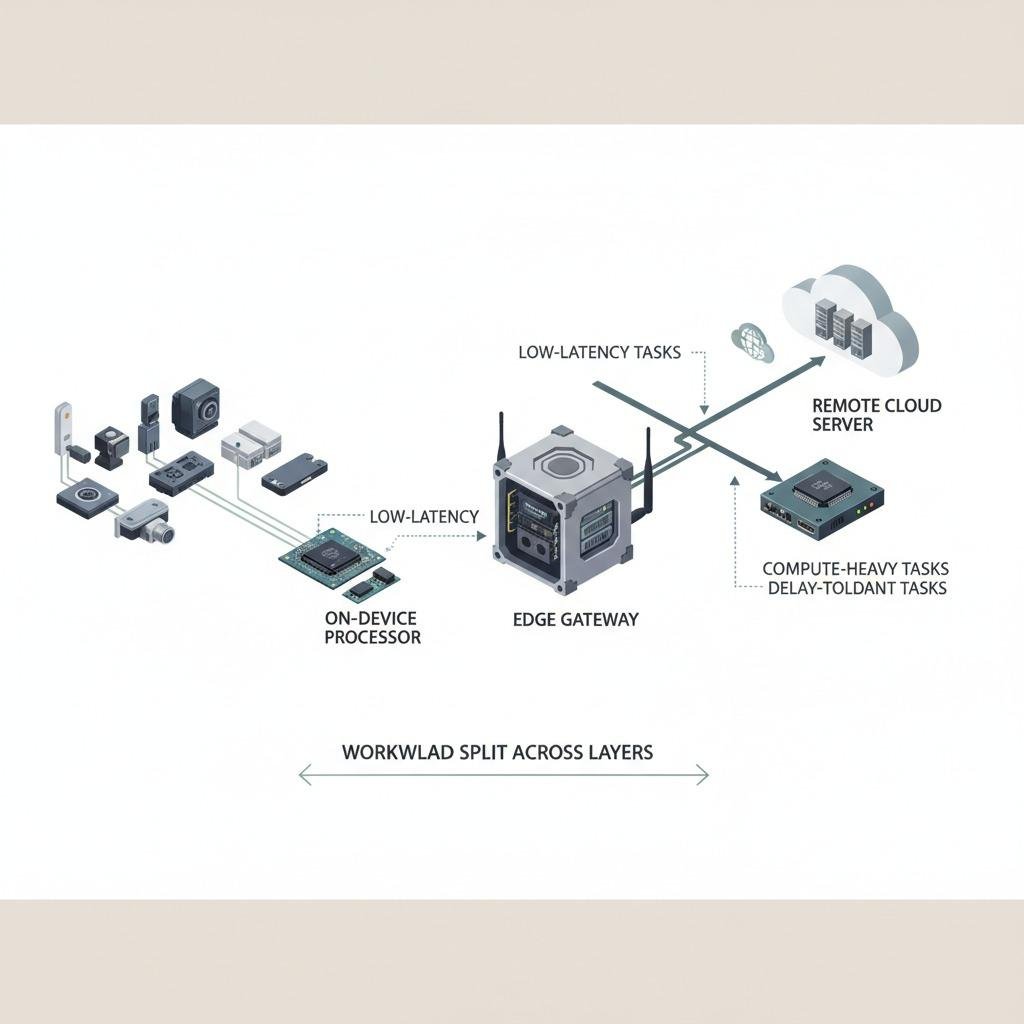
The most useful way to think about offloading is not as a yes-or-no choice, but as a latency and resource budget exercise. Some tasks need low-latency on-device inference because the device has to react to a changing condition in milliseconds. Other tasks can tolerate a delay and may be better suited to a more capable processor elsewhere in the system.
In practice, the boundary often comes down to three questions: How quickly does the result need to be used? How much compute does the local hardware really have? And what happens if the network is slow, congested, or unavailable? Those questions sound obvious, but they are often answered too late, after the sensor stack and software pipeline are already locked in.
What a distributed setup can actually improve
A distributed edge computing network can reduce pressure on a single endpoint by spreading workloads across nearby devices, gateways, and edge servers. For teams working with high-rate sensors, this can be a useful way to keep immediate decisions local while sending heavier analysis outward. It is especially relevant when the raw data stream is large, the connection to central infrastructure is inconsistent, or privacy rules make continuous uplink transmission unattractive.
The practical gain is usually not “more AI” in the abstract. It is better use of scarce resources: CPU cycles, memory bandwidth, power, and airtime. In many products, that translates to a more stable user experience and a system that fails more gracefully under load.
Where on-board processing earns its keep
On-board real-time processing is still the right answer when a system cannot wait for instructions from outside. This is common in safety-related control loops, autonomy stacks, inspection devices moving at speed, or any application where a missed window is worse than a slightly simpler model. The challenge is that on-board hardware rarely has unlimited headroom, so software teams need discipline about model size, data preprocessing, and the number of steps performed before a decision is made.
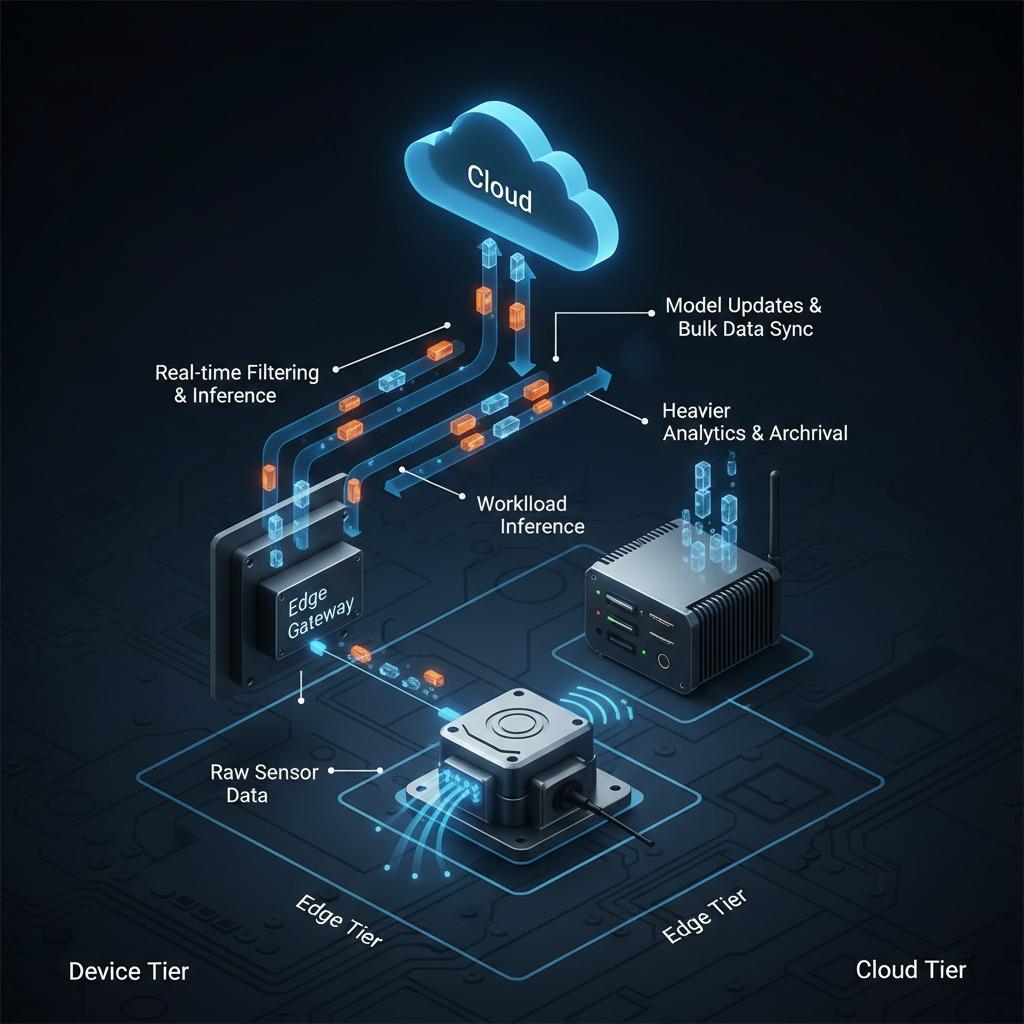
A sensible architecture often keeps the first pass local: filtering, event detection, anomaly screening, or compact inference. More computationally expensive tasks can then be offloaded only when the device has capacity and the result is not time-critical. That split is often more robust than trying to push everything to the edge server.
Radar and sensor-heavy systems are a good example
Edge AI for radar data is a strong use case for offloading decisions because radar streams can be dense, noisy, and time-sensitive all at once. The local device may need to detect motion, classify a target, or flag a collision risk before the next frame arrives. Yet longer-horizon pattern analysis, logging, or model retraining support can happen further out in the system.
One caution: radar and similar sensor pipelines are easy to over-engineer with a model that looks impressive in a demo but is too heavy for deployment. The better design is usually the one that respects the compute envelope first and the benchmark second.
Selection criteria engineers should use
When evaluating resource-aware computational offloading, it helps to look beyond raw inference accuracy. Useful criteria include:
Latency tolerance
If the application cannot absorb network delay, the work needs to stay local or very close to the device.
Compute and power budget
Small processors can handle more than they used to, but sustained load still affects heat, battery, and reliability.
Data volume
High-rate sensor streams are often expensive to move. Preprocessing at the source can make the whole system more efficient.
Operational resilience
If connectivity is intermittent, the system should still function in a reduced mode without falling apart.
Security and data handling
Not every data set should travel off device. Sometimes the best offload strategy is to move features, not raw inputs.
Common mistakes that create costly redesigns
One frequent mistake is assuming the edge layer will automatically solve performance problems. It will not, if the model is too large or the data path is poorly organized. Another is treating offloading as a networking problem only. In reality, it is a systems problem that touches hardware selection, firmware, model design, and monitoring.
A more subtle mistake is designing for ideal conditions. A system that works when the link is clean and the device is cool may fail on a hot production line, in a moving vehicle, or in an outdoor cabinet. Buyers should ask how the architecture behaves when resources are constrained, because that is when offloading decisions prove themselves.
Practical buyer advice
If you are comparing approaches, ask vendors or internal teams for a workload split diagram, not just a performance claim. You want to see what runs on the endpoint, what runs in the edge tier, and what depends on a round trip. That simple map often reveals whether the system is well-designed or just optimistic.
For procurement and product planning, the real question is not whether offloading is possible. It is whether the split preserves response time, keeps power within limits, and leaves enough operational margin for real-world use. A modest architecture that stays predictable is usually better than a powerful one that becomes fragile under load.
What to do next
Before you commit to hardware or a deployment model, define the tasks that must remain local, the tasks that can be delayed, and the tasks that can be moved upward when resources are available. That exercise will usually tell you whether resource-aware computational offloading belongs in your system architecture and how aggressive it should be.
For teams building connected sensing products, autonomous devices, or inspection platforms, that decision is worth making early. It shapes the rest of the design more than many buyers expect.