






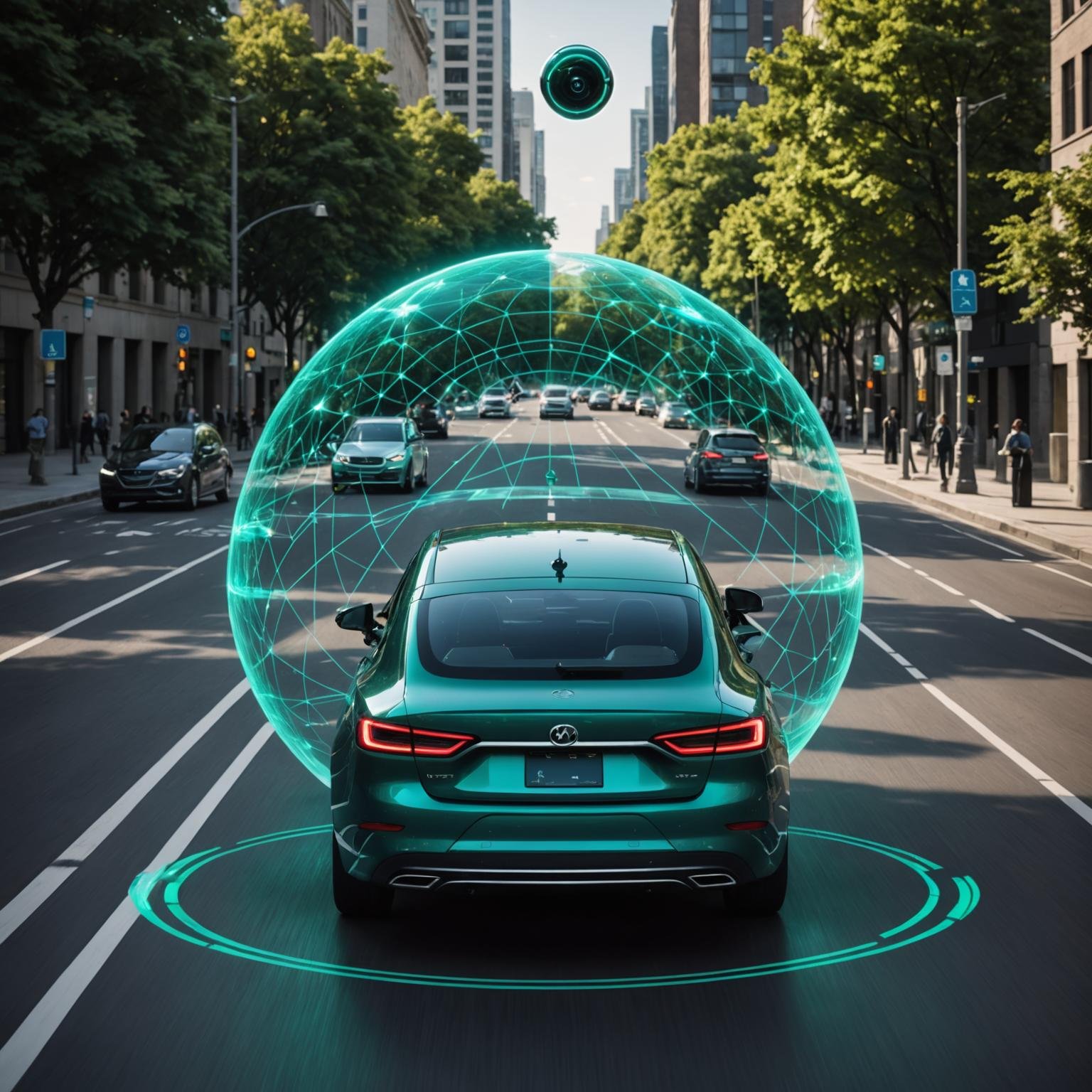
Unlocking the power of mmwave radar in autonomous driving: beyond vision and lidar
🚧Pain point: Vision sensors fail in the real world
Most autonomous platforms rely heavily on cameras and laser lenses. These sensors degrade in fog, rain, snow, dust and glare, causing inconsistent perception and increasing safety risks. To achieve reliable real-world autonomy, sensors must be consistent across all conditions.
MMWave Radar Meets this need, MMWave Radar provides motion tracking and object detection that is windproof and independent of lighting.
📡mmwave Radar: Reliable perception of stimulating and dynamic environments
MMWave radar uses electromagnetic waves to detect distance, angle and speed. It operates in the 76-81 GHz frequency band. Compared to vision sensors, it remains stable in environments with high levels of interference and low visibility. It allows:
-
Reliable detection of static and moving objects
-
Remote tracking of Doppler velocity information
-
All weather, day and night feeling
This performance is brought to advanced ADA and automotive applications with Linpowave’s V300 4D imaging radar.
💡Radar for fully autonomous driving
Perception systems must function reliably without human intervention (Levels 4 and 5). There are serious risks as vision and lidar systems deteriorate in low light, fog and rain. The radar provides all-weather, light-independent detection for fully autonomous driving, with accurate speed and range measurements. Its ability to track numerous dynamic objects in real-time due to background noise is critical for full-stack autonomy.
📌For real-world deployments, Linpowave's V300 4D radardelivers high-resolution imaging in demanding urban and highway scenarios.
🧠Pain point: complex radar data processing
Raw radar signals are computationally intensive and challenging. This is solved by the Linpowave radar module, which contains real-time edge signal processing such as
-
Object classification and tracking
-
Clutter removal
-
Multidimensional data filtering
-
ROS-compatible output
⚙️Radar signal processing for autonomous driving
Radar data in its raw state is complex and noisy. Without sophisticated signal processing, the perceived resolution and false positives are poor. To filter out clutter, extract motion cues and output structured object information, radar signal processing for autonomous driving requires edge-level computing. A powerful device processor enables embedding FFT, object clustering, Doppler velocity detection and filtering into the Linpowave radar module. This makes sensor fusion easier downstream and reduces system latency.
📌Learn more about the H20 compact edge intelligenceradar module.
🔗Pain point: multi-sensor fusion is error-prone
Radar must coordinate with LIDAR, cameras, GPS and IMUS; however, synchronizing and calibrating the data poses significant engineering challenges. For seamless integration, the H20 compact radar module was made. In addition
-
Compact form factor for flexible installation
-
Low latency signaling
-
Dataset alignment (such as TJ4Dradset)
🎯Radar, radar, camera in autonomous driving
One sensor cannot guarantee safe autonomy. Despite its low performance, vision provides rich semantics. Although Lidar has trouble with reflective surfaces, Lidar provides depth. In autonomous driving, the integration of LiDAR, RADAR and cameras allows reliable and redundant perception. Especially in speed estimation, object tracking in glare or fog, and background filtering, MMWave radar closes important perception gaps. Linpowave modules facilitate real-time fusion through ROS compatibility and dataset alignment (e.g. TJ4Dradset).
📌For multi-sensor use cases, explore Linpowave's industrial radar kit, optimized for robotics and autonomous navigation.
🏭Pain points: limited space, harsh environment in robotics
Robots, AGVs and drones work in restricted or reflective areas where vision is impaired. LinPowave's suite of industrial MMWave sensors facilitates these uses by providing them
-
IP-level ruggedness
-
Sub-center accuracy
-
Heat resistance
-
SDK for rapid robot integration
✅Conclusion: Radar solves real-world autonomy challenges
Sight is not enough. Robust perception among clutter, lighting and weather is critical for real-world autonomous swarms. Linpowave Radar modules provide this functionality, supported by sophisticated hardware, integrated software and smooth system compatibility.
Explore the complete radar portfolio at linpowave.com.