






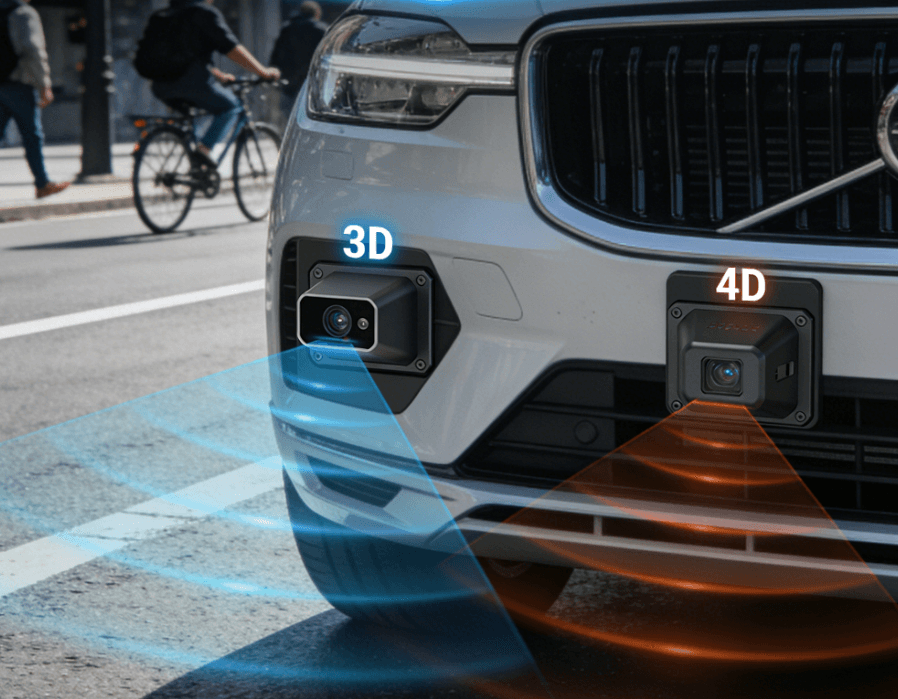
As businesses deploy autonomous solutions in complex low-speed environments—such as factory AGVs, smart mobility fleets, and urban autonomous vehicles—the selection of radar technology becomes critical. Millimeter-wave (mmWave) radar is no longer a supplementary sensor; it is a critical enabler of spatial awareness, safety compliance, and operational reliability.
Understanding the technical differences between 3D and 4D mmWave radar is critical for system integrators and OEMs seeking to reduce costs, increase safety margins, and ensure predictable system behavior in dense, low-speed environments. While the difference may appear to be a single additional dimension, it actually determines whether a perception system can reliably separate, track, and classify multiple close-range targets.
Technical Definitions: 3D Vs. 4D Radar
The 3D mmWave radar provides:
-
Range: The distance between each object.
-
Azimuth: horizontal angle.
-
Velocity: Doppler-derived motion.
This configuration supports basic object detection and motion estimation, which are sufficient for simple collision avoidance or low-speed navigation tasks.
4D mmWave radar includes:
-
Elevation is the vertical position of objects.
Elevation allows for full 3D spatial modeling. Targets are no longer projected onto a 2D plane, allowing for more precise multi-object separation and shape understanding while retaining velocity data.
For B2B decision-makers, the key takeaway is that 4D radar converts perception from a "detection-only" tool to a robust, spatially aware input for path planning, occupancy grids, and sensor fusion.
Why Low-Speed Environments Demand Specialized Radar Considerations
Low-speed environments pose unique challenges when compared to high-speed scenarios:
-
Target Proximity: Objects are frequently tightly clustered, which increases the likelihood of target merging in 3D radar outputs.
-
Reduced Motion Cues: At low speeds, Doppler velocity is low, rendering motion-based filtering unreliable.
-
False alarm risk is high because multipath reflections and dense static infrastructure can generate a large number of ghost targets without additional spatial information.
If these challenges are not addressed during the sensor selection stage, they will result in operational risks, system rework, and a higher total cost of ownership for B2B applications.
Elevation provides measurable value.
Incorporating elevation in 4D radar provides three major advantages:
-
Target Separation: Even overlapping objects in range and azimuth can be distinguished along the vertical axis, increasing reliability in dense industrial, urban, or warehouse environments.
-
False Target Suppression: Multipath reflections and spurious returns can be better filtered, resulting in less system downtime and unnecessary emergency stops.
-
Stable Multi-Object Tracking: Track continuity is improved, reducing merging and fragmentation. For enterprise-grade automation, this means better fleet performance and safer operations.
When 3D Radar is still a viable option.
For cost-sensitive or less complex applications, 3D radar remains a viable option.
-
Simple environments include outdoor campuses, structured warehouses, and open spaces with little vertical variation.
-
Basic Obstacle Awareness systems prioritize conservative safety measures over precise spatial modeling.
-
Cost-Constrained Deployments: With mature supply chains and lower BOM costs, 3D radar is an appealing option for large-scale fleet rollouts where fine-grained perception is not required.
When 4D radar becomes necessary.
4D radar becomes indispensable for enterprise-grade low-speed autonomy when:
-
High-density environments include industrial sites, city streets, and multi-level parking lots with multiple overlapping objects.
-
Safety-critical operations are autonomous fleets or vehicles that operate without constant human supervision.
-
Advanced Sensor Fusion: Systems that use occupancy grids, BEV projections, or AI planners require precise 3D point cloud input.
For OEMs and integrators, using 4D radar during the design stage reduces integration complexity, limits long-tail development issues, and improves system reliability—particularly when visual or ultrasonic sensors alone cannot handle occlusions, lighting changes, or reflective surfaces.
Commonly Asked Questions:
Is it always better to use 4D radar instead of 3D?
This is not always the case. 4D radar provides more detailed spatial data, but requires more bandwidth and processing power. The system of choice should strike a balance between environmental complexity, operational risk, and cost.
Do low-speed systems really need elevation?
In structured and sparse environments, 3D radar may suffice. Elevation becomes important in dense, ambiguous environments where multi-object separation influences decision-making.
Is velocity still relevant when traveling at a low speed?
True, but only to a certain extent. While micro-Doppler effects can help detect subtle movements, velocity alone is rarely sufficient for accurate low-speed perception, emphasizing the importance of spatial resolution.
In conclusion
For enterprise-grade low-speed autonomy, the distinction between 3D and 4D radar reflects more than just technological advancement; it also reflects operational confidence and spatial reliability.
-
The 3D radar responds, "Is there an object ahead?"
-
4D radar answers the question, "Where exactly is each object in three-dimensional space?"
For B2B customers, this distinction has an impact on design decisions, system reliability, safety compliance, and total cost of ownership. As low-speed autonomous systems progress from pilot projects to full deployment, choosing the appropriate radar technology becomes a strategic decision with direct operational implications.