






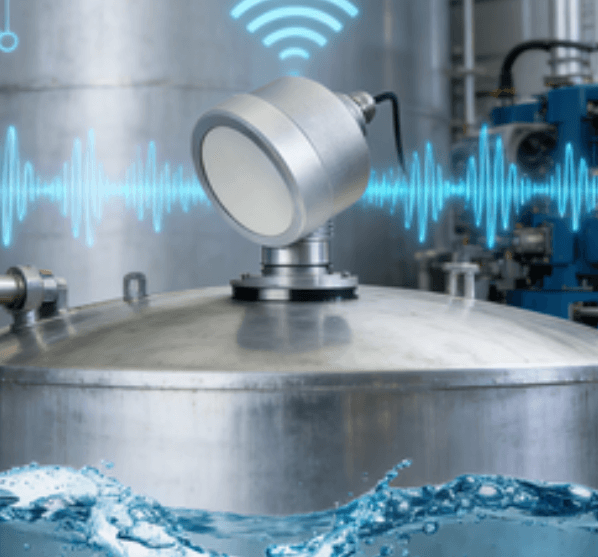
1. Industrial Measurement Challenges: Why Traditional Methods Fail in Extreme Environments
In long-term industrial practice, liquid level measurement remains one of the most challenging aspects of process industries. Traditional ultrasonic level sensors heavily rely on the air medium, and under extreme conditions such as vacuum, high pressure, or drastic temperature fluctuations, the speed-of-sound compensation often becomes inaccurate. Low-frequency radars, such as 26 GHz, have relatively wide beam angles (typically over 10°), making them prone to multiple interference echoes in narrow tanks or complex setups with agitators and supports. This often results in “lost” or unreliable signals.
Steam condensation, viscous foam, and chemical corrosion in these environments not only attenuate signals but may also physically damage sensors. The industry therefore urgently needs a detection technology capable of penetrating interference and focusing precisely on the target—this is the core rationale behind the growing adoption of 80 GHz mmWave radar.
2. 80 GHz Technology Core: From Frequency Shift to Precision Revolution
The main advantage of 80 GHz radar lies in its frequency-modulated continuous-wave (FMCW) technology, which provides extremely wide bandwidth. Compared to low-frequency radars, it achieves breakthroughs in three key dimensions:
Spatial Resolution Leap: The wavelength at 80 GHz is only 3.75 mm, allowing antennas to focus energy into extremely narrow beams around 3°. This “laser-level” directivity enables the radar to easily penetrate short pipes in confined installations and avoid tank wall obstacles.
Micrometer-Level Measurement Accuracy: The larger the frequency scan bandwidth, the higher the range resolution. 80 GHz radar can distinguish two reflecting surfaces separated by only a few centimeters. This allows it to differentiate subtle differences between foam and actual liquid levels, keeping measurement errors within ±1 mm.
3. Field Performance: Handling “Signal Swallowing” in Extreme Conditions
The reliability of 80 GHz radar in extreme environments comes from its strong dynamic range.
-
Heavy Steam and Condensation: High-frequency signals have better penetration. Antennas are often fully encapsulated in PEEK or PTFE lenses, with low surface tension that prevents condensation droplets from blocking signals.
-
Corrosive Media: Non-contact 80 GHz radars avoid direct exposure to chemicals, eliminating the risk of sensor corrosion.
-
Low-Dielectric Media (e.g., LPG, oils): High-frequency radars have enhanced sensitivity. Even weak echoes can be extracted from background noise using advanced algorithms, providing stable level readings.
4. Installation and Commissioning Logic: Avoiding Multipath Reflection
Even the most advanced hardware can fail if installed incorrectly. Key practical rules include:
-
Eccentric Installation: Avoid placing sensors in the center of tanks to prevent wave peak superposition from multiple reflections.
-
Minimizing Blind Zones: 80 GHz radars typically have blind zones under 50 mm. Early-stage design can leverage this to maximize effective tank volume, especially in small buffer tanks or high-overflow-risk reactors.
-
Beam Path Clearance: Ensure no metal fixtures are within the 3° beam axis. For tanks with intense agitation, use “false echo suppression” in software and record empty tank background during commissioning to enable dynamic filtering.
5. Digital Integration: Building IoT-Ready Sensing
Industry 4.0 demands sensors with self-diagnosis and remote communication capabilities. 80 GHz radars, integrated with Modbus-RTU or HART protocols, transmit not only liquid height but also real-time feedback on echo signal strength (SNR) and internal component temperature.
Through edge gateways, this data can feed into SCADA systems or cloud platforms. By analyzing long-term echo trends, factories can implement predictive maintenance. For example, if echo strength steadily declines, the system can automatically alert operators to clean the antenna surface, rather than waiting for complete signal loss.
6. Industry Trends: Deployment and Future Evolution of High-Frequency Radar
80 GHz radars are increasingly replacing legacy technologies across industries—from petrochemical storage tanks to CIP tanks in food and beverage to precision reactors in pharmaceuticals.
Future evolution focuses on AI signal processing. Machine learning algorithms will allow radars to recognize physical states of media, such as detecting violent surface fluctuations or thick floating residues, and automatically adjust compensation parameters. This is not just a measurement upgrade but a leap from “data reading” to “environmental perception” in industrial sensing.
FAQ – 80 GHz mmWave Radar in Extreme Environment Level Measurement
Q1: Why choose 80 GHz radar over 26 GHz or ultrasonic sensors?
A1: 80 GHz radars offer narrower beam angles (~3°), higher spatial resolution, and micrometer-level accuracy. They can penetrate steam, foam, and low-dielectric media where lower-frequency radars or ultrasonic sensors fail.
Q2: Can 80 GHz radar handle corrosive or viscous liquids?
A2: Yes. Its non-contact measurement principle avoids chemical corrosion, while high sensitivity allows accurate readings even in viscous or low-reflectivity media.
Q3: How do I avoid false echoes from tank walls or agitators?
A3: Use eccentric sensor placement, ensure beam path clearance, and enable software-based false echo suppression. Recording an empty tank background during commissioning helps dynamic filtering.
Q4: What is the typical measurement accuracy?
A4: ±1 mm under normal conditions, even in the presence of foam or minor surface disturbances.
Q5: How does 80 GHz radar support Industry 4.0 integration?
A5: It supports Modbus-RTU and HART protocols, providing real-time echo signal strength, temperature monitoring, and liquid level data, which can feed SCADA or cloud systems for predictive maintenance.
Q6: What are the future trends for high-frequency radar in industrial sensing?
A6: AI-driven signal processing to identify media states, detect floating residues, and adjust measurement compensation automatically—transforming radar from a mere measurement tool to an intelligent environmental sensing device.