






In the grain storage industry, the measure of automation is not how smoothly systems run on sunny days—but the “survival rate” of instruments under extreme conditions. For level measurement, a grain silo is not just a confined space; it’s a battlefield full of unpredictable physical challenges.
Many grain managers have experienced this “nightmare”: during peak storage periods, the monitoring screen freezes, or an absurd reading pops up, forcing the automated conveyor line to stop, or even causing overflow incidents. These failures often happen during the most extreme 48 hours of operations, when the environment is harshest, and work is busiest.
Extreme Conditions Are the “Touchstone” for Level Sensors
In industrial sites, we often say, “One part redundancy equals ten parts safety.” High redundancy is not about overperformance—it is about ensuring devices retain a margin for survival when nonlinear, extreme environmental changes occur.
Grain silo environments are complex due to multiple overlapping variables. Dust is not static; it comes with strong static electricity and fluctuating airflow. Condensation is not just water vapor—it can combine with dust to form a sticky layer. If a level sensor is designed only to be “just enough,” its measurement chain can collapse quickly under these interfering variables.
The Two Most Challenging Moments in a Grain Silo
Moment A: Rapid Inflow—The “Blind” Dust Storm
During peak harvest seasons, hundreds of tons of grain enter large silos every hour. Fine dust fills the air so densely that it becomes invisible to the naked eye.
-
Technical challenge: The interior becomes a “turbid medium.” Traditional measurement waves—whether ultrasonic or low-frequency radar—scatter heavily when passing through high-density airborne particles. By the time energy reaches the grain surface, most has dissipated. The sensor is like shining high beams into a fog: you see only white, not the real target.
-
Survival logic: Truly redundant equipment must have powerful background noise filtering capabilities. It needs to extract the real grain surface echo from weak, dust-reflected signals—like “seeing the sun through clouds.”
Moment B: Day-Night Temperature Differences—The “Suffocating” Sensor Coating
After summer thunderstorms or during late autumn, a 20°C temperature difference between inside and outside the silo can cause heavy condensation on the roof.
-
Technical challenge: Sensors installed on the silo roof are the first to be affected. Moisture condenses on the sensor lens and quickly attracts dust, forming a “mud-like” coating that absorbs and blocks electromagnetic waves.
-
Survival logic: Devices must not only resist interference but also self-compensate. Non-contact solutions require a non-stick physical design or automatic gain compensation algorithms. Even if 80% of the sensor’s view is blocked, the remaining 20% of energy must still enable accurate measurement.
Why 80 GHz Radar Offers Higher “Anti-Interference Redundancy”
The popularity of 80 GHz radar in grain silo level measurement is not a trend—it’s because its physical characteristics naturally address these two critical pain points.
1. Surgical Focus of Energy
Compared with traditional 26 GHz radar, 80 GHz has a much narrower beam. If 26 GHz is a flashlight, 80 GHz is a laser pointer.
-
Obstacle avoidance: Grain silos often have ladders, support beams, or spray pipes. The narrow beam of 80 GHz can bypass obstacles and reach the grain surface directly, reducing interference and improving signal-to-noise ratio.
-
Penetration redundancy: Highly focused energy ensures sufficient echo even in high-density dust, guaranteeing accurate level measurement.
2. Physical Defense: Special Lens Design
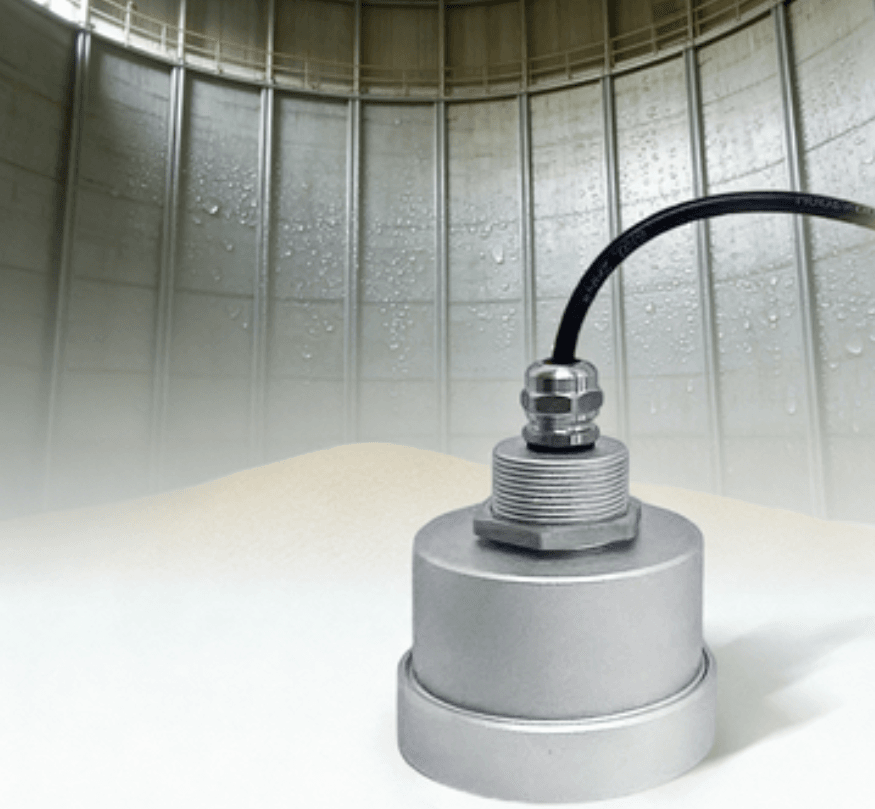
To resist coating, high-end 80 GHz radars abandon water-collecting horn structures in favor of convex lens antennas.
-
Self-cleaning: Lenses use high-performance polymers such as PTFE, making it difficult for water and dust to stick.
-
Structural advantage: The droplet-shaped design leverages gravity, allowing condensation to slide off naturally, solving the “blinded sensor” problem physically.
Case Study: Stability Report of a Large South China Grain & Oil Silo During Rainy Summer
Project background: A large oil plant in South China, with a 30-meter steel silo storing soybeans. Summer rains brought heavy dust and condensation.
Previous measurement performance: Traditional radar produced 2-3 false signals per 24 hours after each rain, requiring manual cleaning—a high-risk, low-efficiency operation.
With high-redundancy 80 GHz radar:
-
Stability improvement: Measurement curves remained smooth during 48 hours of extreme testing, with no jumps due to dust or coating.
-
Maintenance-free operation: Minor dust accumulation on the sensor did not affect measurement accuracy, thanks to strong signal redundancy algorithms.
-
User feedback: “Previously, rain during storage was stressful. Now, operations can run unattended.”
Conclusion: Redundancy Is the Technical “Peace of Mind”
In grain storage, a solution’s quality is not just measured by its datasheet specs but by its fault tolerance under extreme conditions. High redundancy is not for daily routine—it is for that rare, critical moment.
The 80 GHz radar thrives under extreme environments because of superior physical characteristics and deep respect for the grain silo environment.
FAQ
Q1: Why is 80 GHz radar better for grain silo level measurement than traditional 26 GHz radar?
A1: 80 GHz radar offers a narrower beam for obstacle avoidance, stronger energy penetration through dust, and physical lens designs that resist condensation and dust buildup, ensuring accurate measurement even in extreme environments.
Q2: Can 80 GHz radar handle rapid grain inflow during peak harvest?
A2: Yes. Its high redundancy and signal processing can filter out noise from dense airborne dust, providing reliable readings even during hundreds of tons of grain entering the silo per hour.
Q3: How does 80 GHz radar perform during temperature-induced condensation?
A3: The convex lens and PTFE materials prevent dust and water adhesion. Combined with automatic gain compensation algorithms, sensors maintain measurement accuracy despite partial blockage.
Q4: Is this solution applicable to high silos in South China or similar regions?
A4: Absolutely. 80 GHz radar has proven effective in 30-meter steel silos in humid, rainy climates, making it suitable for extreme environments across China and other regions with high dust and condensation challenges.
Q5: Do I need frequent maintenance for 80 GHz radar in grain silos?
A5: No. Its self-cleaning design and high signal redundancy mean maintenance is minimal, reducing both labor and safety risks.
Are your grain silos experiencing “data loss” or false alarms due to condensation?
We can provide a customized high-redundancy level measurement upgrade plan tailored to your silo height and operational conditions.