






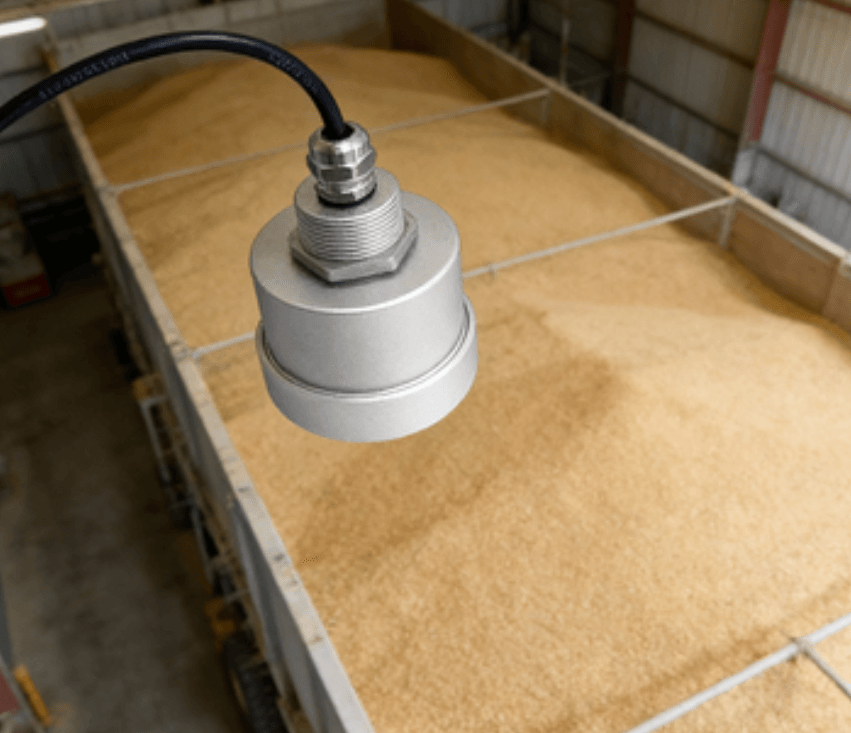
In the bulk grain storage industry, many technicians face an embarrassing scenario: despite purchasing a top-tier 80 GHz radar level meter, the device starts “acting up” during testing. Data jumps, signal lockups, and inexplicable signal loss occur repeatedly, forcing teams to revert to manual rope measurements.
This frustration usually stems from a common misconception: thinking that a radar will automatically provide accurate readings just because it’s “installed.” In reality, the inside of a silo is an extremely harsh environment. Dust, metal reflections, uneven grain piles, and incoming material impacts create a “signal slaughterhouse.” If the installation position deviates from the optimal point, even the most expensive instrument becomes a mere ornament.
Understanding Radar: Not a Flashlight, but an Echo Detector
Radar emits electromagnetic waves and detects extremely weak reflections. Unlike a flashlight, which simply illuminates the surface, radar relies on these echoes to measure grain level accurately.
Inside a closed silo, waves bounce between walls, supports, and grain surfaces. Poor placement can result in reflections from walls or falling grain instead of the actual grain surface.
Core challenge: how to allow radar to accurately “lock onto” loose grain surfaces amid a chaotic background.
Avoid the “Dead Zones” in Silo Installation
Three internal locations are notorious for causing measurement errors:
1. Near the Feed Inlet: The “Baptism of Grain”
-
Physical damage: Grain impact can quickly wear down radar lens surfaces.
-
Signal drowning: Dense grain flow scatters the radar beam, causing false “full silo” readings.
2. Close to Silo Walls: The “Echo Trap”
-
Multipath reflections: Waves bouncing off walls first can cause delayed echoes and underestimation.
-
Adhered grain: Grain sticking to walls can be misinterpreted as actual level.
3. Near Internal Supports: “Vanishing Effective Range”
-
False targets: Metal supports produce strong reflections; radar may pick them instead of the weak grain surface echoes.
80 GHz Narrow Beam Radar: Microsurgery Installation
Modern 80 GHz radars have extremely narrow beam angles. Use this precision to avoid obstacles:
Find a “Clean” Signal Path
Conduct onsite inspections to identify a clear path from the silo top to bottom without metal interference. Narrow beams can pass through framework gaps, improving signal strength and reducing maintenance.
Universal Flange: Adjusting for Sloped Grain
Grain rarely forms a flat surface. Fine-tune the antenna angle using a universal flange. Even a 3–5° adjustment can multiply signal-to-noise ratio (SNR), ensuring accurate readings.
Standardized Installation Steps
-
1/3 Radius Rule: The optimal position for cylindrical silos is 1/3 of the radius away from feed impact and wall reflections.
-
Clear Cone Check: Ensure the radar beam path is free from supports, cables, or obstacles.
-
Flange Vertical Tuning: Observe echo strength at full and half-full levels and adjust to peak signal.
-
Lightning & Dust Protection: Install lightning protection and anti-static devices; consider compressed air cleaning ports for dusty silos.
Field Validation: Millimeter-Level Accuracy
A test in a 15 m-diameter wheat silo compared two installations:
-
Random installation: Near manhole, close to wall, no angle adjustment. Result: frequent signal loss; data jumps up to 40 cm.
-
Standardized installation: 1/3 radius, universal flange aligned, clear of supports. Result: radar readings matched manual measurements with errors under 10 mm.
Conclusion: True accuracy comes from technicians respecting site conditions and optimizing installation. Avoiding “dead zones” turns a high-cost radar from a display piece into a reliable “eye” for digitalized grain management.
FAQ: Grain Silo Radar Installation
Q1: Why does my radar give false full/empty readings?
A: Typically due to placement near feed inlets, walls, or internal supports. Follow 1/3 radius and universal flange guidelines.
Q2: Can dust or moisture affect accuracy?
A: Yes. Dust attenuates signals, and moisture creates false reflections. Use protective covers and compressed air cleaning ports.
Q3: How important is beam angle adjustment?
A: Very. Even 3–5° misalignment can miss echoes on sloped grain surfaces. Use a universal flange for fine-tuning.
Q4: Can I install radar anywhere?
A: Avoid the three “death zones”: near feed inlets, less than 50 cm from walls, and near internal supports. Seek a clear path for the radar beam.
Q5: How do I verify installation quality?
A: Compare radar readings at full and half-full levels with manual measurements. Peak echo strength indicates correct alignment; millimeter-level errors are achievable.