





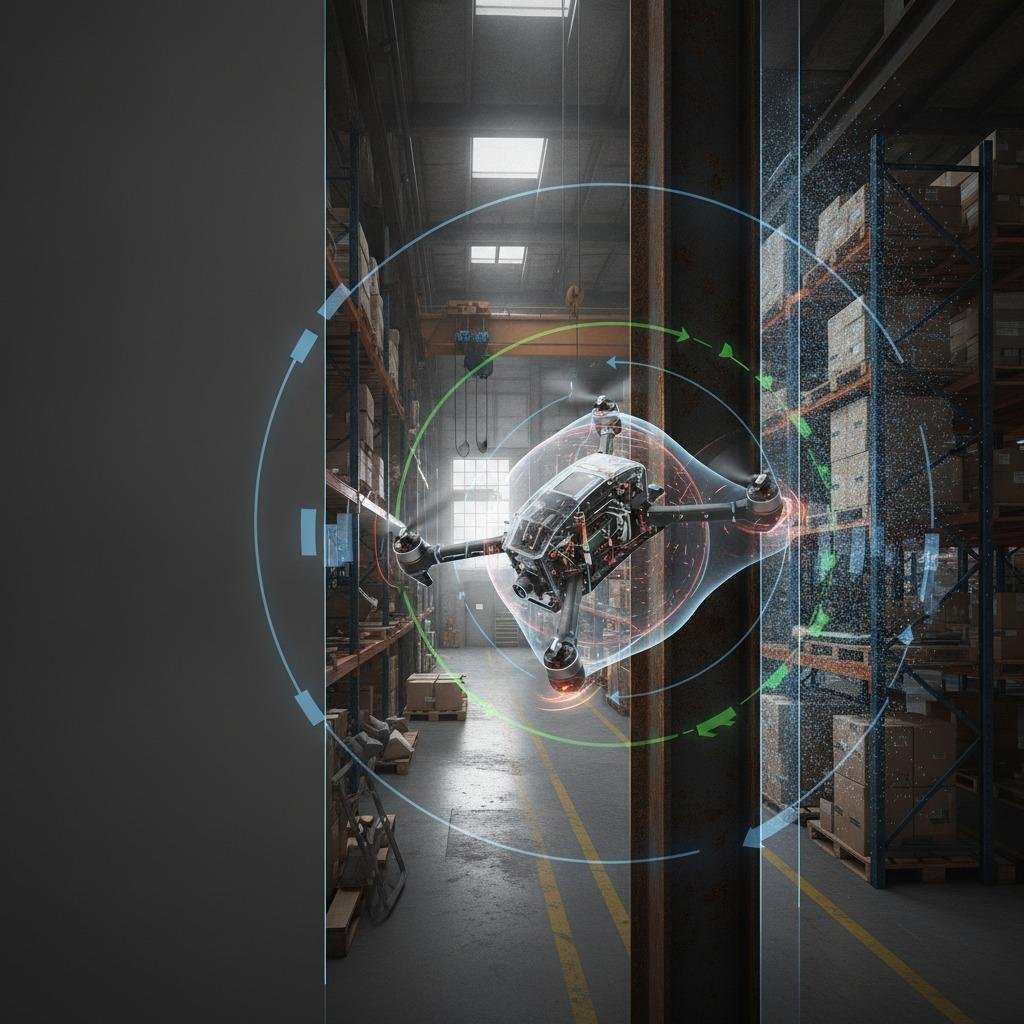
The Latency Dilemma: Why High-Velocity Autonomy Stalls in Cluttered Environments
When autonomous aerial and robotic platforms transition from open-field testing to complex industrial sites—such as decommissioned plants, dense canopy, or indoor manufacturing warehouses—the operating envelope changes abruptly. Navigating narrow corridors and moving gantries demands consistent, millisecond-level responsiveness. For systems engineers and flight-control integrators, achieving reliable agile obstacle maneuvering remains one of the toughest deployment challenges. The fundamental problem is rarely propulsion alone; rather, it is the compounding latency between detection, local replanning, and motor output.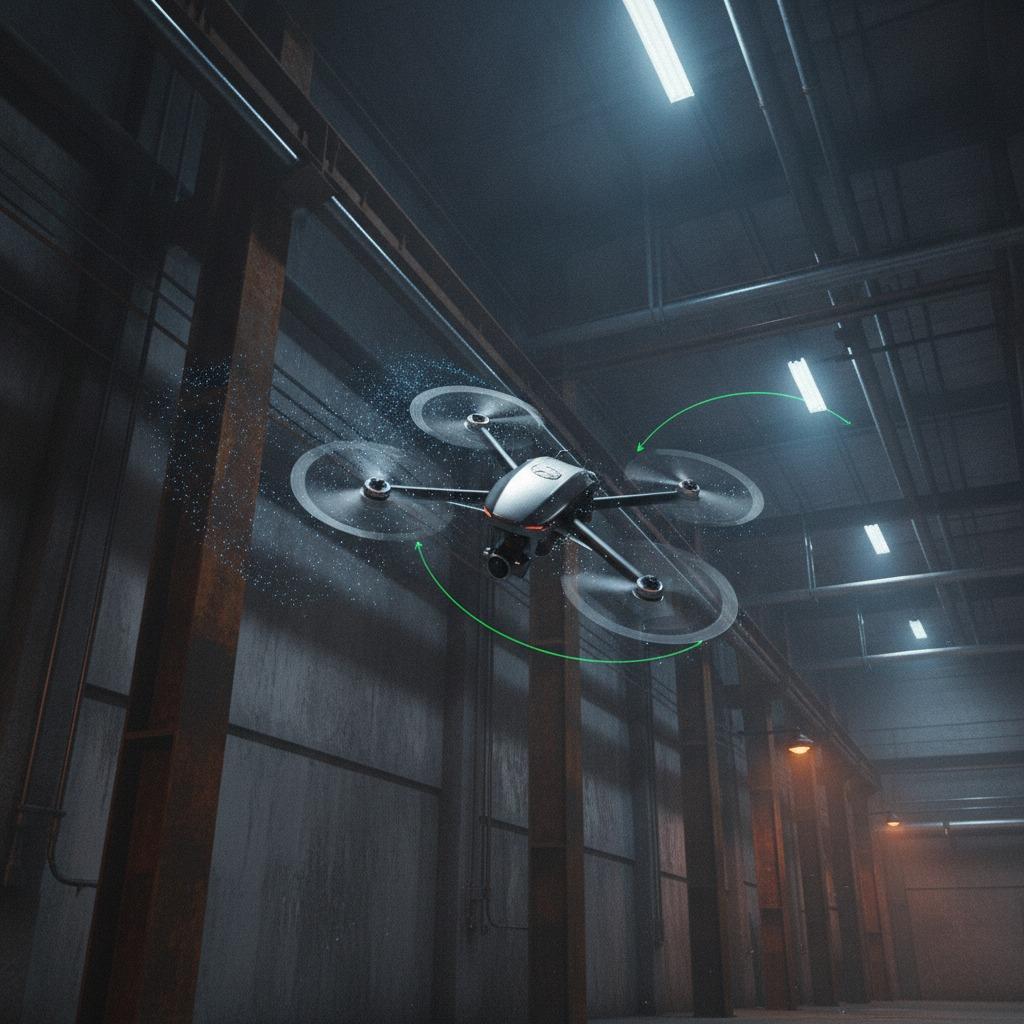
At modest velocities (under 3 m/s), an autonomous UAV or ground robot can rely on traditional sense-plan-act architectures. Global point clouds update at standard camera frame rates, global planners compute a collision-free corridor, and lower-level PID loops execute the command. However, once cruise velocity increases, that sequential pipeline falls apart. An obstacle entering the flight path at close range leaves zero margin for multi-frame filtering or offloaded compute. The vehicle either throttles back excessively to maintain a wide safety buffer or experiences aerodynamic overshoot into the very obstacle it detected. Bridging this operational gap requires rethinking how flight perception couples with real-time actuation.
Root Causes of Guidance Failures at Speed
When autonomy stacks fail during high-speed field operations, post-incident telemetry usually points to two mechanical and computational bottlenecks:
Sensor Pipeline Jitter and Perception Drift
Standard commercial depth cameras and rolling-shutter stereo modules often introduce 30 to 60 milliseconds of pipeline latency before data reaches the trajectory generator. At 12 m/s, a vehicle travels over half a meter while merely digesting the raw frames. Furthermore, in challenging lighting or reflective industrial interiors, sparse point clouds generate false voids or ghost obstacles. Integrating dedicated high-speed flight sensing—such as global-shutter stereo rigs, solid-state LiDAR, or event-based sensors—is essential to cut exposure delays and feed clean temporal frames into local state estimators.
Actuator Saturation and Dynamic Envelope Limits
Software path planners frequently generate geometrically valid trajectories that are dynamically infeasible for the airframe. If a commanded bank angle or collective thrust exceeds the platform's control authority, the propulsion system saturates. The drone stalls along its roll axis, causing drift. Without real-time dynamic envelope protection built directly into the inner control loops, the guidance system commands maneuvers that the brushless motors and ESCs simply cannot deliver under changing aerodynamic loads.
Architecture Comparison: Reactive vs. Map-Based Guidance
Engineering teams often debate whether to prioritize heavier onboard mapping or lightweight reflexive controls. In practice, high-performance platforms implement a layered hierarchy rather than choosing one exclusively:
| Subsystem Tier | Primary Function | Update Frequency | Typical Tradeoff |
|---|---|---|---|
| Global Path Planning | Waypoint optimization, global clearance | 1 Hz - 5 Hz | High compute overhead; vulnerable to dynamic obstacles |
| Local Replanning | Rapid trajectory adjustment around newly sensed vectors | 20 Hz - 50 Hz | Requires continuous local voxel mapping; medium latency |
| Reactive Safety Layer | Reactive collision avoidance and emergency braking | 100 Hz - 250 Hz+ | Coarse spatial awareness; can divert vehicle from mission path |
Selection Criteria for Avionics and Payload Architects
When evaluating onboard compute boards, vision sensors, and autonomy firmware for demanding applications, procurement and technical leads should measure suppliers against specific operational criteria:
End-to-End Latency Budgets: Demand verified photon-to-motor latency metrics rather than standalone camera frame rates. A sensor reporting 90 FPS provides little benefit if the onboard IPC spends 45 milliseconds parsing point-cloud messages.
Deterministic Compute Priority: The hardware stack must guarantee that the reactive collision avoidance daemon holds preallocated CPU cycles and direct bus access, ensuring high-priority avoidance triggers are never starved by background mapping or payload telemetry.
Adaptable Trajectory Generators: Look for algorithms that support continuous rapid trajectory adjustment using minimum-snap or polynomial formulations constrained by real-world motor limits. Abrupt step-changes in commanded acceleration rattle airframes and degrade visual-inertial odometry.
Fail-Safe Envelope Enforcement: Ensure the autopilot layer incorporates autonomous dynamic envelope protection to cap aggressive maneuvers before they induce aerodynamic stall or uncontrolled descent, particularly when operating with slung payloads or asymmetric battery payloads.
Common Integration Mistakes in the Field
A regular mistake during platform development is benchmarking avoidance performance in synthetic simulator worlds where sensor noise, motor hysteresis, and wind gusts are idealized. In the field, rotor downwash kicks up dust that blinds optical sensors, while sudden ambient drafts consume the thrust reserve needed for rapid evasion.
Another common misstep is setting reactive avoidance thresholds too conservatively. If the vehicle initiates evasive maneuvers at excessive distances, it risks 'corridor freezing'—oscillating between tight indoor walls without making forward progress. Tuning proximity margins requires careful calibration against the vehicle's true deceleration curve under maximum payload weight.
Frequently Asked Questions
Why is high-speed flight sensing critical if LiDAR already provides centimeter-level accuracy?
While mechanical LiDAR provides dense structural data, it often updates at only 10 Hz to 20 Hz and can suffer from motion distortion at higher vehicle speeds. High-speed flight sensing combines fast global-shutter vision or event sensing with high-rate IMUs to capture immediate surface shifts in dynamic flight environments between LiDAR sweeps.
Can software-based reactive collision avoidance replace physical propeller guards or bumpers?
No. While reliable reactive logic drastically reduces close-proximity strikes, physical shielding remains critical for edge-case contact, rotor protection during wall-glancing events, and structural resilience in constrained industrial settings.
Next Steps: Benchmarking Your Flight Stack
If your engineering group is working to stabilize agile obstacle maneuvering on next-generation platforms, start with latency profiling. Instrument your software stack to track timestamp propagation from camera shutter trigger through local planner recalculation to the ESC motor command. Isolating and shaving 20 milliseconds off that communication pipeline will yield far greater flight agility than upgrading your airframe motors.