





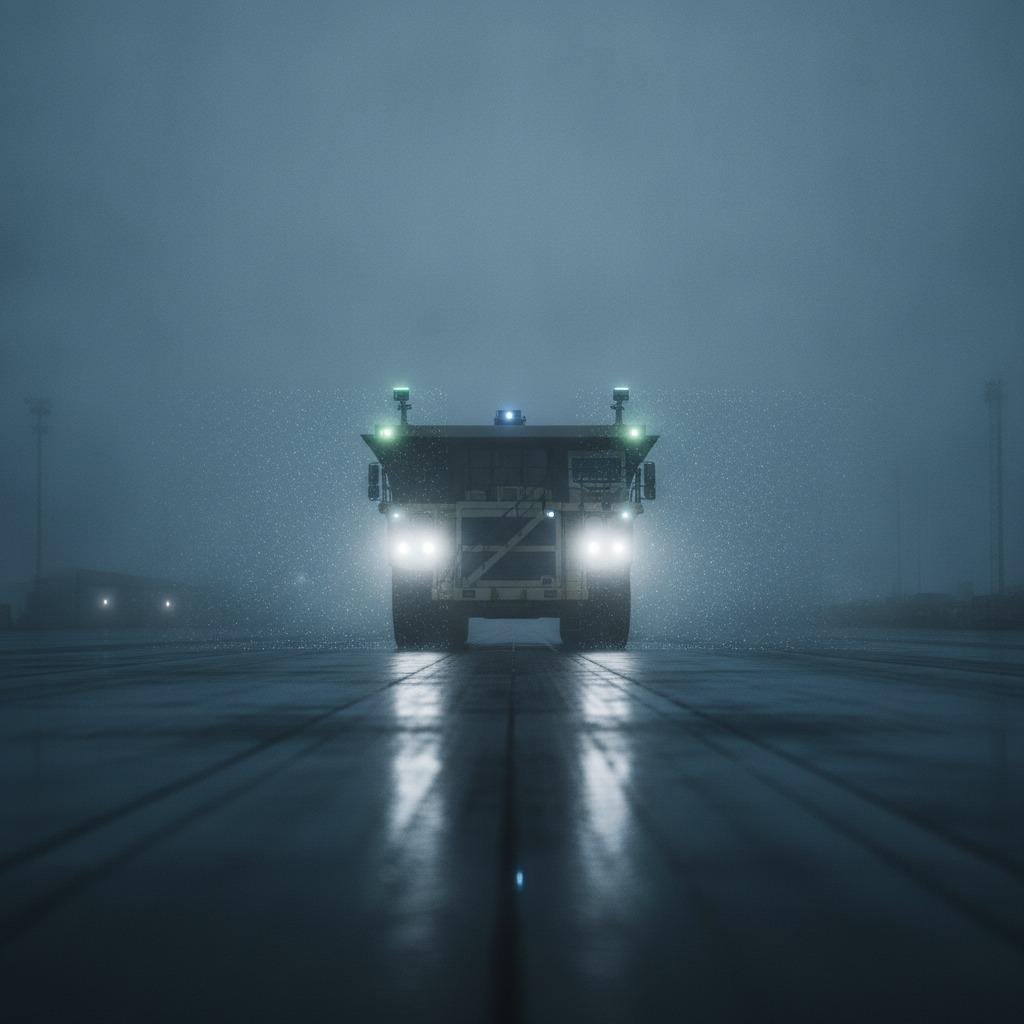
Field trials for autonomous industrial equipment usually go well until November. On a clear, dry afternoon in an open yard, high-resolution cameras and standard pulsed LiDAR deliver crisp, beautifully segmented point clouds. Move that same autonomous hauler or terminal tractor into heavy maritime fog, freezing rain, or the airborne particulate envelope of an aggregate processing plant, and the system either throws phantom obstacle flags or triggers emergency stops. Achieving dependable all-weather perception is no longer a luxury feature for edge-case research; it is the single engineering hurdle determining whether autonomous heavy machinery delivers an actual return on investment or simply parks itself whenever conditions turn sour.
For systems engineers and technical procurement teams, the frustration usually stems from an over-reliance on visual-spectrum optics. Standard RGB cameras behave much like the human eye: when light scatters through moisture droplets or particulate suspensions, contrast collapses and dynamic range vanishes. If your operational envelope includes unpaved haul roads, port terminals, or agricultural acreage, designing an perception stack around clear-sky performance guarantees operational downtime.
The Mechanics of Environmental Blindness
Optical degradation rarely happens cleanly. Instead, sensors suffer from two distinct physical disruptions: attenuation and backscatter.
In heavy precipitation or suspended dust, water droplets and dirt particles absorb and disperse ambient light. Short-wavelength optical sensors face immediate photon starvation. At the same time, active emitters like standard 905 nm LiDAR experience intense backscatter. The laser pulse reflects off nearby suspended moisture or dust particles rather than reaching the target, creating a dense cloud of false-positive returns within the first two meters of the aperture.
Thermal infrared sensors bypass some of these illumination traps by reading long-wave emissions (LWIR), but high humidity and dense fog still sap their thermal contrast. Left unaddressed, these issues cripple low visibility navigation, forcing system designers to set detection thresholds so conservatively that machinery stalls on harmless exhaust plumes or morning ground mist.
Engineering the Fix: Multi-Modal Sensor Topologies
Solving the environmental bottleneck requires moving past single-sensor dominance toward an integrated architecture where physics complements physics.
Millimeter-Wave Radar as the Ground Anchor
While cameras and standard LiDAR struggle with atmospheric scattering, millimeter-wave (specifically 77 GHz to 79 GHz) radar operates at wavelengths several orders of magnitude larger than fog droplets and industrial dust. This provides exceptional dust and fog penetration. The trade-off has historically been poor spatial resolution and an inability to distinguish an empty steel pallet from a standing technician.
However, the recent adoption of 4D imaging radar—which adds elevation angle and denser point clouds to classic range-Doppler measurements—bridges this gap. Imaging radar does not deliver photorealistic boundaries, but it supplies unambiguous velocity vectors and hard physical barrier detection through conditions that completely obscure the human eye.
Multi-Echo Processing and Wavelength Shifts
Where LiDAR remains necessary for precise volumetric profiling, hardware selection must account for environmental clutter. Switching from 905 nm to 1550 nm wavelengths allows for higher emitter power without exceeding eye-safety regulations, giving the beam a better chance of punching through thin moisture layers.
Just as crucial is multi-echo detection. When a single laser pulse hits both a suspended water droplet and the solid steel frame of a trailer behind it, a multi-echo receiver captures both returns. By configuring the firmware to discard the early, low-intensity pulse and map only the subsequent return, engineering teams can filter out airborne clutter before the signal even reaches the primary perception pipeline.
Firmware-Level Interference Resilience
Hardware layout is only half the battle. When multiple autonomous platforms work the same loading yard or quarry, active sensor cross-talk becomes a serious threat. Radars running on unmodulated chirp cycles will jam each other, while neighboring LiDAR emitters can register as phantom obstacles.
Achieving true interference resilience requires randomized pseudo-noise chirps in radar front-ends and time-stamped, phase-encoded laser pulses. Without these digital protections, adding more sensors to solve weather blindness simply creates a new problem: platform-to-platform RF and optical blinding.
Practical Integration Pitfalls to Avoid
Even the most sophisticated perception software fails if basic hardware integration is treated as an afterthought:
1. Ignoring Mechanical Self-Cleaning: It is remarkably common to see an advanced sensor suite mounted without lens heaters or high-pressure air/wash nozzles. Road salt, mud splatter, and freezing rain will blind a radar radome or camera glass long before the atmosphere itself stops the signal.
2. Asynchronous Data Fusion: Combining inputs from a 10 Hz LiDAR, a 20 Hz radar, and a 30 Hz camera requires precise hardware-level time synchronization (such as IEEE 1588 PTP). If your compute module fuses out-of-sync frames while the platform is moving across uneven terrain, the resulting coordinate drift destroys localization accuracy.
3. Over-Filtering Raw Point Clouds: Software engineers often tune heuristic noise filters to strip out rain speckle, only to discover they have inadvertently stripped out thin obstacles like chain-link fences, suspended cables, or rebar.
Frequently Asked Questions
Can software-only AI models deliver all-weather perception from standard cameras?
No. Machine learning models can infer missing edges and enhance degraded contrast up to a point, but they cannot manufacture photons that never reached the sensor. If thick dust or heavy fog scatters the light completely, optical-only stacks produce hallucinations or fail outright. Physics-level hardware diversity remains essential.
Why not rely solely on thermal imaging for low-visibility operations?
Long-wave infrared (LWIR) is outstanding for pedestrian and wildlife detection through darkness and light smoke because living beings radiate heat. However, non-living obstacles—such as concrete road barriers, dropped cargo, or non-running machinery—often reach thermal equilibrium with their environment. In a cold, wet yard, a concrete block may blend seamlessly into the background on a thermal feed.
What is the minimum configuration for robust sensing on heavy machinery?
A practical baseline for industrial duty cycles is a tripod architecture: dual-band or 4D imaging radar for baseline velocity and obstacle detection, high-dynamic-range (HDR) cameras with localized illumination for asset identification, and multi-echo LiDAR for close-proximity boundary confirmation, all supported by active radome heating and washing.
Next Steps for Engineering Teams
If your platforms are losing uptime to weather cutoffs, start by auditing your failure logs to isolate whether the root cause is optical attenuation, aperture contamination, or sensor cross-talk. Document the exact particulate and precipitation thresholds of your target operating environment, and bench-test candidate radar and multi-echo LiDAR hardware under simulated environmental stress before committing to a final compute and sensor architecture.