






Why bandwidth-efficient sensing matters on the factory floor
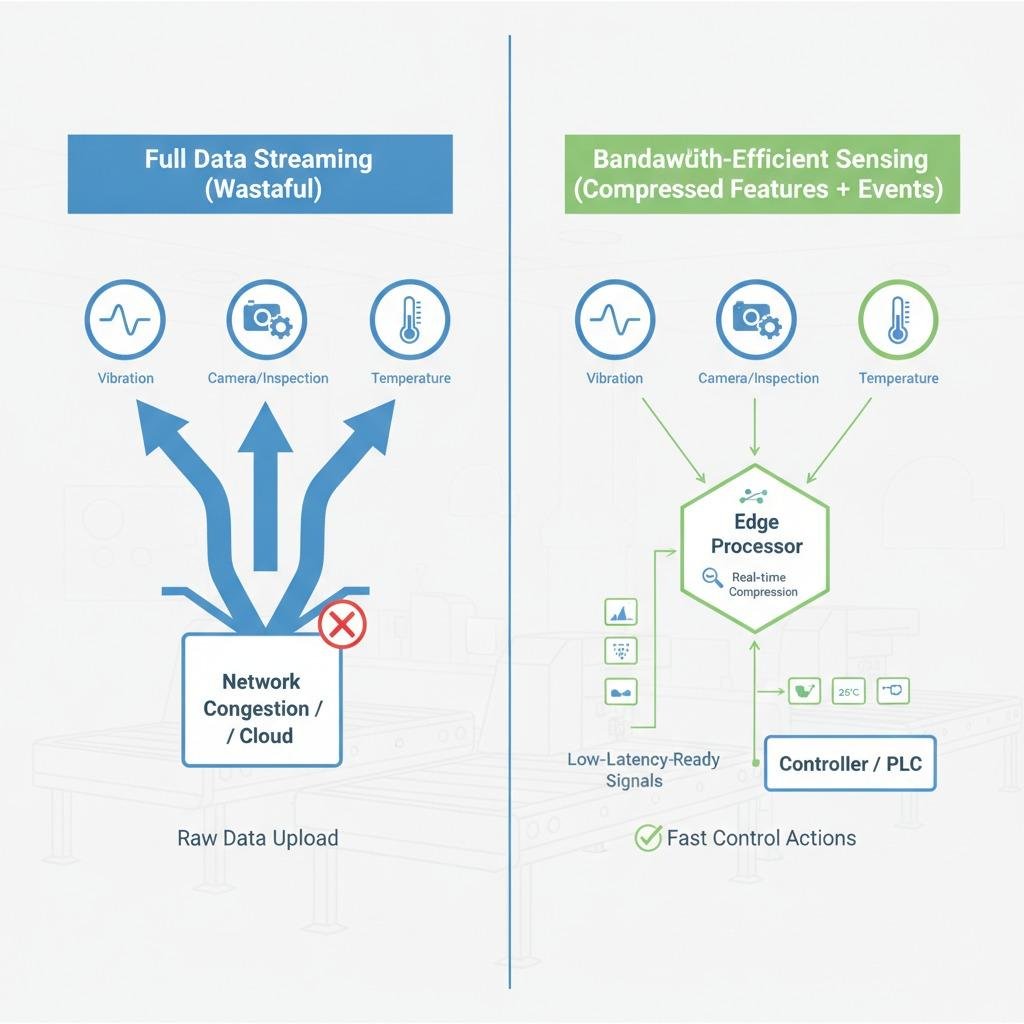
Bandwidth-efficient sensing is becoming a practical design issue, not just an academic one. As plants add more distributed sensors, vision points, machine monitors, and edge devices, the problem is no longer whether data can be collected. The harder question is which data actually needs to move across the network, and how quickly. For engineers and sourcing teams, that affects everything from controller responsiveness to infrastructure cost, especially when a line depends on a low-latency data link and does not tolerate delays.
The pressure is familiar: more signals, more machines, more remote assets, but not always more network headroom. In those environments, raw data streaming can become wasteful. A temperature trace, vibration feed, or inspection image may carry only a small amount of decision-worthy information. The rest is overhead. That is where bandwidth-efficient sensing helps by reducing what is transmitted while preserving what matters for control, quality, or maintenance decisions.
What the term really means in industrial systems
At its core, bandwidth-efficient sensing is about shifting intelligence closer to the source. Instead of sending every sample, device, or frame upstream, the system extracts meaningful features first and sends only the useful subset. In some applications, that may mean event triggers, compressed summaries, or filtered measurements. In others, it may involve sparse representation methods that encode a signal in a compact form without throwing away the important structure.
This is not a one-size-fits-all approach. A machine health sensor has different priorities than a machine vision node. A vibration monitoring system may benefit from real-time data compression, while an inspection camera may need feature extraction for transmission so that only defects, coordinates, or confidence scores travel to the host. The design choice depends on latency, compute budget, and how much data the downstream system truly needs.
Quick comparison: full-data streaming versus bandwidth-efficient sensing
Full-data streaming is straightforward. It is also expensive in bandwidth, storage, and often power. It suits cases where engineers need full traceability, advanced post-processing, or frequent model retraining.
Bandwidth-efficient sensing trades some raw visibility for better responsiveness and lighter network use. It is often preferred when the decision must happen locally, when wireless links are constrained, or when multiple devices compete for the same network resources. The caveat is obvious: if the compression or feature selection is too aggressive, you can hide the very anomaly you were trying to catch.
That is why the best systems usually keep a path for exceptions. Send summaries during normal operation, but allow richer data capture when thresholds are crossed or when a diagnostic mode is triggered.
Methods engineers actually use
Feature extraction at the edge
Feature extraction for transmission is one of the most practical methods. The sensor node or edge processor calculates values such as peaks, RMS levels, counts, edge locations, or defect signatures before sending data onward. This reduces network load while preserving decision-ready information.
Sparse representation and signal encoding
Sparse representation is useful when the underlying signal can be described with relatively few meaningful components. Instead of shipping the entire raw waveform or image, the system encodes a compact representation that downstream software can reconstruct or interpret. This can be effective, but it requires careful validation so that the compression does not distort the process signal.
Real-time data compression
Real-time data compression works well when the value of the data is in its continuity, but not every point is equally important. Compression can be lossless or lossy, depending on the application. Lossless methods preserve exact values, which is safer for audit trails and regulated environments. Lossy methods can be acceptable for trend monitoring or noncritical analytics, but they deserve a conservative review before deployment.
Selection criteria for buyers and engineering teams
When evaluating a bandwidth-efficient sensing approach, start with the decision the system must support. If the goal is closed-loop control, latency and determinism matter more than raw data richness. If the goal is condition monitoring, the threshold for acceptable data reduction may be higher. If the goal is quality inspection, the system may need enough detail to support traceability and later root-cause analysis.
A practical checklist usually includes the following:
- How much data must be retained versus summarized
- What latency the control or analytics loop can tolerate
- Whether processing happens on-device, at the edge, or in the cloud
- How failures are handled if the compression or extraction step misfires
- Whether the network is wired, wireless, or a mix of both
Do not underestimate failure mode planning. A system that performs beautifully in a lab can become fragile once sensors drift, vibration changes, or product mix varies. In practice, a conservative fallback path is worth more than an elegant algorithm that cannot explain itself when production changes.
Common mistakes to avoid
One common mistake is treating bandwidth reduction as the whole objective. It is not. If the downstream team cannot interpret the transformed signal quickly, the savings may come at the expense of maintainability.
Another mistake is pushing too much intelligence into a tiny device without checking compute headroom. Edge processing is useful, but it still costs cycles and power. When the device is already running near its limit, feature extraction can create new bottlenecks.
A third mistake is assuming one compression strategy will work across all assets. Different machines produce different signal structures. A method that is stable for periodic vibration data may be a poor fit for bursty inspection images or event-driven alarms.
Practical buyer advice
If you are sourcing a sensing solution, ask vendors how their system behaves under load, not just in nominal conditions. Ask what data is retained, what is discarded, and whether raw capture can be recovered when needed. That last point matters more than many teams admit. Once data is reduced, it may be impossible to reconstruct the full context after a quality issue appears.
It is also worth asking where the intelligence sits. A low-latency data link is only part of the story. If every decision waits on a remote server, the network may remain the bottleneck even when the payload is smaller. In many plants, the real gain comes from combining local preprocessing with a disciplined transmission strategy.
FAQ
Is bandwidth-efficient sensing only for wireless systems?
No. It is especially useful on wireless networks, but wired plants can benefit too when many devices share the same infrastructure or when historical storage needs are climbing.
Does data compression always reduce accuracy?
Not always. Lossless methods preserve accuracy, while lossy methods may be acceptable if the application only needs trends or alerts. The right choice depends on the decision being made.
Where does this approach fit best?
It fits best where sensors generate more data than operations can comfortably move or store, and where the key decision can be made from a smaller set of extracted features.
What to do next
For teams planning a sensor upgrade or a connected equipment rollout, the smart next step is a data audit. Identify which signals are essential, which are repetitive, and which can be summarized closer to the source. From there, compare feature extraction, sparse representation, and real-time data compression options against your latency and reliability needs. The goal is not to send less data for its own sake. It is to move the right data, fast enough, with enough context left over to trust the result.