






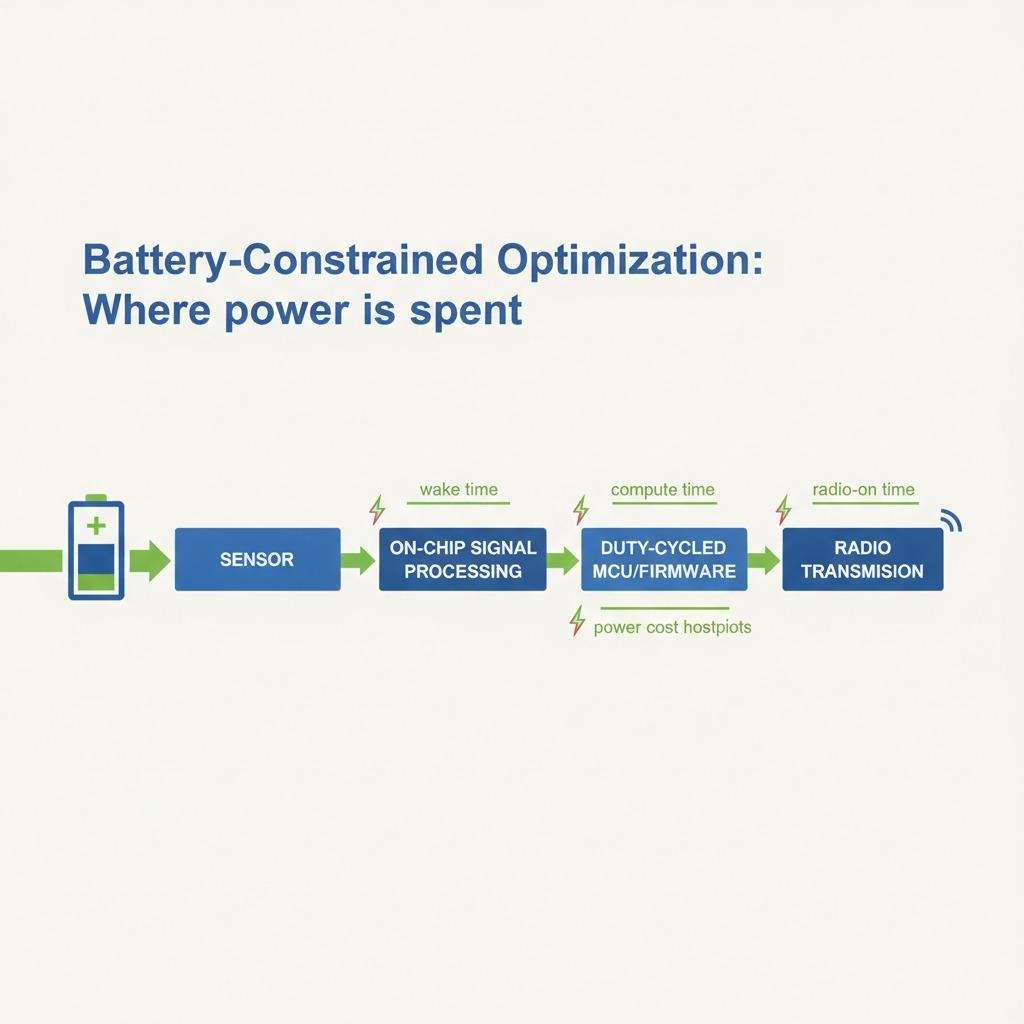
Why battery life has become a design constraint, not just a maintenance issue
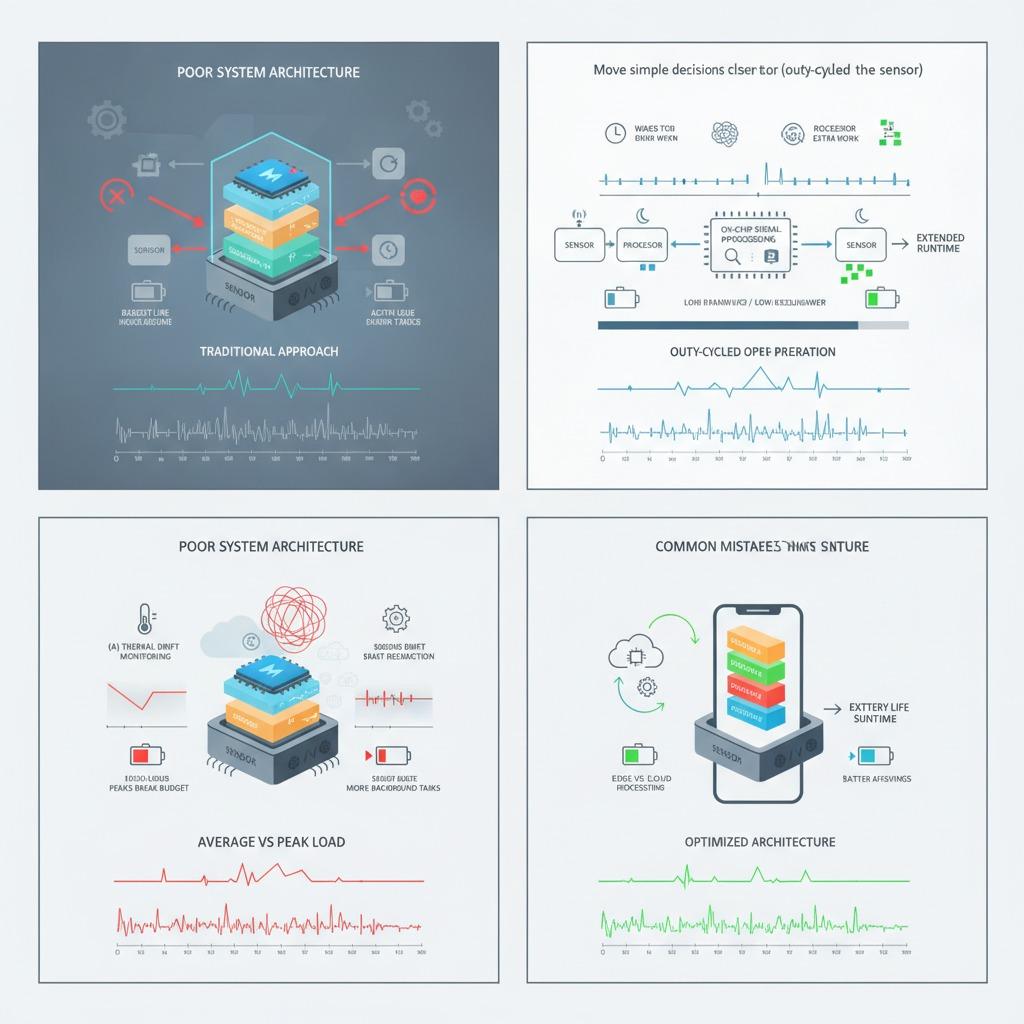
Battery-constrained optimization is now one of the first questions engineers ask when they spec connected devices, remote sensors, wearables, and industrial monitoring hardware. That is not a marketing trend; it is a practical response to a simple problem. If a device has to run for months or years in the field, every microamp matters, and every extra wake-up cycle shortens the service interval.
For sourcing managers and product teams, the real decision is not whether to save power. It is where to save it without compromising data quality, responsiveness, or reliability. That is why battery-constrained optimization tends to touch the whole stack: sensing elements, firmware, radio behavior, and sometimes the silicon itself.
What the power budget is really telling you
A battery specification gives capacity, but the application defines endurance. Two devices with the same battery can behave very differently once you factor in sampling frequency, transmission intervals, signal conditioning, and ambient temperature. In practice, power problems usually show up in one of three places:
The device wakes too often.
The processor does more work than the task requires.
The radio or sensor stays active longer than necessary.
That is where design choices like duty-cycled operation and energy-aware sensing begin to matter. They are not abstract efficiency ideas; they are ways of controlling when power is spent and when the system can afford to sleep.
Where the biggest gains usually come from
1. Cut unnecessary wake time
Many low-power systems lose energy in short bursts rather than long continuous draws. A sensor that wakes every few seconds to check a condition may seem harmless, but over weeks that pattern adds up. Duty-cycled operation reduces this by keeping subsystems asleep until they are actually needed. The trade-off is obvious: wake less often, but make sure the sampling interval still matches the process being monitored. Missing a brief event can be more costly than using a little extra power.
2. Move simple decisions closer to the sensor
On-chip signal processing can reduce the amount of raw data that needs to be moved, filtered, or transmitted. If the chip can handle thresholding, smoothing, or event detection locally, the main controller and radio do not need to stay active as long. In many applications, this is one of the cleanest ways to improve endurance because data movement is often more expensive than modest local computation.
3. Match sensing to the actual use case
Energy-aware sensing means choosing sampling rates, resolution, and sensor modes based on the real environment rather than a theoretical maximum. A monitor used for slow thermal drift does not need the same behavior as a vibration sensor watching for rapid faults. This sounds obvious, yet it is a common source of waste. Teams often over-spec the sensor path because they want margin, then discover the battery budget has quietly been consumed by that margin.
Low-power chipset design is important, but it is not the whole answer
Low-power chipset design gets a lot of attention, and for good reason. Better sleep states, lower active current, efficient peripherals, and smarter power domains can all improve runtime. Still, a capable chipset cannot rescue a poor system architecture. If firmware keeps the chip awake, or if the radio stack is too chatty, the savings may disappear.
A useful buyer question is: does the platform reduce power only in ideal lab conditions, or does it still behave well in a real deployment with retries, temperature swings, and intermittent connectivity? The latter matters more.
Selection criteria engineers and buyers should keep in view
If you are comparing device architectures or supplier proposals, look beyond headline battery life claims. Ask how the system behaves under the following conditions:
Battery voltage decline over time
Long idle periods punctuated by bursts of activity
Reconnection after signal loss
Sensor drift or recalibration events
Edge processing versus cloud processing split
Those scenarios often expose the difference between a robust design and a lab-friendly one. It is also worth checking whether the power profile is documented clearly. Vague claims about “ultra-low power” are not enough for procurement decisions.
Common mistakes that shorten runtime
One familiar mistake is designing for average load and ignoring peak load. Another is letting firmware grow feature by feature until background tasks dominate the energy budget. Teams also sometimes choose a higher data rate than the application needs, simply because the hardware can support it. That is an expensive habit in battery-powered products.
A more subtle issue is assuming every reduction in sensing frequency is free. It is not. If the system is monitoring safety-critical or high-value equipment, under-sampling can create operational risk. The best battery-constrained optimization balances endurance against the cost of uncertainty.
Practical buyer advice
If you are sourcing a platform or specifying a new product, start with the operating profile rather than the battery size. Define how often the device must sense, compute, and communicate. Then ask which parts of the workload can be handled through on-chip signal processing, whether duty-cycled operation is supported cleanly, and how the design handles real-world interruptions.
For product teams, the strongest option is usually the one that makes power savings repeatable in production, not just possible in a demo. That may mean a slightly more disciplined feature set, but in battery-powered hardware, discipline is often the difference between a workable product and a maintenance headache.
FAQ: a few questions that come up early
Is battery-constrained optimization only for small devices?
No. It matters anywhere replacement is costly, access is difficult, or uptime is tied to data integrity. Industrial sensors, asset trackers, and field instruments all benefit.
Should I optimize the sensor, firmware, or chipset first?
Usually the answer is all three, but the quickest wins often come from firmware behavior and duty-cycled operation. Hardware changes can help more, but they also tend to take longer.
Does local processing always save energy?
Not always. On-chip signal processing helps when it reduces data movement or radio activity. If the algorithm is heavy or poorly matched to the task, it can do the opposite.
A sensible next step
Before locking a design, map the real power budget from sensor to transmission. That exercise usually reveals which functions need to stay active, which can be staged, and where the battery is really being spent. If you are comparing architectures, ask vendors to explain how their platform supports battery-constrained optimization in ordinary field conditions, not only in best-case demos. That question tends to separate polished brochures from durable engineering.