






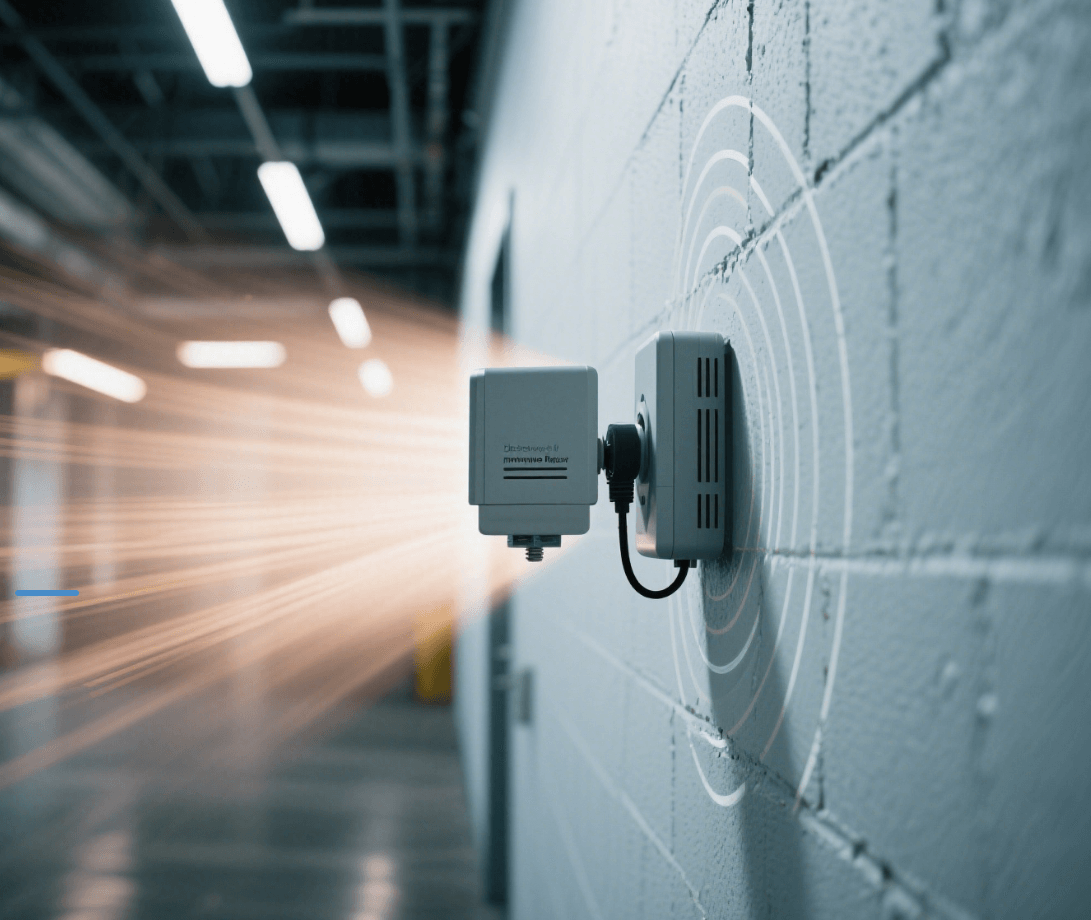
Introduction
Millimeter-wave (mmWave) radar, operating between 30 and 300 GHz, has emerged as a key technology in industrial automation, smart buildings, security monitoring, and autonomous systems. Its short wavelength enables high spatial resolution, allowing detection of small or fast-moving objects with centimeter-level precision.
A critical question for engineers and system designers is: Can mmWave signals penetrate walls? Understanding the practical limits of mmWave penetration is crucial when deploying sensors in warehouses, factories, office spaces, or urban environments. Misjudging penetration capabilities can lead to false expectations, suboptimal sensor placement, or inefficient system design.
1. Physical Principles of mmWave and Wall Penetration
Millimeter waves have wavelengths from 1 to 10 mm and frequencies from 30 to 300 GHz. Their interaction with materials depends on:
-
Frequency-dependent attenuation: Higher frequencies experience greater free-space path loss and stronger absorption by walls.
-
Material dielectric properties: Concrete, brick, wood, and drywall have varying permittivity and loss tangents, which determine how much signal passes through.
-
Wall thickness and construction layers: Multi-layered or reinforced walls can attenuate signals exponentially.
Experimental attenuation data at 60 GHz:
| Material | Thickness | Signal Attenuation | Notes |
|---|---|---|---|
| Drywall | 12 mm | ~50% remaining | Common in offices/warehouses |
| Brick | 200 mm | ~10–20% remaining | Older buildings, structural walls |
| Concrete | 150 mm | <10% remaining | Dense reinforced walls |
| Glass | 10 mm | ~70–80% remaining | Windows or glass partitions |
These results show mmWave cannot penetrate thick, dense, or metallic walls effectively, but thin non-metallic walls allow partial detection.
2. Real-World Applications of Through-Wall mmWave Sensing
Despite attenuation limitations, mmWave radar is used successfully in controlled through-wall scenarios:
Industrial Monitoring
-
Warehouses with partitioned areas can track forklifts or AGVs behind drywall partitions.
-
Enables real-time tracking without installing multiple cameras.
-
Case Study: A logistics company deployed 24 GHz mmWave sensors behind 12 mm drywall and observed 95% motion detection accuracy for forklifts up to 15 meters behind partitions.
Security Applications
-
Detecting human presence in restricted or low-visibility environments.
-
Advantages: operates in darkness or smoke, non-invasive, preserves privacy.
-
Limitation: thick walls (>20 cm brick or concrete) prevent reliable detection.
Smart Buildings and Occupancy Detection
-
mmWave sensors detect occupant movement behind thin partitions or inside rooms without direct line-of-sight.
-
Enables energy savings via dynamic HVAC control.
-
Benefit: Unlike cameras, mmWave cannot capture facial or identity information, maintaining privacy compliance.
Key Insight: mmWave is best suited for motion detection, occupancy monitoring, or equipment tracking, rather than high-resolution imaging through thick structures.
3. Technical Challenges and Optimization Techniques
Challenges:
-
Signal attenuation: Thick or dense walls reduce signal strength, limiting detection range.
-
Multipath reflections: Walls cause scattering, leading to false positives or noisy readings.
-
Material variability: Differences in wall composition, moisture, or metal reinforcement affect performance.
Optimization Strategies:
-
Beamforming & phased arrays: Direct radar energy to enhance penetration and focus on target areas.
-
Advanced signal processing: Adaptive filters and clutter suppression mitigate multipath and noise.
-
Multi-sensor fusion: Combining mmWave radar with LiDAR, cameras, or low-frequency radar improves reliability.
-
AI-based motion inference: Machine learning models can predict movement patterns even with partial signals.
Example: In a warehouse scenario, combining mmWave radar with overhead LiDAR allowed detection of forklifts behind multiple thin partitions, reducing false positives by 60% compared to mmWave-only sensors.
4. Realistic Expectations and Performance Limits
Key considerations for deployment:
-
Effective penetration: Limited to thin, non-metallic walls (drywall, plaster, glass).
-
Resolution limitations: mmWave can detect motion or approximate position but cannot reconstruct object shapes behind thick walls.
-
Environmental factors: Temperature, humidity, and wall moisture can slightly alter signal attenuation.
Decision-maker takeaway: mmWave provides actionable insights for industrial safety, occupancy monitoring, and equipment tracking but should not be relied upon for surveillance through dense barriers.
5. Future Trends and Research Directions
-
Optimized frequency selection: Lower mmWave frequencies (~30–40 GHz) can improve penetration while retaining usable resolution.
-
Sensor fusion networks: Distributed mmWave arrays combined with cameras or LiDAR increase coverage and reliability.
-
AI-enhanced interpretation: Deep learning algorithms can infer object movement and presence with limited signal strength.
-
Modular deployment: Configurable arrays can adapt to different wall materials, thicknesses, and facility layouts.
These trends suggest mmWave radar will remain a key enabler for industrial automation, smart building monitoring, and limited security applications, even where direct line-of-sight is unavailable.
FAQ
Q1: How deep can mmWave penetrate a wall?
-
Typically, a few centimeters for dense materials like concrete or brick, and several centimeters for drywall or glass.
Q2: Can mmWave detect motion through thick walls?
-
Detection is significantly reduced; only thin, non-metallic walls allow reliable motion sensing.
Q3: Are there commercial through-wall mmWave solutions?
-
Yes, for industrial monitoring, warehouse automation, and robotics, with known material and thickness constraints.
Q4: How does mmWave compare to LiDAR or cameras for through-wall detection?
-
mmWave works in low-light and obscured conditions but suffers from attenuation and lower resolution; sensor fusion often yields the best results.