






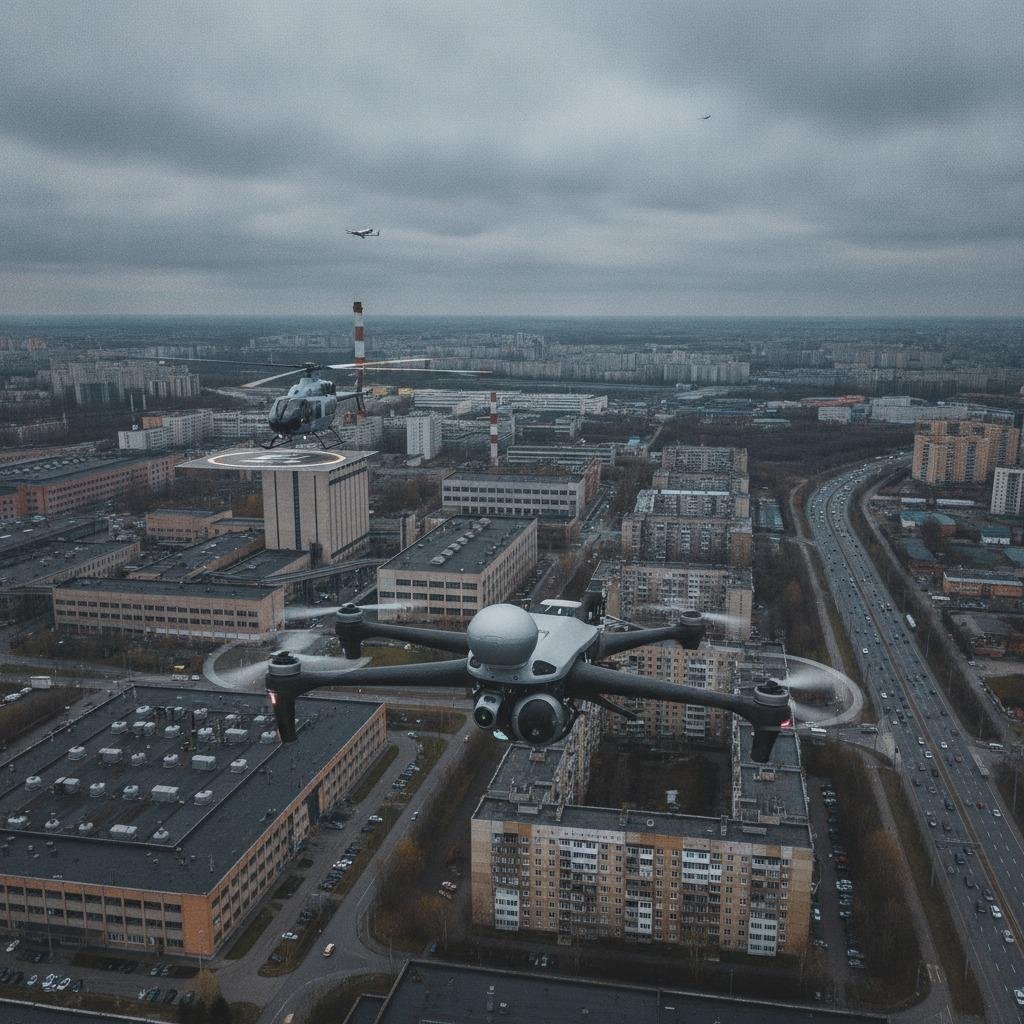
Why complex airspace operation is becoming a harder engineering problem
Complex airspace operation is no longer a niche topic reserved for defense planners or air traffic specialists. It now affects unmanned aircraft manufacturers, industrial drone operators, logistics teams, and system integrators that need aircraft to move safely through crowded, changing airspace without constant human intervention. The challenge is not simply flying from point A to point B. It is making reliable decisions in environments where weather shifts, radio links degrade, obstacles appear, and traffic patterns change faster than a remote operator can react.
That is why buyers are looking closely at technologies that support real-time decision making, sense-and-avoid system functions, and autonomous navigation. These are not just software features on a brochure. They are the difference between a platform that can operate in a tightly managed corridor and one that stalls every time the operating environment becomes messy.

What makes the problem difficult in practice
On paper, airspace can look orderly. In the field, it rarely is. A drone or unmanned vehicle may need to interpret moving aircraft, temporary flight restrictions, terrain, structures, birds, wind gusts, and sensor noise at the same time. The aircraft must make a decision quickly, then execute it without introducing new risk.
That is the core difficulty: the system must perceive, evaluate, and respond under uncertainty. If one layer fails, the others need enough margin to keep the operation safe. A strong communications link helps, but it does not solve the whole problem. Better sensors improve visibility, yet they still need processing logic that can weigh conflicting inputs. Even a well-designed autopilot can struggle if its navigation model is too brittle for the operating environment.
Key capabilities buyers should compare
When teams evaluate platforms or subsystems for complex airspace operation, it helps to separate the discussion into a few functional layers. The details vary by application, but the structure is usually similar.
Perception
AI-driven perception helps interpret what the aircraft is seeing. In practical terms, this may include object detection, classification, tracking, and scene understanding. The important question for buyers is not whether the system uses AI, but whether it can maintain useful awareness in cluttered or low-contrast conditions. A perception stack that performs well in clean demonstrations can still struggle near buildings, trees, haze, or motion blur.
Decision making
Real-time decision making is where perception becomes operational behavior. The system must decide whether to continue, slow down, reroute, climb, hold position, or hand control back to an operator. This logic should be understandable enough for engineers and operators to trust it. Black-box behavior is a problem, especially in regulated or safety-sensitive environments.
Collision avoidance and navigation
A sense-and-avoid system is central to safe autonomous movement. It should not only detect hazards, but also support a sensible response path. Autonomous navigation adds another layer by managing route planning and mission execution with limited human input. In buyer conversations, it is worth asking how the platform handles edge cases, not just nominal routes.
How to evaluate a solution without getting distracted by marketing language
Some vendor language sounds impressive but hides the real question: can the system perform consistently in the exact airspace you plan to use? That means looking at sensor coverage, processing latency, fallback behavior, and operator override options. If a platform depends on perfect connectivity, it may not be suitable for remote or congested operations. If it cannot explain its own failure modes clearly, that is a warning sign.
Another practical issue is integration. Many teams underestimate how much work it takes to connect flight control software, sensors, mapping data, and mission planning tools. A solution may be technically capable yet still awkward to deploy if it does not fit existing workflows. Engineers usually notice this early. Sourcing teams often notice it later, when commissioning takes longer than expected.
Common mistakes that slow adoption
One common mistake is treating autonomy as a single feature instead of a system-level capability. Autonomous navigation depends on the quality of perception, the speed of decision making, and the reliability of the underlying control stack. If one of those pieces is weak, the whole operation becomes fragile.
Another mistake is overestimating the clarity of the operating environment. Maps age. Temporary structures appear. Other aircraft do not always behave as planned. Buyers should press for evidence that the system can cope with change, not just repeat a clean test flight. And if a vendor cannot describe how human operators are brought back into the loop, that is worth a second look.
What a practical buying decision should look like
The best choice is usually the platform that matches the mission environment most honestly. For some organizations, that means a conservative system with strong oversight and simpler automation. For others, it means more advanced AI-driven perception and higher levels of autonomy because the mission cannot scale otherwise. The decision should follow operational risk, not the novelty of the feature set.
In procurement terms, it helps to ask three plain questions: Can the system see enough? Can it decide fast enough? Can it recover safely when conditions change? If the answer to any of those is vague, the solution is not ready for serious complex airspace operation, no matter how polished the demo looks.
Buyer checklist for next steps
Before you move to pilot testing or supplier shortlisting, define the operating environment, the expected traffic density, the fallback requirements, and the level of human supervision you can support. Then ask vendors to show how their sense-and-avoid system, autonomous navigation stack, and real-time decision making perform under those exact constraints.
If you are comparing systems now, focus on evidence that the platform can survive imperfect conditions. That is where most of the operational value lives, and it is also where most failures begin.