






Why dynamic envelope protection matters in fast-moving systems
Dynamic envelope protection is one of those control concepts that sounds abstract until a vehicle, drone, or other high-speed platform gets close to the edge of safe operation. In practical terms, it is the logic that keeps a machine inside its allowable performance envelope while still letting the operator or autonomy stack move quickly. For engineers, sourcing managers, and product teams, the real question is not whether the feature sounds impressive. It is whether it prevents loss of control, reduces the chance of a collision, and still allows enough agility for the job at hand.

That balance matters because modern systems are expected to do two things at once: move faster and make smarter decisions. A platform that hesitates too long can miss its window. A platform that reacts too late can hit an obstacle, exceed a safe angle, or simply become unstable. Dynamic envelope protection is meant to sit between those failure modes and the mission itself.
What the protection layer is actually doing
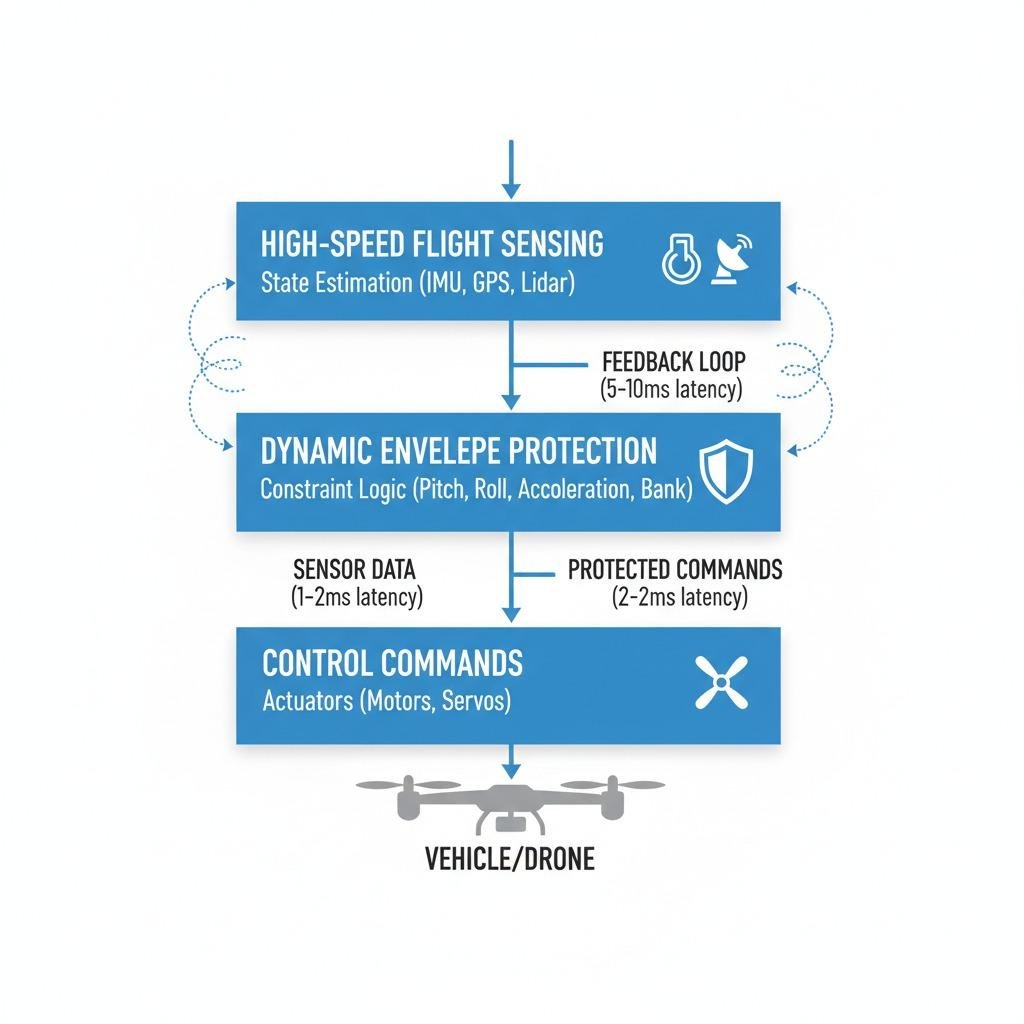
At a basic level, the system monitors vehicle state, predicted motion, and external conditions, then constrains commands before they become unsafe. It may limit pitch, roll, acceleration, bank angle, climb rate, or other operating parameters depending on the platform. The exact implementation varies, but the objective is consistent: preserve controllability while allowing the vehicle to keep moving.
That makes it closely tied to high-speed flight sensing and to the broader perception-and-control chain. If the sensing layer is slow, the protection layer will be late. If the control logic is too conservative, the machine becomes frustrating to operate. The value is in the middle ground, where a system can support rapid trajectory adjustment without turning every maneuver into a near miss.
Key use cases where the feature earns its keep
This kind of protection is especially relevant in systems that operate near obstacles, in crowded environments, or at speed. Think of drones navigating infrastructure, autonomous platforms moving through warehouses, or vehicles that must react to unexpected changes in their environment. In those settings, reactive collision avoidance is not a nice-to-have. It is part of the survival logic.
Agile obstacle maneuvering is where the tradeoff becomes visible. A machine may need to shift course immediately, but it still has to avoid a control excursion that would worsen the situation. A well-designed envelope protection layer can trim the command, reshape the response, or hand back a safer alternative rather than allowing an aggressive input to push the platform into an unstable state.
What buyers should compare before they sign off
For product teams, the temptation is to treat envelope protection as a checkbox. That is usually a mistake. The underlying questions are more practical:
How quickly does the system sense state changes?
How much of the operating envelope is protected, and where are the limits?
Can the logic be tuned for different missions or payloads?
Does it fail safely if a sensor drops out?
The last point is worth underlining. A protective system that depends on a single sensor path can become brittle. In the field, dirt, vibration, interference, and timing issues show up faster than they do on paper. Buyers should ask how the control stack behaves when inputs are delayed, noisy, or incomplete. That is often where the real engineering difference shows up.
Common mistakes teams make
One common mistake is overconstraining the machine until the operator or autonomy software starts fighting the system. Another is assuming the protection layer will fix poor sensing or bad path planning. It will not. Envelope protection is a guardrail, not a substitute for competent control architecture.
Teams also sometimes ignore mission context. A platform designed for slow inspection work does not need the same response profile as one expected to execute rapid trajectory adjustment in a dynamic environment. If you specify the wrong response window, you may end up with a system that is safe on paper and awkward in use. That is a costly kind of safe.
Practical selection advice
If you are evaluating a system that includes dynamic envelope protection, focus on integration, latency, and tuning flexibility. Ask for examples of how the logic behaves during abrupt maneuvers, sensor uncertainty, and close-proximity operation. If possible, review how the protection layer interacts with the autonomy stack rather than looking at it as a separate module.
Engineers usually want to know whether the feature can be validated against real mission profiles. Sourcing managers often want to know whether it is configurable enough to support multiple SKUs without a redesign. Product teams should care about the user experience, because a system that repeatedly intervenes at the wrong moment will be blamed by the customer, not by the control engineer.
What good envelope protection should feel like in the field
The best systems do not announce themselves constantly. They step in when needed, preserve stability, and let the machine continue its job with minimal drama. In practice, that means the platform stays responsive, obstacles are handled without panic, and the operator does not have to second-guess every command.
If you are choosing between platforms, ask not only whether dynamic envelope protection exists, but how gracefully it behaves under pressure. That distinction is usually what separates a promising control feature from one that actually earns trust.
Next step
When you evaluate suppliers or platform options, request a control-logic overview, a sensing-and-latency summary, and a description of how the system handles unsafe commands. Those three items will tell you more than a brochure ever will.