






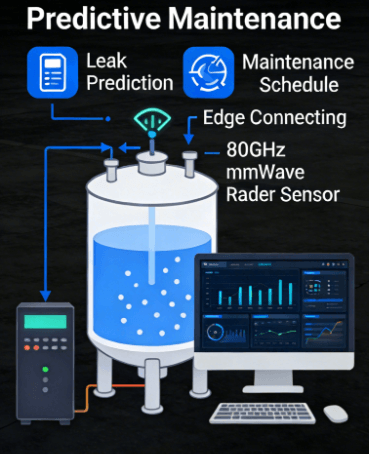
Introduction: Redefining Level Monitoring in Industry 4.0
In the age of Industry 4.0, data collection is no longer the most important challenge. Today's industrial operators are focused on converting raw sensor data into actionable insights that drive real-time decisions. Liquid level monitoring, one of the fundamental variables in industrial processes, is evolving from a simple overflow alarm to a strategic tool for predictive maintenance and operational optimization.
By integrating edge computing with high-precision 80 GHz mmWave radar, level monitoring now goes beyond safeguarding tanks and pipelines. It has become a key metric for assessing equipment health, enhancing production yields, and supporting intelligent decision-making across complex industrial systems.
Level Monitoring: The Industrial “Barometer” of System Health
Traditional industrial maintenance often relies on vibration sensors to track pumps or thermal cameras to monitor motors. While effective, these indicators may not always detect early signs of failure. In contrast, subtle fluctuations in liquid level often provide earlier warnings of system anomalies, offering a valuable window for predictive maintenance.
Early Detection of Hidden Failures
-
Micro-leak detection: In long-distance pipelines or fine chemical processes, pump seal degradation often begins with tiny leaks. By analyzing static level changes during non-operational periods with millimeter-level precision, edge algorithms can detect risks before traditional environmental sensors respond.
-
Pipe scaling and blockages: A gradual decline in refill slope (ΔL) under constant pump pressure often signals filter or pipeline obstruction.
-
Pump efficiency loss: Nonlinear patterns in liquid level changes, combined with flow measurements, can indicate impeller wear in centrifugal pumps.
Multi-Sensor Fusion for Complete Insights
A single liquid level reading provides limited information. Modern industrial monitoring solutions rely on multi-sensor fusion for actionable intelligence:
-
Level + Pressure: Calculates medium density in real time, distinguishing between true liquid drop and cavitation.
-
Level + Temperature: Applies thermal expansion compensation to maintain accuracy under extreme temperature variations.
-
Level + Vibration: Establishes baselines for rotating equipment, like agitators, enabling dynamic filtering of disturbances.
This multi-dimensional approach creates a holistic “system health profile,” enabling engineers to detect subtle issues long before they escalate into costly failures.
Edge Computing: On-Site Intelligence for Industrial IoT
Traditional IIoT architectures often depend on cloud computing. While powerful, cloud-only solutions face latency, bandwidth, and security challenges, especially in industrial environments. Edge computing addresses these challenges by processing data locally, empowering real-time decision-making, and improving system reliability.
Real-Time Responsiveness and Reliability
Milliseconds matter in extreme scenarios, such as tank overflows or dry-running pumps. Edge devices execute local loop control, allowing emergency shutdowns (ESD) even when the factory network is offline. This capability minimizes asset damage and operational downtime.
Local Noise Reduction and Feature Extraction
Industrial environments are inherently noisy due to agitation, foam, steam, and mechanical vibrations. Edge computing enables:
-
De-noising at the sensor level: Techniques like Kalman filtering and wavelet transforms clean signals before sending them to the cloud.
-
Smart feature extraction: Sensors no longer merely report “Level = 1.2m.” Instead, they can detect patterns like “Periodic surface fluctuation detected, potential agitator imbalance,” reducing computational burden on central systems.
By moving from raw data to actionable semantic insights, edge computing elevates liquid level monitoring from reactive to predictive.
Hardware Foundation: High-Precision mmWave Radar
High-quality decisions require high-quality data. 80 GHz mmWave radar is rapidly replacing traditional ultrasonic or hydrostatic sensors due to its precision, robustness, and reliability.
-
High-frequency FMCW radar: Offers millimeter-level measurement accuracy and narrow beam angles (3°–8°) to avoid obstacles like ladders and agitator supports.
-
Signal interpretability: Advanced radar sensors analyze echo energy distributions to differentiate liquid surfaces, surface foam, and bottom sediment—critical for predictive maintenance in complex industrial processes.
The combination of edge computing and mmWave radar allows operators to detect subtle variations in liquid level that are indicative of hidden failures long before they escalate.
System Integration: From Single Devices to Industrial Collaboration
For maximum value, level monitoring must be integrated with other industrial systems rather than functioning as an isolated data source.
-
MES integration: Monitors tank levels in real time and automatically adjusts refill rates to production demand, supporting “just-in-time” operations.
-
SCADA coordination: Injects liquid level anomalies into process control loops, enabling dynamic adjustment of valve positions and flow rates.
-
ERP & CMMS integration: When edge devices detect “pump efficiency anomalies,” spare parts availability is checked in ERP, and CMMS automatically generates work orders with supporting evidence for maintenance teams.
This level of integration ensures that predictive insights translate directly into operational actions, reducing downtime and improving resource utilization.
Industry Applications
-
Biopharmaceuticals: In continuous reaction processes, minor level fluctuations impact heat exchange and dissolved oxygen. By leveraging mmWave radar with edge computing, a leading pharmaceutical company maintained ±2 mm level precision, increasing batch yield by 8%.
-
Energy & Oil & Gas: Remote collection stations equipped with low-power edge gateways monitor tank settlement and slow leaks, cutting field inspection frequency by 70% while improving safety.
These examples demonstrate that predictive level monitoring is no longer theoretical—it’s delivering measurable operational and financial benefits.
Conclusion: Building a Digital Foundation for Intelligent Operations
The evolution from data collection to decision support marks a critical milestone in Industrial IoT maturity. Edge computing provides speed, mmWave radar ensures precision, and predictive maintenance delivers tangible business value by reducing unplanned downtime, extending asset life, and improving operational safety.
As industrial systems grow more complex, intelligent-level monitoring will play an increasingly central role, acting as both a barometer for system health and a driver of operational efficiency.
FAQ
Q1: Why is edge computing better than cloud-only solutions for predictive maintenance?
A1: Edge computing detects millisecond-level signal distortions locally, such as water hammer effects, which may be lost if data is first uploaded to the cloud.
Q2: How is ROI measured for a smart level monitoring system?
A2: ROI comes from reducing losses due to overflow or leakage, extending the life of pumps and valves, and saving labor through condition-based maintenance.
Q3: Can mmWave radar operate in dusty or high-steam environments?
A3: Yes. 80 GHz mmWave penetrates dust and steam, and its non-contact design avoids adhesion issues, offering reliability far beyond ultrasonic or contact sensors.