






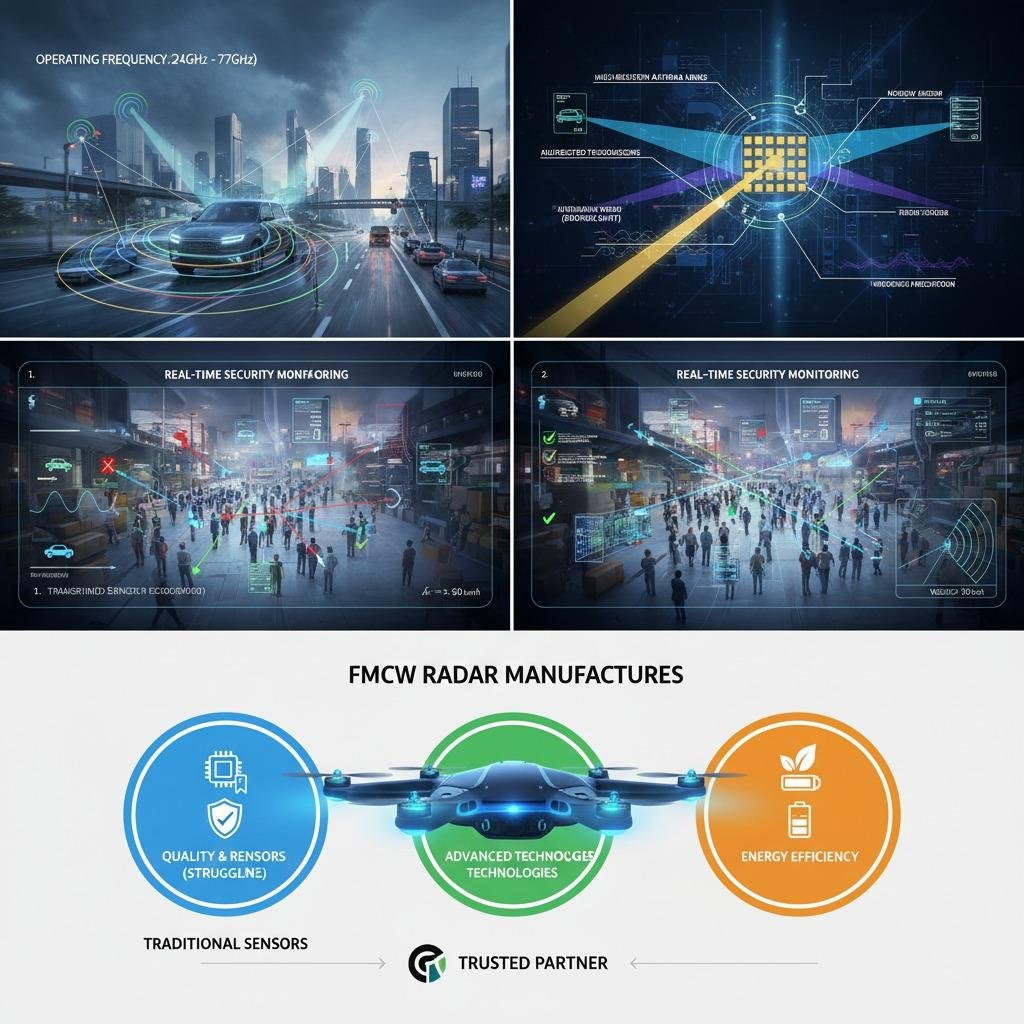
Challenges of object detection in complex environments

In today's fast-paced world, accurately detecting objects in complex or harsh environments poses a significant challenge for industries such as automotive, security, and industrial automation. Traditional sensing technologies are often affected by weather, obstacles, or multiple moving targets, leading to unreliable data and potential safety hazards. Frequency Modulated Continuous Wave (FMCW) radar offers a powerful solution, providing accurate distance and velocity measurements without the limitations of optical or ultrasonic sensors. By modulating the frequency of the transmitted signal, FMCW radar achieves high-resolution detection even in adverse environments such as fog, rain, or darkness, thus solving the environmental challenges faced by other systems.
Integrating millimeter-wave radar to improve accuracy
To overcome the limitations of broadband radar, millimeter-wave radar has emerged as a key advancement within the frequency-modulated continuous wave (FMCW) radar framework. Operating at higher frequencies, typically in the 24 GHz to 77 GHz band, millimeter-wave radar offers higher resolution for detecting small objects or close-range targets, crucial for applications such as autonomous vehicles or drone navigation. Its shorter wavelength addresses the issue of insufficient detail detection, allowing for the design of compact sensors and seamless integration into modern devices. For example, in busy urban environments, this technology can filter out noise from irrelevant echoes, ensuring reliable performance even when line-of-sight methods fail.
Using phased array antennas and beamforming technology
Another major challenge for radar systems is achieving directional accuracy without relying on mechanical scanning, which is slow and prone to wear. Phased array antenna technology solves this problem by electronically controlling the radar beam, enabling it to adapt quickly to dynamic scenarios. Combined with beamforming technology (concentrating energy in a specific direction to improve signal strength and reduce sidelobe interference), frequency modulated continuous wave (FMCW) radar can achieve excellent angular resolution. This approach is particularly effective in security surveillance, where tracking multiple intruders requires rapid and accurate target location. Beamforming algorithms optimize array elements to form narrow beams, thereby mitigating signal attenuation in wide-area surveillance and improving overall system efficiency.
Applying Doppler processing technology to velocity analysis
Velocity measurement errors can lead to misjudgments in motion prediction, a common challenge in collision avoidance systems. Doppler processing technology in FMCW radar addresses this problem by analyzing frequency shifts in reflected signals, providing real-time velocity data for moving objects. This technology can distinguish between stationary clutter and approaching threats, solving the challenge of identifying relevant motion in busy environments such as airports or highways. By processing the phase difference between linear frequency modulated pulses, Doppler processing technology provides high-precision velocity profiles, enabling proactive responses to prevent accidents or optimize traffic flow.
Choose a reliable FMCW radar solution from a trustworthy manufacturer.
Choosing the right hardware is crucial to fully leveraging the advantages of these technologies; however, the market is flooded with products of varying quality, complicating integration. Partnering with reputable millimeter-wave radar manufacturers like Linpowave ensures access to cutting-edge FMCW radar modules that integrate phased array antennas, beamforming, and Doppler processing. These manufacturers focus on scalable, low-power designs tailored for industrial applications, addressing deployment challenges such as size constraints and energy efficiency. For example, in smart city infrastructure, their millimeter-wave radar solutions enable continuous monitoring with minimal maintenance, directly addressing reliability concerns in long-term applications. By adopting such advanced FMCW radar systems, businesses can transform detection challenges into opportunities for innovation and enhanced security.