





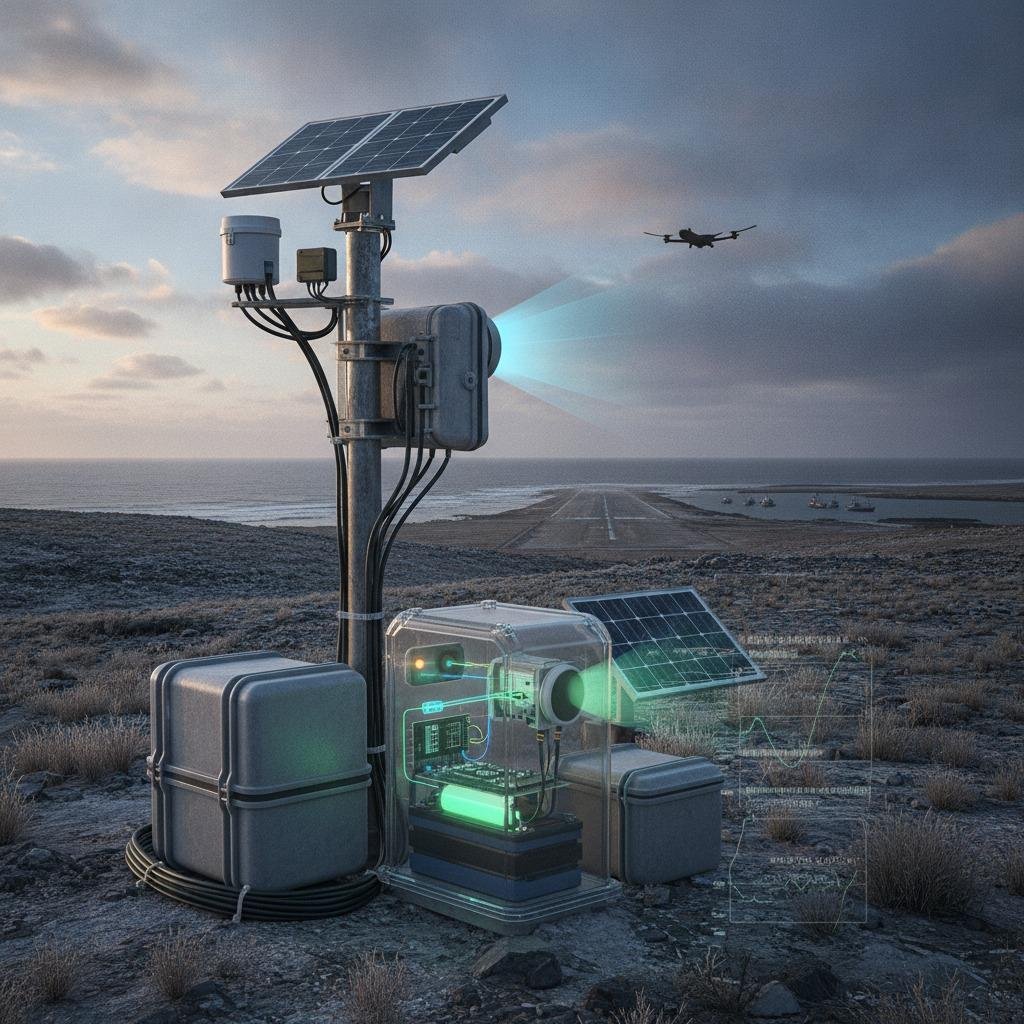
The Power Budget Bottleneck in Autonomous and Remote Infrastructure
For systems engineers deploying autonomous monitoring stations, perimeter security arrays, or long-endurance unmanned aerial vehicles, power consumption is almost always the limiting factor. Active sensors—specifically millimeter-wave radar, lidar, and high-framerate vision systems—consume substantial wattage. In remote off-grid installations, this thermal and electrical overhead forces teams to specify heavy battery enclosures and oversized photovoltaic arrays, ballooning structural costs and complicating field service. Adopting green sensing for energy saving is no longer a corporate sustainability gesture; it has become a hard engineering necessity to keep remote hardware operational without constant battery replacement cycles.
When an active radar module draws between 2W and 15W continuously, an unattended sensor node deployed in sub-zero winter conditions can drain a standard lithium iron phosphate (LiFePO4) bank in a matter of days if overcast weather persists. Sourcing teams and hardware architects face a direct tradeoff: either scale back spatial resolution and frame rates, or find an architecture that isolates heavy sensor transceivers until target verification is strictly necessary.
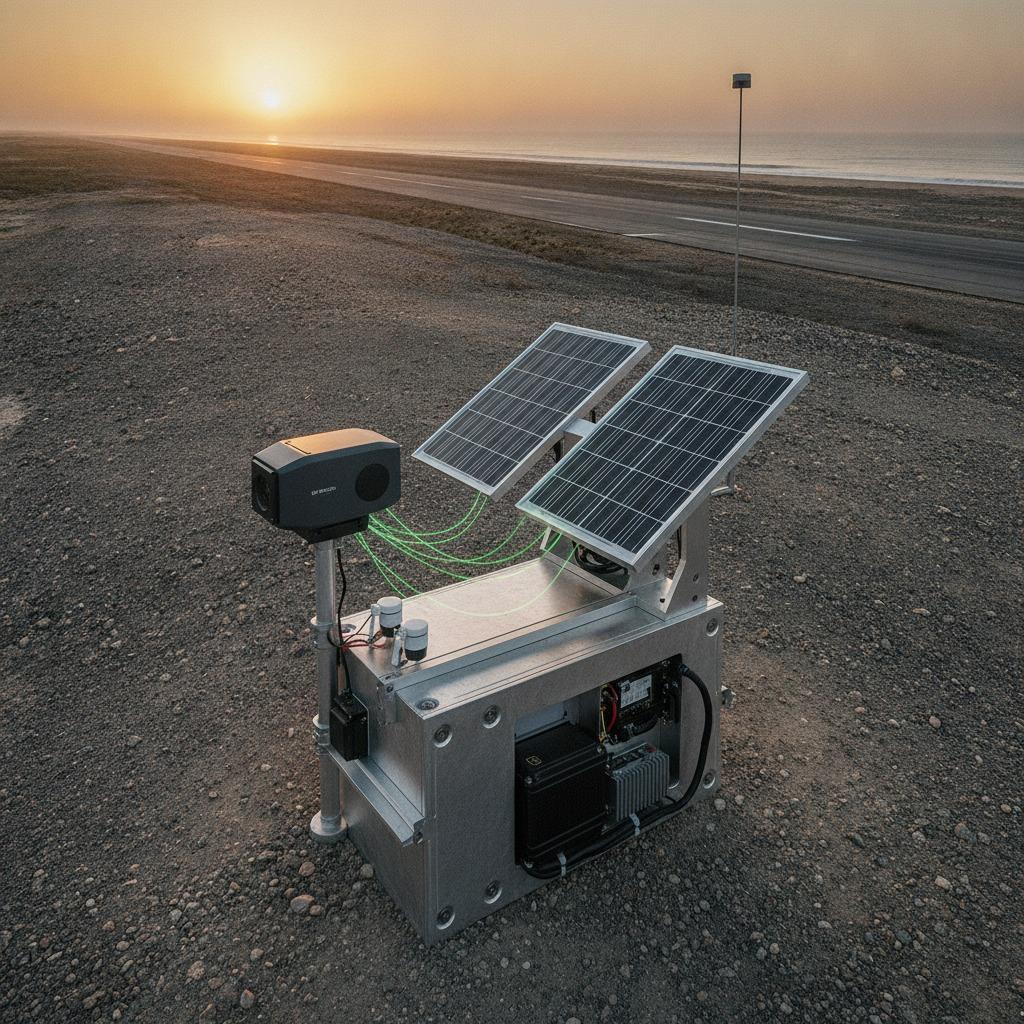
Decoupling Detection: The Role of Multi-Tiered Wake-Up Logic
The standard architectural failure in continuous perimeter or telemetry monitoring is running high-resolution transceivers around the clock. The vast majority of collected data across a 24-hour cycle consists of empty fields, static runways, or barren open water. Running full-bandwidth digital signal processors (DSPs) to compute fast Fourier transforms on empty space is inherently wasteful.
A proven remedy lies in hierarchical triggering via intelligent wake-up sensing. Instead of maintaining primary RF front-ends in continuous transmit mode, the node relies on micro-power secondary inputs—such as ultra-low-power passive infrared (PIR), piezoelectric vibration sensors, or specialized micro-Doppler radar units drawing less than 50 microwatts in a listening state. Only when target thresholds for mass, velocity, or acoustic signature are crossed does the system gate power to the primary FMCW radar transceivers and host microcontrollers.
There is a design caveat here that bench tests often miss: wake-up latency. Bringing a high-performance radar front-end out of deep sleep requires stabilizing phase-locked loops (PLLs) and loading calibration tables from flash memory. If your targets are fast-moving UAVs or low-altitude threats, an unoptimized cold boot of 300 milliseconds might mean the target has exited the narrow field of view before the first chirp finishes processing. Hardware engineers must balance deep sleep states against warm standby modes that keep oscillators stabilized while shutting down power amplifiers.
Harvesting Balance and Field Realities
For installations where grid access or wired umbilical power is cost-prohibitive, solar-powered radar integration offers an attractive route toward self-sustaining nodes. However, field engineers regularly encounter the limits of nominal panel ratings. A 100W solar panel rarely outputs its rated power across changing seasons, dust accumulation, and oblique sun angles.
Achieving true energy-neutral operation requires a dynamic sensing cadence rather than a fixed duty cycle. In practical terms, the sensor node’s embedded controller must monitor its own state of charge (SoC) and internal battery impedance. If the solar harvest drops during consecutive rainy days, the firmware should automatically downshift chirp repetitions, extend sleep intervals between sweeps, or restrict tracking algorithms to narrower angular sectors.
| Operational Mode | Average Draw | Detection Latency | Primary Application |
|---|---|---|---|
| Continuous FMCW Active | 3.5W – 12.0W | Instantaneous (< 5 ms) | Critical base defense, high-speed collision avoidance |
| Fixed Duty-Cycled Radar | 350mW – 1.2W | 100 ms – 1.0 s | Wildlife tracking, coastal traffic monitoring |
| Triggered (Multi-Tier Wake-Up) | < 5mW standby / 4W burst | 50 ms – 250 ms | Remote perimeter surveillance, pipeline security |
| Adaptive Energy-Harvesting | Dynamic (Varies by SoC) | Adaptive (10 ms – 2.0 s) | Off-grid meteorological and solar-powered radar integration |
Aviation and Inspection Platforms: Reducing Payload Penalties
On airborne platforms such as solar-electric pseudo-satellites (HAPS) and industrial inspection drones, electrical power translates directly into physical payload mass. A larger battery requires a larger airframe, which increases induced drag and demands more thrust power. Integrating green sensing for energy saving into airborne sensor suites breaks this compounding weight penalty.
Through intelligent software control and eco-friendly flight optimization, flight computers can coordinate sensor active cycles with navigation flight profiles. When a surveying drone is cruising between flight waypoints, heavy downward-looking sensors can be placed into quiescent modes, activating high-rate sensing sweeps only when crossing designated survey corridors. This practice reduces thermal strain on enclosed avionics bays, cuts down on heatsink weight, and directly expands operational loiter times without increasing battery pack size.
Practical Traps in Low-Power Sensor Sourcing
When evaluating sensor modules and integrated chipsets for remote deployment, sourcing managers should look beyond the headline standby numbers on component summary sheets:
- Quiescent Current vs. Peak Inrush: A radar transceiver might claim a microscopic average draw when duty-cycled, but switching on the power amplifiers can generate sudden current spikes. If your power management IC (PMIC) or battery chemistry has poor transient response at low temperatures, the resulting voltage drop can brown out adjacent microcontrollers.
- Nuisance Triggers Destroy Power Budgets: In hierarchical wake-up systems, false alarms are battery killers. If high winds or ambient thermal gradients repeatedly trip a low-power trigger, the primary high-power system will fire constantly, draining reserves long before the intended service interval. Algorithmic filtering at the edge must accompany the hardware trigger.
- Extreme Temperature Degradation: Lithium cells lose effective capacity and increase internal resistance below 0°C. Power budgets must be modeled against mid-winter capacities rather than standard 25°C laboratory figures.
Frequently Asked Questions
How does wake-up sensing affect detection reliability?
When properly calibrated, reliability remains comparable to always-on systems, provided the primary sensor can stabilize before the target leaves the detection zone. The key is setting trigger thresholds conservatively enough to prevent missed events, while using edge processing to drop false alerts before spooling up full transceiver telemetry.
Can existing legacy radar installations be upgraded for lower energy consumption?
In many cases, yes. Rather than replacing the primary radar head, teams often install an external power-gating switchboard driven by a secondary micro-power sensor or modified firmware running state-of-charge adaptive duty cycling.
Next Steps for Engineering Teams
Before locking in mechanical enclosures or ordering custom battery packs for remote sensing projects, conduct bench profiling with a dynamic power analyzer across the entire temperature operating envelope. Verify the exact power-up stabilization curve of your RF transceivers, calibrate secondary trigger thresholds against actual field noise, and calculate the true power margin required for autonomous, year-round field reliability.