






Merging onto a highway has always been one of the most demanding and stressful maneuvers for drivers. Vehicles must accelerate quickly while matching the speed of fast-moving highway traffic. Drivers must judge distance and timing within seconds, often with limited visibility. These conditions make highway on-ramps a hotspot for near misses and serious collisions.
Traditional safety systems such as roadside signage or cameras have limitations. Signage is static, offering general guidance rather than real-time support. Cameras depend heavily on lighting and weather conditions and may fail during heavy rain, fog, or nighttime driving. In contrast, Linpowave’s millimeter-wave (mmWave) radar technology provides reliable, real-time, all-weather detection, significantly improving safety and efficiency at highway merging points.
Why Highway Merging is a High-Risk Scenario
Several factors combine to make on-ramp merging dangerous:
-
Speed differentials: Vehicles entering from ramps may be moving at 40–60 km/h, while highway traffic flows at 100–120 km/h or more.
-
Limited sightlines: Barriers, curves, or large trucks block the driver’s view, making it hard to assess safe gaps.
-
Unpredictable driver behavior: Hesitation, sudden acceleration, or abrupt braking increases risks for all nearby vehicles.
-
Weather and lighting challenges: Rain, snow, fog, or darkness reduce visibility and slow reaction times.
The result is a high frequency of unsafe merges, lane-change conflicts, and rear-end collisions in merging zones. According to global traffic safety studies, on-ramp accidents account for a significant portion of highway crashes, especially during peak hours.
How Linpowave Radar Addresses These Challenges
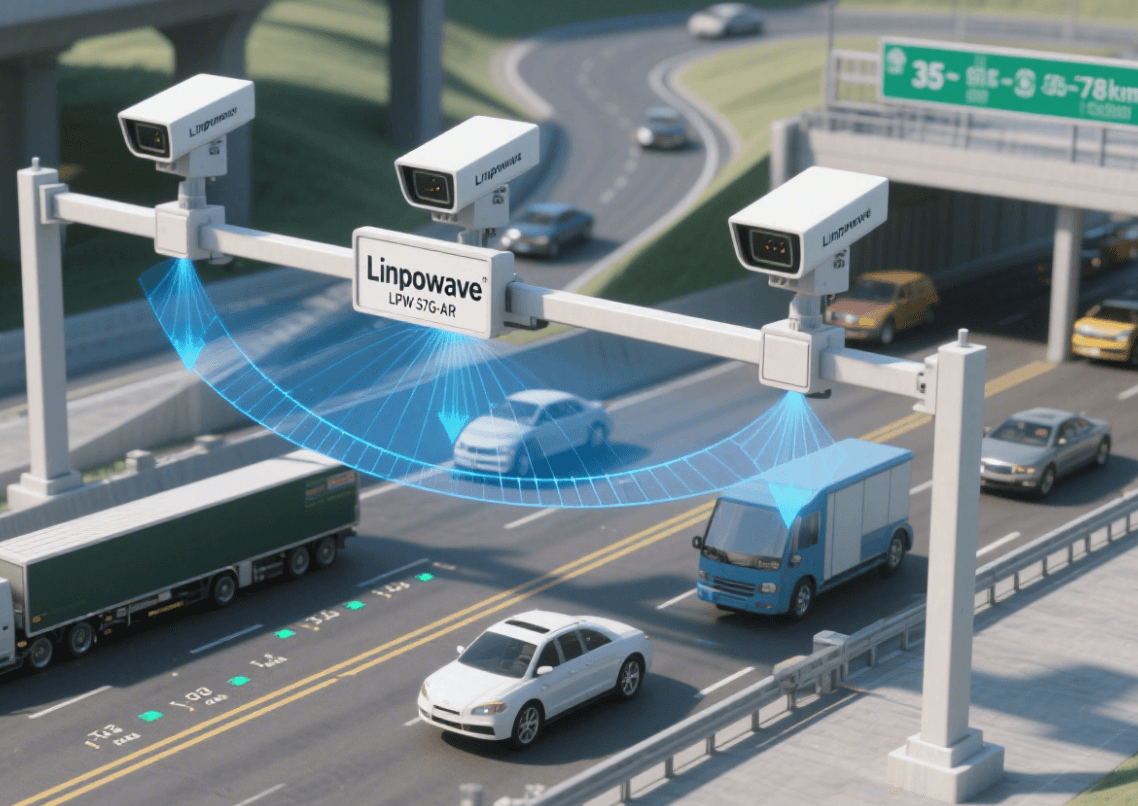
Linpowave’s advanced mmWave radar systems are designed for long-range, multi-target detection, capable of monitoring up to 300 meters ahead. They provide actionable data to both drivers and intelligent transportation systems (ITS).
Key capabilities include:
-
Multi-target tracking: Radar simultaneously detects dozens of vehicles, measuring their speed, distance, and relative trajectory in real time.
-
Dynamic gap assessment: By continuously analyzing traffic flow, radar identifies safe merging opportunities and communicates them to drivers or connected infrastructure.
-
All-weather reliability: Unlike cameras or lidar, mmWave radar maintains consistent accuracy in rain, fog, snow, or low-light conditions.
-
Seamless V2X integration: Radar data can be transmitted to roadside units (RSUs), traffic management systems, or directly to connected vehicles, enabling cooperative safety functions.
Real-World Example: Safer Evening Commutes
Imagine a busy urban highway during the evening rush hour. Dozens of vehicles are merging while heavy traffic flows steadily at 100 km/h. Visibility is low due to light rain and glare from headlights.
Without radar support, drivers must rely on limited visibility and instinct, often leading to hesitation or risky maneuvers. With Linpowave’s mmWave radar, the system continuously monitors both highway lanes and the merging ramp. It calculates safe gaps, identifies potential collision risks, and communicates this data to a dynamic roadside display or directly to vehicles via V2X connectivity.
This means drivers gain confidence in when and how to merge, traffic flows more smoothly, and the likelihood of accidents decreases significantly.
Preventing Rear-End Collisions
Another critical issue on ramps is sudden braking. A vehicle may slow down unexpectedly when searching for a safe gap, leaving following drivers with little time to react. Linpowave radar detects these rapid decelerations early and can trigger warning alerts for trailing vehicles. This early detection provides valuable extra seconds for drivers—or automated braking systems—to respond safely.
Benefits Beyond Safety: Improving Efficiency
Linpowave radar not only reduces crashes but also enhances overall traffic efficiency. By enabling smoother merges:
-
Drivers avoid abrupt braking and unnecessary lane changes.
-
Traffic throughput is maintained, reducing bottlenecks.
-
Fuel consumption and emissions decrease, contributing to greener mobility.
Over time, this means highways can accommodate higher traffic volumes with fewer disruptions, supporting the development of sustainable smart cities.
The Road Toward Smarter Highways
Highway safety is entering a new era where vehicles, infrastructure, and intelligent systems work together. Linpowave’s radar is a key enabler of this future. By combining robust sensing with V2X communication, it transforms highways from passive roadways into dynamic, responsive environments.
Future applications may include:
-
Automated merging assistance for connected and autonomous vehicles.
-
Integration with traffic control centers for adaptive speed management.
-
Enhanced incident detection for quicker emergency response.
As highways evolve, radar sensing will be central to creating safer, more efficient, and more connected transportation networks.
Conclusion
Highway on-ramps will always pose challenges, but technology can make them far safer. With its ability to track multiple vehicles, assess safe merging gaps, and deliver reliable performance in all conditions, Linpowave’s millimeter-wave radar is redefining highway safety. Beyond reducing collisions, it improves traffic flow and supports the broader vision of intelligent, sustainable mobility.
To explore how Linpowave radar is shaping the future of intelligent transportation, visit our solutions page.