






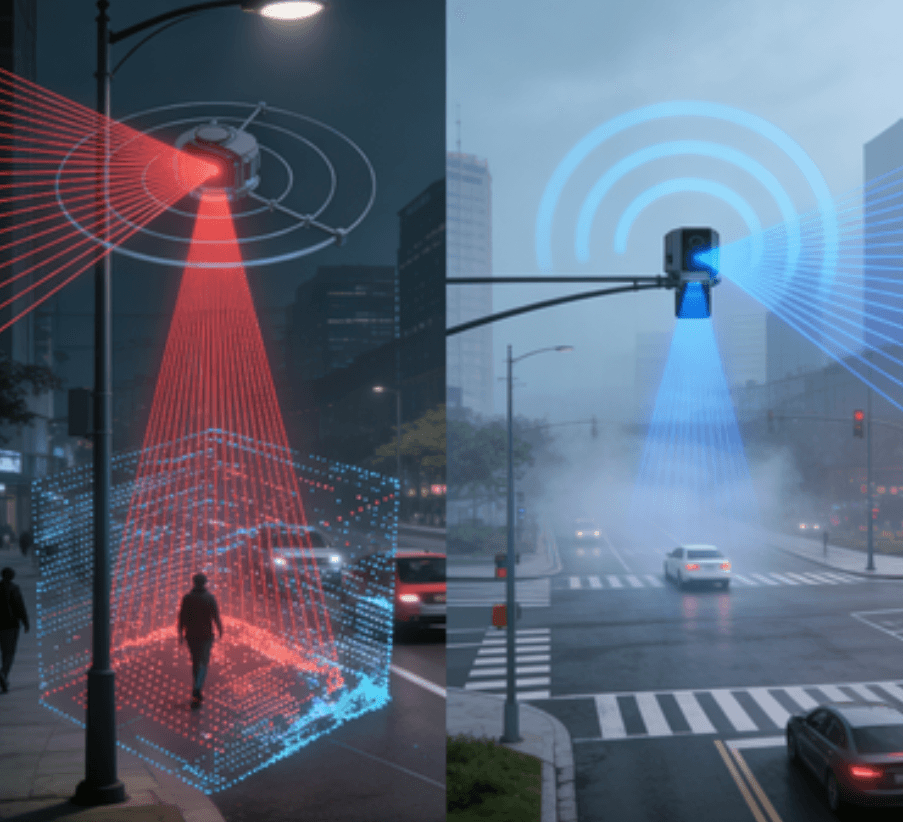
Accurate environmental perception is crucial for performance, safety, and dependability in autonomous driving, robotics, intelligent transportation, and industrial automation. LiDAR (Light Detection and Ranging) and mmWave (millimeter-wave) radar are two of the most popular sensing technologies. What distinguishes them, and how can you pick the best one for your application?
System design and efficacy can be greatly impacted by an understanding of these distinctions. In this piece, we present a thorough analysis of these technologies' functions, areas of strength, and practical applications. The text also includes links to related Linpowave mmWave radar solutions.
For detailed product specifications and use cases, visit Linpowave mmWave Radar products.
How Do You Use LiDAR?
LiDAR uses a technique known as Time-of-Flight (ToF) to measure distance by sending out laser pulses and timing how long it takes for the reflected light to return. LiDAR creates high-resolution 3D point clouds that precisely depict object shapes, contours, and spatial relationships by scanning a scene.
LiDAR is perfect for detailed mapping and classification tasks because it can achieve centimeter-level spatial precision at near-infrared wavelengths like 905 nm or 1550 nm. It is extensively utilized in self-driving cars to create accurate maps of their surroundings and to facilitate sophisticated navigation and obstacle avoidance.
However, there are drawbacks to LiDAR's reliance on light. Rain, fog, snow, and dust are examples of atmospheric conditions that can scatter or absorb laser pulses, decreasing the accuracy of point clouds. Significant processing power is needed to process dense point cloud data, which raises system costs and energy usage.
How Does mmWave Radar Operate?
Electromagnetic waves in the 30–300 GHz frequency range, or roughly 1–10 mm in wavelength, are used by millimeter-wave radar. It employs radio waves rather than light, in contrast to LiDAR. mmWave radar uses time delays, phase shifts, and Doppler frequency variations to transmit these waves and analyze the reflected signals to determine object distance, velocity, and angle.
The all-weather dependability of mmWave radar is one of its main advantages. Radar is extremely resilient in difficult circumstances because millimeter-band radio waves are far more effective than optical signals at penetrating rain, fog, dust, and other environmental obscurants. Additionally, radar can directly measure the radial velocity of moving objects, giving accurate real-time speed information.
Linpowave's mmWave radar products use cutting-edge chip-level design to provide small, low-power, and economical sensing solutions appropriate for smart infrastructure, automotive, and industrial applications. Learn more at Linpowave mmWave Radar products.
Important Differences in Technology
Weather Robustness versus Spatial Resolution
LiDAR is unique in that it can produce high-density 3D point clouds that enable fine-grained environmental mapping and intricate object recognition. Because of this, LiDAR is particularly useful in settings where it's essential to comprehend object placement and shape.
mmWave radar, on the other hand, provides reliable detection in low visibility. Its strength in measuring velocity adds an additional layer of situational awareness, and its longer radio wavelengths are less impacted by lighting, dust, and weather.
Range and Measurement Accuracy
Under ideal circumstances, LiDAR systems usually function well within a range of 50–500 meters; accuracy is dependent on laser power and sensor design. Reliable long-distance tracking and motion analysis are made possible by radar systems' ability to detect objects at 50–300 meters in all weather conditions.
Data Processing and Cost Considerations
Rich datasets produced by LiDAR necessitate extensive processing for segmentation and classification, which raises system costs and computing requirements. Because mmWave radar produces more efficient data, mainly range, angle, and velocity, it requires less processing power and allows for large-scale deployment at a reasonable cost.
Applications and Use Cases
Autonomous Driving
LiDAR is frequently used in autonomous systems to support high-precision object recognition and produce intricate 3D maps. Because mmWave radar is so good at long-range detection and velocity tracking, safety features like adaptive cruise control and collision avoidance operate dependably even in bad weather. In order to improve robustness, many contemporary perception stacks employ sensor fusion, which combines LiDAR with radar and cameras. The radar modules from Linpowave are made to be incorporated into these fused systems, providing reliable performance in a variety of driving situations. Learn more at Linpowave solutions.
Robotics and UAVs
LiDAR makes it possible for drones and robots to precisely locate and map complex environments. In the meantime, mmWave radar is perfect for outdoor and industrial UAV applications because it offers reliable obstacle detection in settings with smoke, dust, or poor visibility.
Industrial Automation and Smart Infrastructure
LiDAR is useful in industrial settings for warehouse automation planning and accurate object measurement. mmWave radar performs exceptionally well in harsh environments, proximity detection, and material level sensing. Radar complements LiDAR's function in precise urban mapping in smart cities by enabling continuous vehicle tracking and traffic monitoring in all weather conditions. Refer to the Linpowave technical resources.
How to Choose Between LiDAR and mmWave Radar
The application determines the appropriate sensor to use:
-
If precise object recognition and high-resolution 3D mapping are important and the environment is under control, then go with LiDAR.
-
If you require accurate velocity measurement, dependable detection in all weather conditions, and economical deployment, go with millimeter-wave radar.
-
When redundancy, environmental adaptability, and safety-critical performance are needed, use both in sensor fusion systems.
Linpowave provides instructions for incorporating mmWave radar into sensor fusion architectures and more general perception systems.
In conclusion
Both mmWave radar and LiDAR have complementary strengths and are essential components of contemporary sensing systems. While mmWave radar provides reliable, all-weather detection and precise speed measurement at a lower cost, LiDAR provides high-fidelity 3D spatial data perfect for in-depth mapping and classification. Combining these technologies results in robust sensor systems that can reliably perceive situations in the real world.