






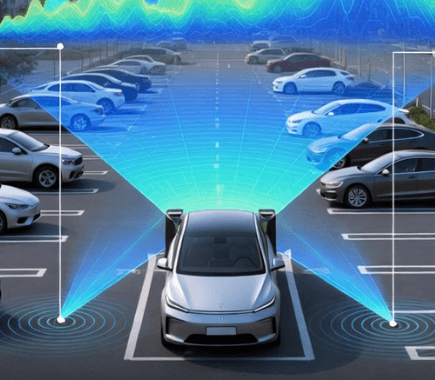
For OEMs and autonomous parking solution providers, 4D mmWave radar is an essential sensor for APS/HPP systems. Its ability to provide verifiable distance and elevation data in low-light, occluded, and close-range environments significantly reduces system uncertainty, allowing for scalable, enterprise-grade deployment of automated parking solutions.
1. Operational and Engineering Aspects of APS vs HPP
Understanding the difference between APS and HPP is critical for system integrators.
-
APS (automated parking system)
Concentrated on assisted parking maneuvers with a driver in the loop. The integration complexity is moderate, but precise control and redundancy are still required. -
HPP (Home Zone Parking Pilot).
Allows for fully autonomous navigation within structured zones, such as parking garages. Vehicles move hundreds of meters while avoiding dynamic obstacles and static infrastructure.
The system bears complete responsibility for safety; redundancy in perception and control is required.
From an enterprise standpoint, HPP deployment necessitates certified sensing reliability and deterministic near-field measurements, making radar selection a critical engineering choice.
2. Technical Challenges in Parking Facilities
Automotive engineers and system integrators must take into account that typical parking garages pose extreme perception challenges:
2.1 Variable and inadequate lighting
Surface lots and underground garages have vastly different lighting conditions, including flickering, backlighting, and near-total darkness. Vision-based systems alone may not be able to provide accurate distance measurements.
2.2 Requirements for Accuracy in the Near Field
Parking spaces are frequently only 30-50 cm wider than the vehicle itself. Pixel-based depth estimation in the sub-2 metre range can be inaccurate, resulting in scrapes or collisions.
2.3 Irregular and low-level obstacles
Wheel stops, columns, low steps, and overhead pipes are common and sparsely placed. Vision systems may misidentify these as background, increasing operational risk. These uncertainties are reduced through physical measurement using radar.
3. How 4D mmWave Radar Overcomes Engineering Challenges
4D mmWave radar provides illumination-independent, verifiable distance and elevation data, complementing cameras and ultrasonic sensors in meeting enterprise safety requirements.
3.1 Verification of Physical Distance.
Radar, in contrast to vision-based systems that infer depth, measures distance directly. It consistently produces centimeter-level accuracy in low-light, occlusion, and dust conditions—essential for HPP deployment.
3.2 Differentiating Obstacles Based on Elevation
Traditional 3D radar cannot distinguish between driveable and impassable obstacles. The elevation resolution of 4D radar enables system integrators to distinguish between 5 cm and 15 cm objects, reducing false braking and operational interruptions.
3.3 Multi-Target Tracking with High Resolution in the Near Field
Targets are often close together in narrow aisles or structured parking. The dense point clouds of 4D radar allow for precise tracking of vehicles, pedestrians, and posts, enabling enterprise-level HPP systems to use deterministic path planning.
4. Four-dimensional radar in HPP system architecture
The integration principle applies to solution providers.
-
Camera: Semantic comprehension of parking lines, arrows, and object classification.
-
4D Radar: Physical validation of obstacles, providing deterministic, actionable distance and elevation data.
Radar functions as the system's safety verification layer. When camera confidence drops due to lighting or occlusion, radar ensures proper path planning and collision avoidance.
This architecture enables unattended parking while maintaining verifiable operational safety, which is required for commercial deployment and OEM certification.
5. 4D Radar Versus Other Sensors in Enterprise Systems
4D Radar Versus Ultrasonic Sensors
Ultrasonic sensors cover very short distances, have low refresh rates, and provide limited spatial information. 4D radar covers the near- to mid-range environment, allowing HPP systems to detect and plan their trajectory early on.
4D Radar versus LiDAR
LiDAR offers high spatial resolution but is more expensive, consumes more power, and is more difficult to integrate. 4D radar provides a cost-effective solution with adequate near-field obstacle perception for scalable deployment in production vehicles.
6. Considerations for Deployment and Integration.
The enterprise-grade integration of 4D radar involves:
-
Mounting positions: Front, side, and corner locations to cover blind spots and close-range areas.
-
Data fusion is the early-stage integration of radar point clouds and camera data to enable deterministic path planning.
-
System redundancy: Radar serves as a validation layer, ensuring fail-safe operations even when vision or other sensors fail.
Future deployments will prioritize early-stage multi-sensor fusion, lowering overall perception uncertainty while remaining cost-effective.
7. FAQ: Enterprise Perspective on 4D mmWave Radar
Q1: Why is mmWave radar more important in APS/HPP than in highway scenarios?
In parking, absolute distance measurements must be taken in the near field. Radar provides deterministic readings in situations where vision alone may fail.
Q2: What is the difference between 4D and 3D radar in HPP deployments?
Elevation resolution distinguishes between drivable and impassable obstacles, which is essential for automated path planning.
Q3: Can cameras and ultrasonic sensors provide adequate enterprise HPP solutions?
They offer only a limited amount of coverage. 4D radar provides continuous near-to-mid-range spatial verification, which is critical for safe autonomous operation.
Q4: Can 4D radar be used to replace LiDAR in parking solutions?
Not exactly. 4D radar strikes a balance between cost, reliability, and integration complexity, delivering adequate performance for scalable deployment.
Q5: Is 4D radar reliable in low-light or occluded environments?
Yes, mmWave radar is lighting-independent, allowing for accurate detection even in underground garages.
Q6: Where is 4D radar typically installed in enterprise parking systems?
Near-field and blind spot coverage is provided from the front, sides, and corners.
Q7: Will additional sensors be required in future enterprise parking systems?
Instead of simply adding sensors, the trend is toward deeper fusion, which involves early integration of radar and camera data to reduce system uncertainty.
Finally,
For OEMs and providers of autonomous parking solutions, 4D mmWave radar is a deterministic safety baseline rather than a camera replacement. Its dependable near-field distance and elevation perception make it an essential component of high-level autonomous parking systems, allowing for scalable, enterprise-grade APS/HPP deployment.