






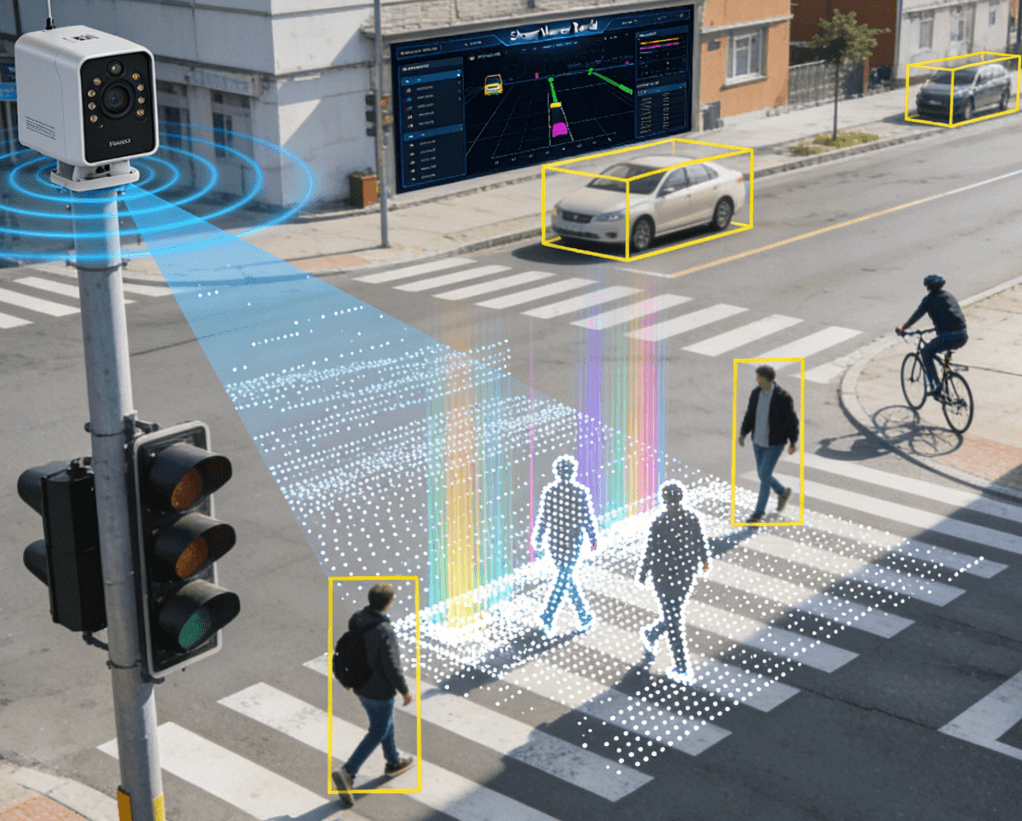
Urban traffic environments around the world are becoming more complex. Narrow streets, dense traffic, shared spaces, and a diverse range of vulnerable road users (VRUs), such as pedestrians, cyclists, and e-scooter riders, all pose significant safety risks. For businesses that provide intelligent traffic systems, autonomous driving solutions, or urban mobility platforms, ensuring VRU safety in low-speed urban scenarios is a critical requirement for designing and deploying high-performance sensor solutions.
Linpowave’s Short-Range 4D mmWave Radar creates a high-resolution safety shield around vehicles, effectively addressing blind spots and detection challenges that traditional sensors face in dense urban environments.
Issues with Traffic Safety in Cities
Even advanced driver assistance systems perform well on highways and straight roads, but low-speed urban scenarios remain dangerous. According to accident statistics, pedestrian and cyclist injuries are most common at city intersections, narrow streets, school zones, and parking lots. Blind corners, unexpected vehicle doors, and crowded environments all contribute to increased risk of traditional sensors failing.
The limitations of typical near-field sensors include:
-
Cameras rely on lighting and may not detect VRUs in low-light, backlit, or shadowed conditions.
-
Ultrasonic sensors have limited range and angular resolution; they can detect an object but not determine its type or trajectory.
-
Traditional 3D radar produces sparse point clouds and lacks height information. In narrow city streets, cyclists may collide with parked vehicles in radar returns, resulting in missed detections.
These gaps highlight the need for high-resolution, multidimensional short-range mmWave radar technology to reliably detect VRUs in complex urban environments around the world.
Key Benefits of Linpowave Short-Range 4D mmWave Radar
Linpowave's short-range 4D mmWave radar is designed for 0-50 meter near-field scenarios and has strong perception capabilities in urban areas.
Height measurement (fourth dimension)
By measuring elevation angles, the radar can distinguish pedestrians and cyclists from infrastructure like curbs, streetlights, and low-hanging signs. This capability ensures that VRUs are detected and classified correctly, reducing false alarms and missed detections in any urban setting.
Dense Point Clouds for Imaging
Linpowave radar uses massive MIMO antenna arrays to generate dense point clouds that outline the shape of objects, rather than just their center points. In congested urban streets, this allows for a clear distinction between stationary and moving targets. The system remains dependable even under changing lighting conditions, providing critical data support for intelligent traffic systems and urban mobility solutions.
Key application scenarios
Intersections have blind corners.
In major cities such as New York, London, Shanghai, Tokyo, and Berlin, vehicle pillars frequently block driver sightlines at intersections, and cameras have limited viewing angles. Linpowave's short-range 4D radar can detect pedestrians and cyclists around corners and distinguish them from parked cars or street furniture. It reduces the likelihood of a collision by providing early warnings or emergency braking support.
Protect against "Dooring"
In cities with a high bicycle and e-scooter usage, such as Amsterdam, Copenhagen, and Shanghai, unexpected vehicle doors can endanger riders. Linpowave's side-mounted short-range 4D mmWave radar monitors adjacent lanes, detecting approaching cyclists quickly and providing real-time alerts to effectively reduce collision risk.
Low-speed navigation in crowded places
Children or pedestrians may appear unexpectedly in schoolyards, parking lots, shared spaces, or city squares. Linpowave radar detects stationary or slow-moving targets using micro-Doppler features, and height information is used to reduce false alarms. This ensures precise identification of critical targets, which improves safety in low-speed urban environments worldwide.
Commercial Value for Corporate Clients
Linpowave short-range 4D mmWave radar offers B2B customers
-
360° VRU Protection: High-resolution near-field perception that includes blind spots and complex low-speed scenarios.
-
Global Urban Adaptability: Suitable for deployment in major cities such as New York, London, Shanghai, Tokyo, and Berlin, allowing intelligent traffic systems to be implemented across regions.
-
Reliable Redundant Perception: Detects pedestrians and cyclists even when cameras and traditional radars are limited, increasing the accuracy of safety decisions.
Businesses that integrate Linpowave radar can provide dependable urban traffic safety solutions and safer low-speed mobility environments for VRUs.
Frequently asked questions (FAQs)
1. What distinguishes short-range 4D mmWave radar from conventional 3D radar?
It incorporates height information and produces dense point clouds that outline the shape of pedestrians, cyclists, and infrastructure, thereby improving near-field detection in urban environments.
2. Does it detect stationary pedestrians or cyclists?
Yes. Micro-Doppler features enable the radar to detect subtle human movements, such as breathing or weight shifts, ensuring accurate detection even of stationary targets.
3. Is the radar reliable under various lighting conditions?
Indeed. Linpowave's short-range 4D radar operates independently of light, achieving high detection accuracy in day, night, backlit, or shadowed conditions across global urban environments.
4. How does it handle traffic in different cities?
The radar detects intersections, school zones, parking lots, shared spaces, and narrow streets, adapting to changing traffic densities and road layouts in cities such as New York, London, Shanghai, Tokyo, Berlin, Amsterdam, and Copenhagen.
5. What benefits does it offer business clients?
It improves low-speed urban safety perception, provides dependable data for intelligent traffic systems and urban autonomous mobility solutions, and lowers operational risks while promoting higher safety standards.
Conclusion
Linpowave's short-range 4D mmWave radar creates a "safety cocoon" around vehicles, protecting pedestrians and cyclists. Its high-resolution imaging and height information allow for continuous and precise detection of VRUs in complex urban environments. This technology is a critical upgrade for businesses developing intelligent traffic systems or urban autonomous mobility solutions, improving low-speed urban safety and reliability while also providing deployable solutions for safer streets around the world.