






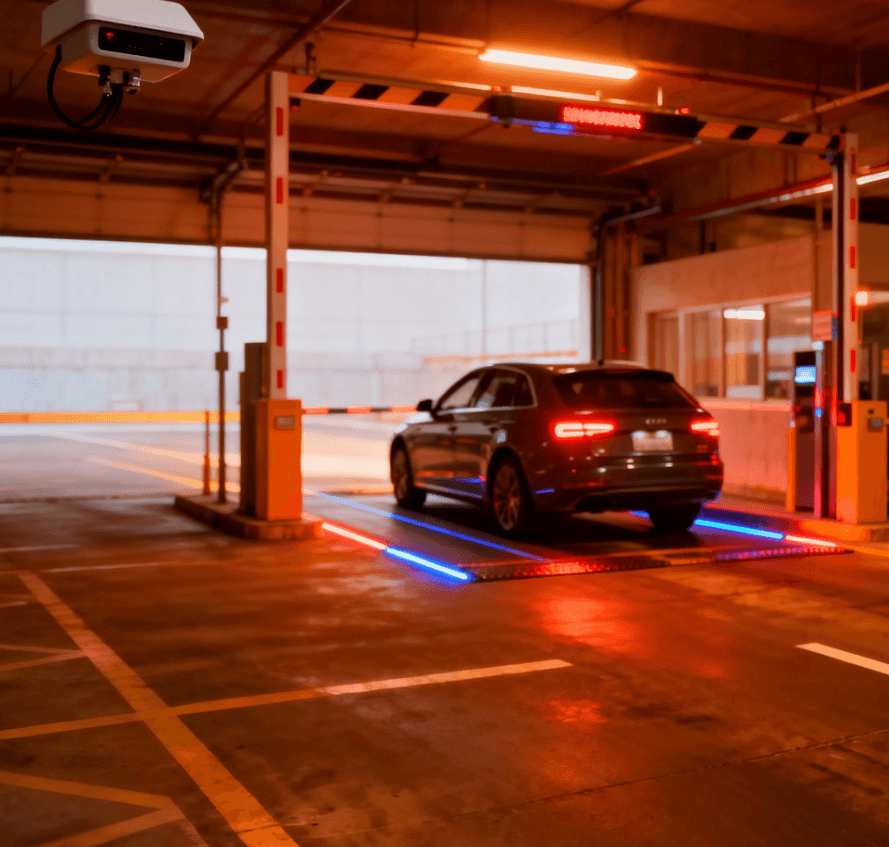
In the era of smart transportation, parking lot management plays a critical role in improving efficiency and user experience. Among various tasks, vehicle detection at parking lot entrances and exits is one of the most fundamental but also the most important. Traditional detection technologies—such as ground induction loops and infrared sensors—face limitations in cost, installation complexity, and long-term stability. In contrast, millimeter-wave (mmWave) radar provides a cost-effective, reliable, and flexible solution.
The Challenges of Traditional Detection Methods
Parking lots typically use technologies like magnetic ground sensors or video cameras for vehicle detection. While these methods are relatively mature, they often present several drawbacks:
-
High installation and maintenance costs: Ground induction loops require excavation, which not only increases construction expenses but also leads to disruptions during repairs.
-
Environmental limitations: Cameras are highly dependent on lighting and weather, while infrared sensors struggle with fog, rain, or snow.
-
Durability issues: Long-term wear or environmental interference can cause frequent failures, leading to increased maintenance costs.
For operators looking to reduce costs and improve reliability, these challenges cannot be ignored.
Why mmWave Radar Is a Cost-Effective Alternative
mmWave radar has gradually emerged as a mainstream solution for vehicle detection in smart parking systems due to its ability to balance cost and performance:
-
Non-contact installation: mmWave radar can be mounted on poles or ceilings without the need for road surface modifications, significantly lowering installation costs.
-
All-weather adaptability: Operating at 60–77 GHz, mmWave radar is resistant to rain, snow, fog, and lighting conditions, ensuring continuous stability.
-
Multi-target detection: A single radar can detect multiple vehicles simultaneously, providing accurate data on distance, speed, and trajectory.
-
Long lifespan: With no physical wear-and-tear parts, maintenance frequency and costs are greatly reduced.
Practical Applications in Parking Lots
In real-world deployments, mmWave radar offers flexibility that can be adapted to different parking lot environments:
Entrance and Exit Management
By installing mmWave radar at the entrance, operators can accurately identify incoming and outgoing vehicles. The system can seamlessly integrate with boom gates or barrier-free systems, ensuring smooth traffic flow.
Occupancy Detection
mmWave radar can monitor whether specific areas or lanes are occupied, providing real-time data for guiding vehicles to available spaces. Unlike cameras, it avoids privacy concerns and works in poorly lit environments.
Smart Payment and Automation
When integrated with license plate recognition systems, mmWave radar enhances automation. For example, it ensures that billing is triggered only when a vehicle is confirmed to have entered or exited, reducing false charges.
Cost Analysis: Where the Savings Come From
Compared to ground induction loops, mmWave radar significantly reduces installation and maintenance costs. There’s no need for road excavation, wiring is simplified, and maintenance can often be performed remotely. Over time, operators save not only on direct expenses but also on indirect costs such as service downtime and labor.
Additionally, with its scalability, operators can expand from a few detection points to a complete parking lot solution without needing a full redesign. This flexibility allows for incremental investment, aligning better with budget constraints.
Future Outlook: Towards Smarter Parking Management
As smart transportation continues to evolve, the role of mmWave radar will extend beyond simple vehicle detection. By combining it with AI algorithms and cloud platforms, operators can achieve:
-
Predictive analytics: Using vehicle flow data to forecast peak hours and optimize traffic allocation.
-
Integration with city traffic systems: Enabling real-time data sharing with smart city platforms.
-
Enhanced user experience: Guiding drivers to available spaces more efficiently while reducing congestion at entrances.
Conclusion
Low-cost implementation doesn’t mean compromising on reliability. mmWave radar offers parking lot operators a practical, scalable, and cost-effective solution for vehicle detection, outperforming traditional methods in many aspects. With its adaptability to diverse environments and reduced maintenance needs, it is becoming a core technology in smart parking systems.
If you’re looking for a solution that balances budget, performance, and long-term reliability, mmWave radar is worth serious consideration.
Explore how Linpowave’s mmWave radar can help you upgrade your parking management system today.
Frequently Asked Questions (FAQ)
Q1: Will mmWave radar mistakenly detect pedestrians as vehicles?
A: No. mmWave radar distinguishes vehicles from pedestrians or bicycles using radar cross-section (RCS) features, significantly reducing false positives.
Q2: Can it detect multiple vehicles passing at the same time?
A: Yes. mmWave radar supports multi-target tracking and can accurately count several vehicles simultaneously.
Q3: Can motorcycles or trailers be detected?
A: Yes. Different types of vehicles produce distinct radar signatures, allowing classification and accurate detection.
Q4: Is the maintenance costly?
A: No. Radar installation doesn’t require cutting the road surface or regular lens cleaning, making maintenance significantly cheaper than loops or cameras.
Q5: Are there privacy concerns?
A: No. mmWave radar only measures motion and distance, without capturing images, ensuring privacy compliance.
Q6: Can it integrate with existing parking management systems?
A: Yes. It supports multiple standard interfaces like UART, CAN, and SPI, allowing seamless integration with most parking management backends.