






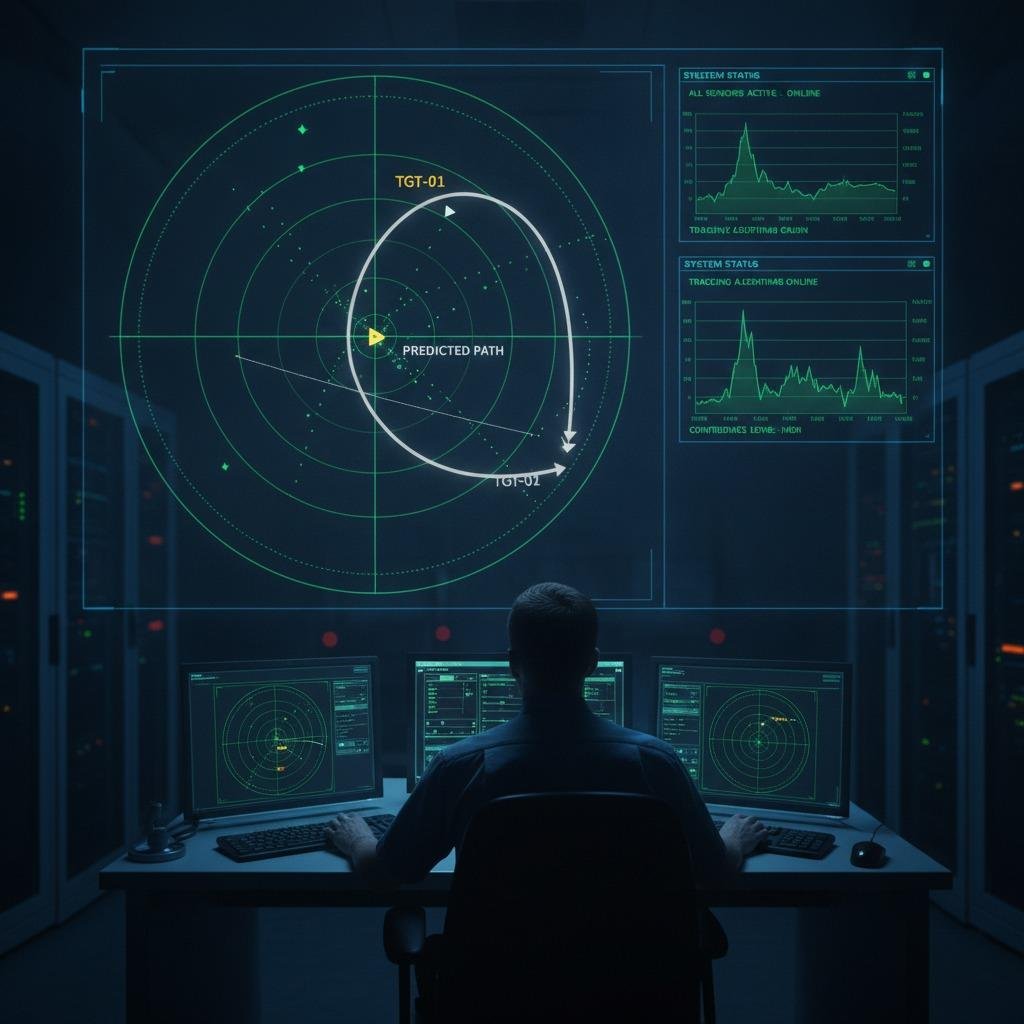
Maneuvering Target Tracking: How to Select a Reliable Tracking Approach
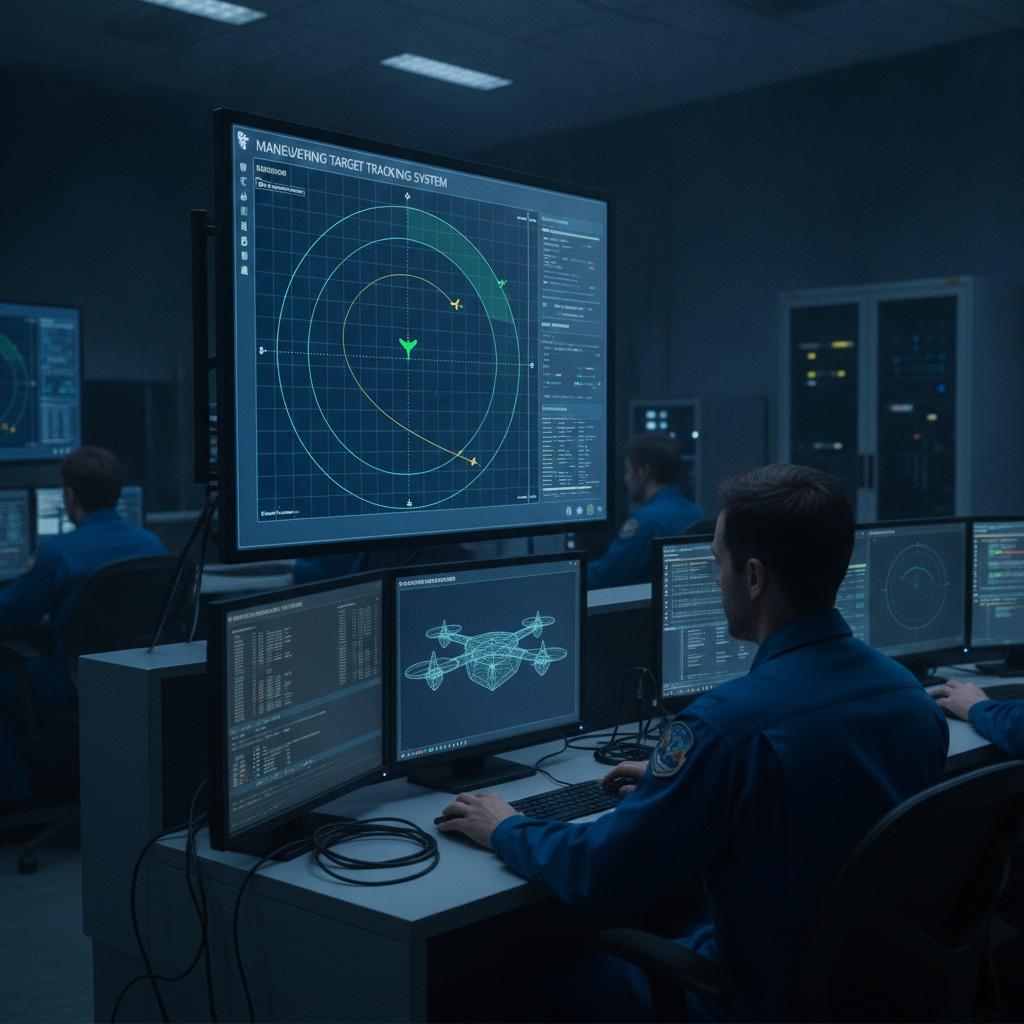
Maneuvering target tracking is the process of estimating and predicting the position, velocity, and future movement of an object whose motion can change over time. It matters whenever a tracking system must follow aircraft, vessels, vehicles, drones, robots, or other moving objects that do not travel in a straight line at constant speed. The central decision is not simply which sensor to use. It is how much motion uncertainty the system can tolerate, how quickly it must respond to a maneuver, and which tracking model best matches the target’s behavior.
Why Straight-Line Tracking Often Fails
A basic tracker can work well when a target moves steadily. In that situation, recent position measurements provide a reasonable basis for estimating the next position. The problem appears when the target turns, accelerates, decelerates, climbs, descends, or changes its operating mode.
Measurement data also contain noise. Radar, optical systems, lidar, acoustic sensors, and positioning systems each introduce different levels of uncertainty, update rates, and temporary gaps. A tracker must therefore separate genuine motion changes from sensor error. If it reacts too aggressively to every measurement fluctuation, the estimated track becomes unstable. If it reacts too slowly, the track lags behind the target during a sharp maneuver.
For engineers and product teams, this creates a practical trade-off: responsiveness versus stability. A robust system should maintain a usable track during ordinary motion while adapting quickly enough when the target’s behavior changes.
Quick Reference: What a Maneuvering Tracker Must Handle
| Tracking challenge | What the system needs to do |
|---|---|
| Variable speed | Update velocity and acceleration estimates without amplifying measurement noise. |
| Turns and curved paths | Represent changing heading and turning dynamics rather than assuming a straight path. |
| Short measurement gaps | Propagate the track using a motion model until new observations arrive. |
| Unexpected maneuvers | Increase model flexibility or switch to a more suitable motion hypothesis. |
| Multiple nearby objects | Associate measurements with the correct track and manage possible track swaps. |
Core Methods Used in Maneuvering Target Tracking
Motion-model filtering
Many systems begin with a state estimator. The state may include position and velocity, with acceleration, heading, or turn rate added when the application requires it. The estimator predicts the next state, compares that prediction with the incoming measurement, and then updates the track according to the assumed uncertainty.
A constant-velocity model is computationally efficient and often adequate for steady targets. It becomes less useful when the object regularly changes speed or direction. Constant-acceleration models can provide better performance for some ground or airborne targets, but they still make assumptions about how motion evolves.
Multiple-model tracking
A target rarely behaves according to one motion pattern for its entire track. Multiple-model methods address this by maintaining several hypotheses, such as straight motion, accelerating motion, coordinated turning, or low-speed maneuvering. The system assigns changing confidence to each model as new measurements arrive.
This approach is especially useful when the target can switch between distinct behaviors. It adds computational and tuning requirements, however. More models do not automatically produce a better tracker; poorly chosen models can make diagnosis difficult and increase false confidence.
Data association and track management
Prediction is only half the problem. A system must also decide which measurement belongs to which target. In a crowded scene, nearby objects, clutter, missed detections, and false detections can cause the tracker to associate a measurement with the wrong track.
Gating, probabilistic association, track initiation, confirmation, maintenance, and deletion all influence practical performance. A sophisticated motion model cannot compensate for weak measurement-to-track association.
Using Motion Features to Improve the Estimate
Trajectory prediction uses the current track history and a selected motion model to estimate where the target may appear next. The prediction should be treated as a probability distribution or uncertainty region rather than a single guaranteed point. This distinction is important for downstream systems that must schedule sensor resources, set search regions, or make safety decisions.
Behavior pattern recognition can add another layer of context. Repeated turns, stop-and-go movement, lane following, loitering, or route changes may indicate a behavioral mode. These patterns can help a tracker choose between motion models, but they should not be treated as proof of intent. Similar movement can arise from very different operating conditions.
Turning rate estimation is valuable for targets following curved paths. It can improve prediction during a turn, particularly when position updates arrive frequently enough to reveal the change in heading. At low update rates or with noisy measurements, turn-rate estimates can become unreliable and should be constrained by realistic system assumptions.
Acceleration profile extraction can also help distinguish gradual speed changes from abrupt maneuvers. The practical caution is that acceleration is obtained from changing velocity estimates, so noise can increase quickly when the sampling interval is short or the position measurements are imprecise. Filtering and suitable uncertainty handling are essential.
Selection Criteria for Engineers and Buyers
Before selecting a tracking architecture, define the operating envelope rather than starting with an algorithm name. Document the expected target speed range, maneuver severity, sensor update rate, measurement accuracy, latency requirement, number of simultaneous tracks, and likely signal interruptions.
- Match model complexity to motion: A simple model may be preferable for predictable targets and constrained processors. More dynamic targets may justify multiple motion hypotheses.
- Check update-rate assumptions: A method that performs well with frequent observations may degrade sharply when measurements arrive intermittently.
- Separate estimation from identification: Tracking where an object is and classifying what it is are related but different functions.
- Plan for uncertainty: Outputs should include confidence or covariance information where downstream decisions depend on prediction quality.
- Evaluate operational edge cases: Test missed detections, clutter, abrupt turns, close approaches, track crossings, and temporary sensor outages.
Common Implementation Mistakes
One frequent mistake is tuning the filter only against clean simulated motion. Real sensor data include bias, latency, outliers, and changing environmental conditions. Another is using an acceleration or turn-rate model without checking whether the sensor resolution can support those estimates.
It is also risky to judge a tracker only by average position error. A system may show acceptable average accuracy while losing tracks during the exact maneuvers that matter most. Review track continuity, reacquisition time, prediction error during turns, false-track behavior, and performance when several objects are close together.
FAQ
Is a Kalman filter enough for a maneuvering target?
It can be, if the motion assumptions are appropriate and the maneuvers are limited. Targets with frequent or abrupt changes usually benefit from adaptive tuning or multiple motion models.
How much history should a tracker use?
There is no universal window. Longer histories can stabilize estimates but may make the system slow to respond. Shorter histories react faster but are more sensitive to noise.
What should be tested first?
Start with representative sensor data and scenarios that include steady motion, turns, acceleration, missed measurements, clutter, and track crossings. Measure both accuracy and track continuity.
Practical Next Step
Build a requirements table from the target motion, sensor behavior, processing limits, and consequence of a tracking error. Then compare a baseline motion-model tracker with a more adaptive alternative using the same test scenarios. This makes the engineering trade-off visible and prevents model complexity from being selected on reputation alone. The best maneuvering tracker is the one that remains predictable, diagnosable, and responsive within the conditions your system will actually face.