






Introduction
The "Golden 15 Minutes" is a critical time frame for patients experiencing acute medical emergencies such as myocardial infarction, stroke, or severe trauma. According to data from the China CDC, if patients with myocardial infarction receive thrombolytic therapy within the first 15 minutes, their survival rate can reach 89 percent. However, if treatment is delayed for more than 30 minutes, the rate drops precipitously to 37%.
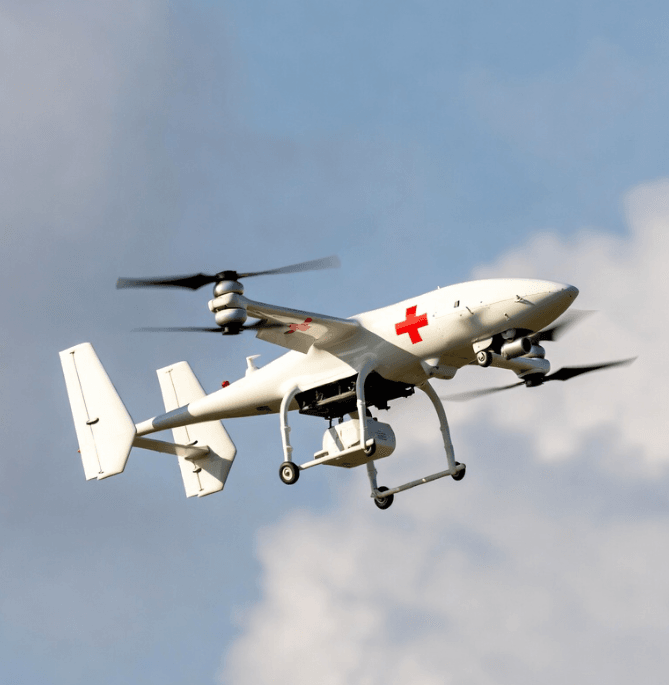
Emergency medical drone delivery, which includes critical supplies like first-aid medications, blood components, and AEDs, has emerged as a critical solution for avoiding urban traffic congestion and filling emergency response gaps in remote areas.
Traditional drone navigation is, however, hampered by dense high-rise environments, complex electromagnetic conditions, rapidly changing weather, and numerous low-altitude obstacles. These factors cause delivery delays in up to 23% of missions and 0.7% of collision-related incidents, both of which have a significant impact on operational safety.
With millimeter-wave radar technology now playing a larger role, the reliability of emergency medical drone delivery has significantly improved, allowing for life-saving speed within the "Golden 15 Minutes." Successful international deployments, such as Zipline's operations in Africa and the United States, demonstrate that radar-powered drones are actively saving lives and accelerating the intelligent transformation of healthcare emergency response systems around the world.
1. Overcoming Urban "Navigation Blind Spots" through Precision Positioning and Navigation.
1.1 Radar-enhanced sensor fusion: centimeter-level accuracy for critical deliveries
GPS/GNSS positioning errors in dense cities frequently exceed 3-5 meters due to signal interference and blockage from tall buildings, rendering precise point-to-point delivery unreliable.
Drones achieve centimeter-level sensing accuracy by combining 60-81 GHz millimeter-wave radar with GPS/BeiDou, correcting positional drift and enabling reliable navigation in complex environments—particularly for the critical "last 100 meters."
Results from the China pilot program:
A hospital in Shenzhen used 77GHz radar in medical drones to achieve a maximum positioning error of ±5 cm in Futian District's high-rise zones. This reduced the thrombolytic drug delivery time for stroke patients from 22 minutes to 13 minutes—completely within the life-saving window—and reduced delivery delay rates from 18% to 2%.
Validation at the global scale:
Zipline's deployment in Rwanda reduced average blood delivery time to under 30 minutes, and its collaboration with Mayo Clinic aims to achieve emergency delivery in under 10 minutes by 2025.
1.2 GNSS-free autonomous navigation
In environments where GPS is not available, such as tunnels or underground facilities, radar continues to provide real-time 3D map construction for autonomous flight.
Radar-guided drones delivered hemostatic drugs in only 4 minutes during an emergency drill at Shanghai Pudong International Airport, which was 12 minutes faster than ground transport.
2. Detecting and Avoiding Obstacles: Creating a Safety Shield at Low Altitudes
2.1 Detecting Static Obstacles for Safer Delivery Routes
Low-altitude obstacles, such as electric wires, billboards, and tree branches, continue to pose the greatest risk to drone emergency operations, accounting for 70% of incidents.
A 360° radar detection system that responds in milliseconds significantly reduces such risks.
As an illustration
Beijing's emergency drone radar system has an avoidance response of less than 0.2 seconds and uses MIMO antennas to detect thin wires as small as 5 cm in diameter up to 200 meters away. The system prevented 17 possible collision points and guaranteed on-time arrival during an emergency food poisoning delivery.
International case:
Fakeeh University Hospital in Dubai implemented radar-enabled collision avoidance, which reduced drug transport time by 70% and prevented crashes in dense urban airspace.
2.2 Airspace Safety through Dynamic Obstacle Tracking
Multi-target tracking is made possible by radar, which helps anticipate and prevent collisions with other drones or unidentified flying objects.
Guangzhou test information:
Accuracy of dynamic obstacle recognition: 99.6%
Three seconds ahead of time for collision prediction
The accident rate dropped to 0.03% from 0.7%.
3. Weather Adaptability: Overcoming Difficult Environmental Barriers
3.1 All-Weather Capability for Dependable Emergency Response
When visibility is less than 50 meters, traditional camera-based navigation suffers. However, radar's strong anti-interference performance allows it to pass through dust, rain, and fog.
Emergency response to Typhoon "Saola" (Shenzhen 2023):
Drug deliveries were completed by radar-enabled drones with 98% mission success in winds up to Level 8 and visibility below 20 meters, compared to 35% for vision-only systems.
International activities:
With success rates above 98%, Zipline has completed over 500,000 deliveries in Ghana during the night and in inclement weather.
4. Enhancing Emergency Response Effectiveness through Collaborative Operations
4.1 Coordinating Multiple Drones for Big-Scale Events
Radar's anti-interference feature and real-time sharing allow for collaborative trajectory planning during pandemics or earthquakes. Delivery efficiency is 4× higher than with a single drone.
4.2 Precise Dispatch through Integrated Airspace Management
In Hangzhou, a smart emergency platform collects radar data from medical drones operating throughout the city to provide real-time status updates. Mass-event delivery delays are reduced to less than 5% with automated air traffic adjustment.
5. Safeguarding the Last Line of Defense with Safety Monitoring and Early Warning
5.1 Monitoring Flight Health in Real Time
In less than three seconds, radar systems automatically issue warnings based on critical indicators like battery voltage and flight posture.
In identified fault events, a Chengdu hospital pilot attained a 100% emergency safety handling rate.
5.2 "No-Control Loss" Anti-Interference Architecture
Radar guarantees the following through frequency-hopping communication, electromagnetic shielding, and BeiDou backup messaging:
✏ Consistent communication despite malevolent intervention
✔ 99.2% detection accuracy at 40 V/m interference level.
6. Multi-Sensor Fusion: Developing Comprehensive Situational Awareness
6.1 Hybrid perception with high reliability
Radar, visual, and infrared systems increase sensing redundancy by 40%, bringing extreme-condition operational reliability to 99.9%.
Mountain Rescue Case (China):
In foggy night conditions, radar detected terrain obstacles and infrared pinpointed the patient—delivery was completed in 12 minutes, saving the victim's life.
Conclusion: Radar Raises the Bar for Urban Emergency Response
Radar-enabled drones greatly improve the safety, dependability, and accessibility of medical emergency drone delivery by resolving a number of bottlenecks in the race against time during the "Golden 15 Minutes," including precise navigation, obstacle avoidance, weather adaptability, coordinated operations, flight safety monitoring, and multi-sensor fusion.
Millimeter-wave radar has emerged as the primary safety enabler of medical drone delivery, driving urban emergency response systems toward a more intelligent and resilient future from everyday emergency cases in China to Zipline's worldwide victories.
Medical drones will continue to develop into a quicker, smarter, and safer emergency logistics infrastructure thanks to advancements in 60–81 GHz radar, AI flight prediction, and 5G + edge computing. This will guarantee that life-saving supplies reach every location where they are most needed.