







Millimeter-Wave Radar for Robots: Enhancing Perception and Interaction in Complex Environments
In the era of intelligent automation, robots are no longer confined to factory assembly lines. They are entering hospitals, warehouses, airports, and even our homes, where they interact closely with humans and navigate complex environments. To operate safely and efficiently, robots require perception systems that go beyond simple cameras and ultrasonic sensors. This is where millimeter-wave (mmWave) radar technology—pioneered by companies like Linpowave—plays a pivotal role.
Why Robots Need mmWave Radar
Traditional sensors such as cameras, LiDAR, and infrared have limitations. Cameras struggle in low light or glare conditions. LiDAR provides high-resolution mapping but can be affected by weather and surface reflectivity. Ultrasonic sensors work well at short ranges but lack precision in cluttered spaces.
Millimeter-wave radar, operating typically in the 60 GHz or 77–81 GHz frequency bands, provides an essential complement to these technologies. Its ability to penetrate dust, fog, smoke, and even light rain makes it highly reliable in real-world applications. For robots, this translates into continuous, robust situational awareness regardless of environmental challenges.
Key Applications in Robotics
1. Autonomous Navigation in Crowded Spaces
Robots in public environments, such as airport cleaning robots or delivery bots in shopping malls, must detect humans, objects, and even moving carts with high accuracy. mmWave radar enables them to distinguish between static and dynamic objects, allowing smooth navigation without collisions.
2. Human-Robot Interaction (HRI)
As robots move closer to daily human interactions, safety becomes critical. mmWave radar can detect subtle human movements, such as a person stepping into the robot’s path, enabling quick response. Unlike cameras, radar respects privacy because it does not rely on visual identification.
3. Industrial Robotics
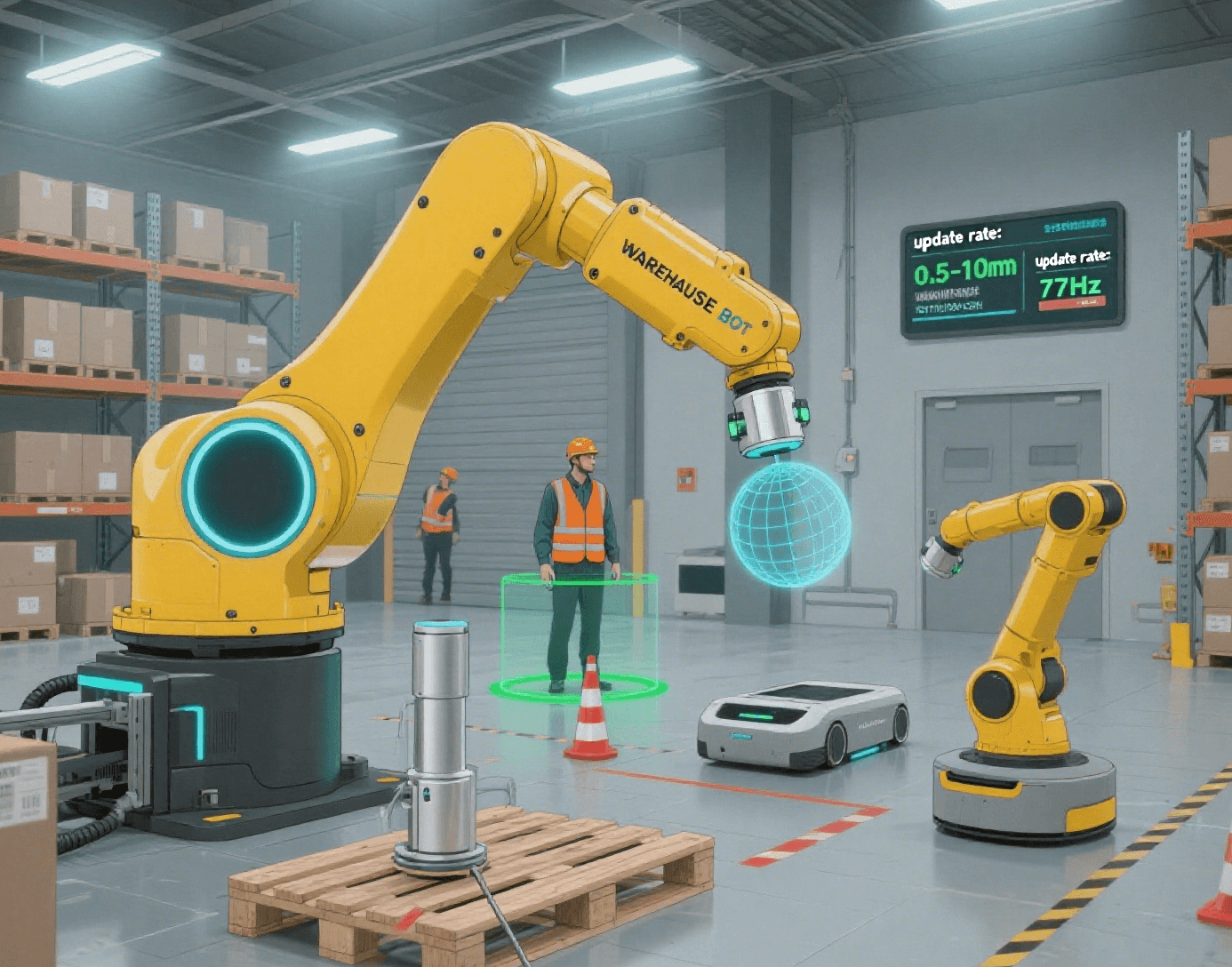
In factories, mobile robots (AGVs and AMRs) often work alongside human operators. mmWave radar provides reliable collision avoidance and zone monitoring, ensuring that production lines remain both efficient and safe.
4. Assistive and Service Robots
Healthcare robots, for example, may assist elderly patients at home. Radar-based sensing allows these robots to detect if a person has fallen or if unusual motion patterns indicate a potential health emergency. This adds value to caregiving beyond mobility support.
Technical Advantages for Robotics
-
High Precision in Range and Speed Measurement: Linpowave’s radar solutions can accurately measure distance and relative velocity, enabling smooth motion planning.
-
4D Imaging Radar: By generating a 3D point cloud with velocity data, mmWave radar can classify objects more effectively than traditional sensing.
-
Compact Modular Design: Linpowave’s radar boards are miniaturized (as small as 50×50 mm), making them easy to integrate into different robot platforms without sacrificing performance.
-
Low Power Consumption: Efficient design ensures radar systems can be deployed on battery-powered mobile robots without compromising operational endurance.
The Future of Robots with mmWave Radar
Looking ahead, mmWave radar will be increasingly critical in enabling collaborative robotics—where robots and humans share the same workspace. As demand for warehouse automation, healthcare support, and service robots grows, safety regulations will require more advanced sensing systems. Radar is likely to become a standard component alongside cameras and LiDAR.
Linpowave continues to push radar technology forward by delivering custom radar solutions for robotics. Their expertise in 60 GHz and 77–81 GHz radar bands positions them as a trusted partner for robotics companies seeking to enhance navigation, safety, and interaction capabilities.
Conclusion
Millimeter-wave radar is transforming the way robots perceive and interact with the world. From ensuring collision-free navigation in crowded environments to enabling safe human-robot interaction, radar empowers robots with the robust perception they need. Companies like Linpowave are leading this shift, making radar not just an add-on but a core sensing technology for the next generation of intelligent robots.