






Introduction
Mining has always been a cornerstone of industrial development, but it is also one of the most dangerous industries in the world. Workers often operate in close proximity to massive haul trucks, drilling rigs, and excavators, where a single miscalculation or unnoticed movement can lead to a catastrophic accident. According to the International Council on Mining and Metals (ICMM), vehicle-related incidents account for a large share of mining fatalities each year.
Conventional safety systems—such as cameras, GPS tags, or manual spotters—have limitations. Cameras struggle in dust, darkness, or rain. GPS loses accuracy in underground tunnels. Spotters cannot cover every angle around massive vehicles. This is why millimeter-wave (mmWave) radar technology is gaining attention in the mining sector. With its high-precision detection, immunity to environmental interference, and ability to monitor large areas in real time, mmWave radar can serve as a “safety shield” for mining personnel.
Safety Challenges in Mining Operations
-
Dust, Fog, and Darkness
Mining environments are full of visibility challenges. Blasting creates dust clouds, underground tunnels lack lighting, and night operations increase risks. Traditional visual detection methods are often compromised. -
Massive Equipment with Blind Spots
Haul trucks used in open-pit mines can be the size of a small building. Operators often cannot see workers standing close to the wheels or rear, creating blind zones of up to several meters. -
Dynamic and Unpredictable Movement
Workers, support vehicles, and heavy machinery constantly move in tight spaces. Even with clear communication protocols, unpredictable human behavior adds risk. -
Noise and Communication Barriers
In open-pit and underground mines, noise levels often exceed safe thresholds, making verbal warnings unreliable. A missed signal can result in disaster. -
Compliance and Liability
Governments and regulators are tightening safety requirements for mining operations. Companies that fail to implement advanced safety systems risk fines, reputational damage, and operational shutdowns.
How Millimeter-Wave Radar Enhances Personnel Safety
1. 360° Detection Around Machinery
By installing radar sensors on the front, rear, and sides of haul trucks or excavators, operators gain a complete 360-degree safety zone. This helps prevent workers from being overlooked in blind spots.
2. Accurate 3D Positioning
Unlike ultrasonic sensors that only measure distance, mmWave radar provides both range and angular information. This allows it to generate a 3D map of nearby objects and distinguish between stationary barriers and moving workers.
3. Performance in Extreme Conditions
Radar waves penetrate dust, rain, fog, and darkness, ensuring reliable detection in conditions where cameras and LiDAR fail. This is critical for underground tunnels where lighting is minimal.
4. Long- and Short-Range Capabilities
One radar unit can monitor up to 250–300 meters for early alerts, while simultaneously tracking near-field hazards around vehicles. This dual-layer detection reduces both high-speed and low-speed accident risks.
5. Integration with Vehicle Control Systems
Radar can trigger audio-visual alarms in cabins or even directly connect to vehicle braking systems. For example, if a worker enters a restricted zone, the haul truck can automatically reduce speed or stop.
6. Smart Data for Site Managers
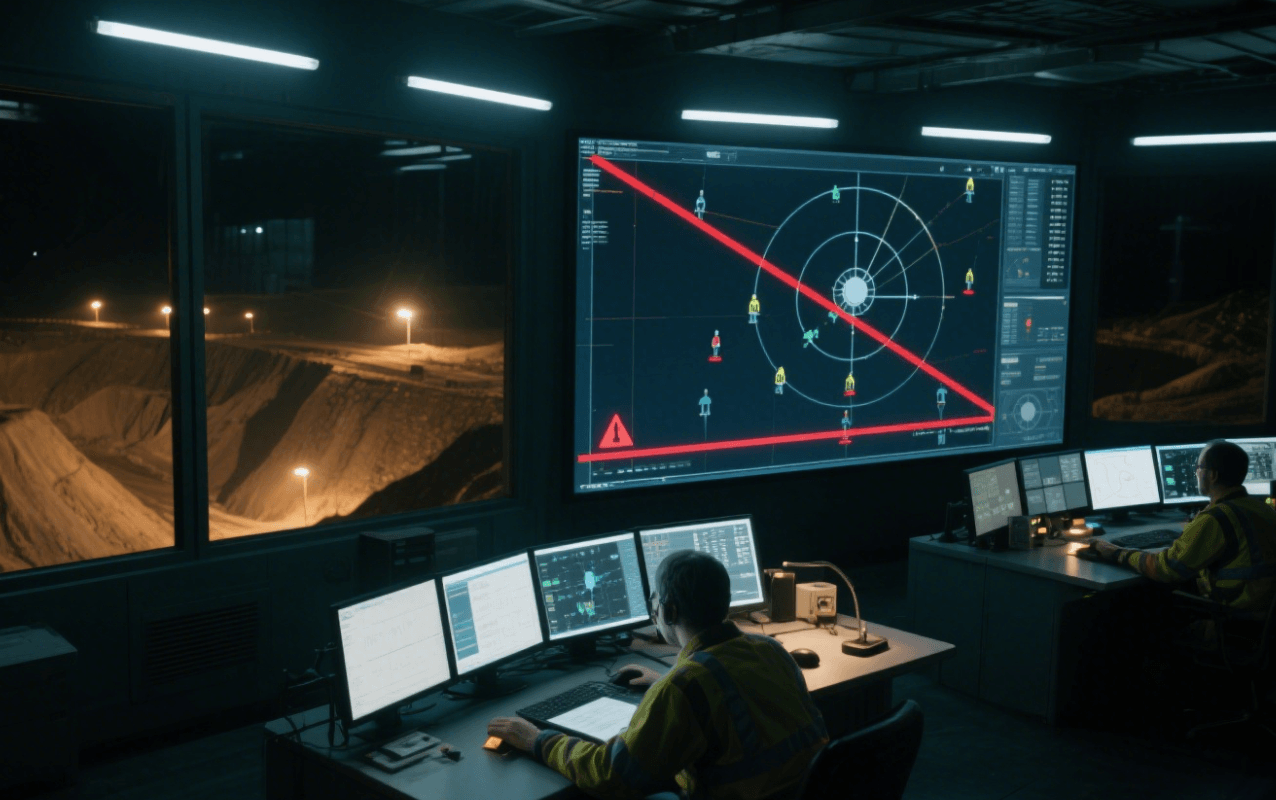
Radar data can be aggregated into IoT-based mining safety platforms. Managers can see heatmaps of high-risk areas, analyze near-miss events, and optimize worker-machine workflows to reduce risks.
Real-World Application Scenarios
-
Haul Truck Blind Spot Protection
A worker checking tire pressure or guiding a truck could remain invisible to the driver. mmWave radar detects their presence and alerts the operator in real time. -
Underground Tunnels
In enclosed, poorly lit tunnels, GPS is unreliable and cameras struggle. Radar ensures that equipment operators can detect both personnel and vehicles ahead, reducing collision risks. -
Blasting Zone Clearance
Before controlled explosions, radar can be used to confirm that all workers have left hazardous areas, providing a double layer of assurance beyond manual checks. -
Multi-Equipment Operations
Excavators, drills, and loaders often work simultaneously in close quarters. Radar sensors reduce the likelihood of equipment-to-equipment collisions by providing operators with real-time proximity awareness.
Case Study: Radar-Enhanced Mining Safety
A leading open-pit mining company integrated Linpowave mmWave radar into its fleet of 220-ton haul trucks and loaders. Each truck was equipped with four radar sensors providing 360° monitoring.
-
Outcome after six months:
-
Near-miss incidents between trucks and workers dropped by 72%.
-
Operators reported reduced stress, as they could rely on radar feedback in low-visibility conditions.
-
The company met updated regional safety compliance requirements without needing costly infrastructure changes.
-
This case demonstrates how radar not only prevents accidents but also supports compliance and operational efficiency.
Learn more about Linpowave’s radar safety solutions for mining and other industrial environments.
Benefits for Mining Companies
-
Enhanced safety: Early detection prevents worker-equipment collisions.
-
Reduced downtime: Fewer accidents mean smoother operations and less unplanned stoppage.
-
Lower costs: Avoid expensive medical claims, compensation, and equipment repairs.
-
Regulatory compliance: Meets occupational safety standards and improves audit readiness.
-
Stronger worker morale: Employees feel safer, which improves retention and productivity.
FAQ
Q1: How does radar perform compared to LiDAR in mines?
A: LiDAR is highly accurate but struggles in dust and fog. Radar is less affected by these conditions, making it more suitable for mining environments.
Q2: Can radar detect both vehicles and people?
A: Yes. mmWave radar can differentiate between large machinery and smaller moving targets such as humans, even when they are partially obscured.
Q3: Is the system expensive to deploy?
A: Compared to the cost of accidents, radar deployment is cost-effective. Sensors are compact, durable, and easy to retrofit on existing vehicles.
Q4: Does radar work in underground mines?
A: Yes. Since radar does not rely on GPS or light, it is highly effective in tunnels and enclosed spaces.