






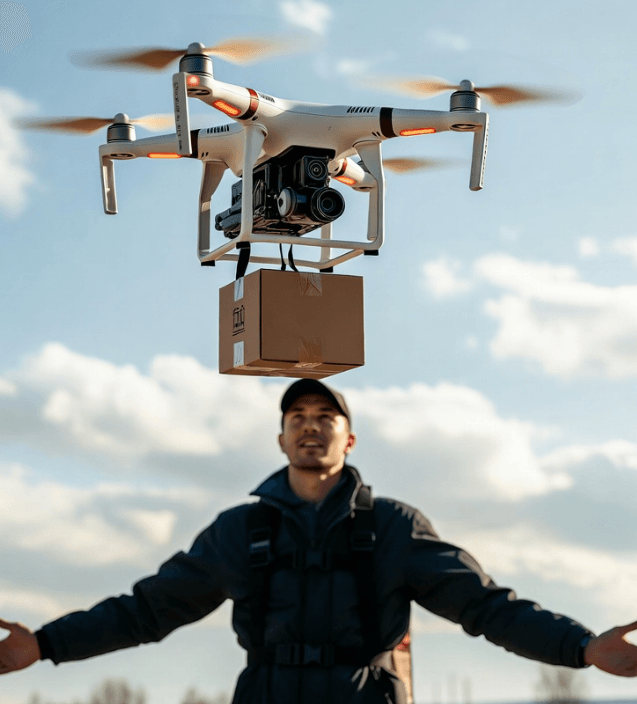
Imagine the following scenario: A security inspection drone is flying along a predetermined route under a viaduct to inspect the bridge structure. Suddenly, the GNSS signal is lost, the aircraft begins to drift uncontrollably, and it nearly collides with the pier. Meanwhile, an e-commerce delivery drone is making its way through a city canyon surrounded by skyscrapers. As it prepares to deliver a parcel, the satellite signal is blocked by buildings, resulting in positioning failure and unstable hovering, making precise landing impossible—this is the common "signal black hole" problem in urban low-altitude flight.
In urban scenarios such as city canyons, under bridges, and viaduct areas, the GNSS (Global Navigation Satellite System, including GPS) signal frequently fails due to two major causes: First, the multipath effect occurs when hard surfaces such as tall buildings and bridge structures reflect satellite signals, resulting in multiple delayed signals and a sharp increase in positioning error. Second, signal blockage occurs when reinforced concrete completely blocks satellite signals, resulting in "satellite loss" and the drone losing its navigation reference. This poses a deadly safety risk for urban security patrols and low-altitude e-commerce deliveries, both of which require high precision and stability.
Millimeter-wave radar is the only stable sensing source in GNSS-denied environments (GPS-denied environments). It essentially resolves the navigation issues in urban low-altitude signal black holes by giving drones "reliable eyes and a measuring ruler" through its active sensing capability, anti-interference performance, and all-weather operation.
Millimeter-wave radar technology is the fundamental logic behind solving urban UAV signal black holes.
Millimeter-wave radar is the preferred solution for urban canyon drone radar due to its distinct technical principles and advantages, which are completely independent of GNSS reliance.
-
Active Perception: "autonomous navigation" without satellites
Millimeter-wave radar uses high-frequency electromagnetic waves at 30-300 GHz and reflected echoes to calculate target distance, speed, and angle without the need for satellite signals. Even when GNSS is completely lost in a building canyon, the radar can still scan surrounding structures such as buildings and bridges, providing real-time positioning data to assist drones in maintaining attitude and stable flight.
-
Designed for complex urban environments, with high precision and anti-interference.
Millimeter-wave radar uses Frequency Modulated Continuous Wave (FMCW) technology to achieve centimeter-level distance accuracy and velocity resolution as low as 0.067 m/s. It is capable of identifying narrow corridors between buildings as well as steel viaduct structures. More importantly, millimeter waves can penetrate rain, fog, and dust unaffected by lighting conditions, ensuring consistent performance even during nighttime security patrol missions or harsh weather delivery flights. This prevents the performance degradation observed in vision sensors and LiDAR in extreme environments.
-
Core Capability Path: From Dynamic Obstacle Avoidance to Environmental Modeling
Millimeter-wave radar creates a comprehensive perception system using four key technical methods to address drone signal black hole flight challenges:
High-Precision Environmental Modeling: Uses electromagnetic waves to generate high-resolution point clouds, maps 3D obstacle contours, extracts corner and plane features, and creates a real-time environment model.
Autonomous Localization and Navigation: Uses the Doppler effect to measure relative motion, dead reckoning with IMU data, and feature matching with pre-stored maps to achieve no-GNSS positioning.
Dynamic Obstacle Avoidance and Path Planning: Detects obstacle distance, speed, and direction in real time, predicts collision risk, and automatically adjusts flight paths to avoid buildings and bridge piers.
Anti-Interference and All-Weather Capability: Immune to lightning and weather conditions and employs algorithms to suppress electromagnetic interference, ensuring accuracy.
Scenario-Based Solutions: Specific Applications in Three Urban Low-Altitude Signal Black Hole Environments
Different urban low-altitude signal black hole environments exhibit distinct characteristics. Millimeter-wave radar offers targeted solutions that perfectly meet the needs of security patrol and e-commerce delivery:
-
Urban Canyons: Double Assurance of Obstacle Avoidance and Path Planning
Dense high-rise areas suffer not only from severe signal interference but also from protruding balconies, air-conditioning units, and billboards. Delivery drones avoid lateral protrusions to ensure safe passage across city canyons, while security drones maintain stable flight through gaps between buildings thanks to millimeter-wave radar's 360-degree omnidirectional scanning, which detects static obstacles in real time and creates avoidance paths when combined with AI planning algorithms.
-
Under Bridges/Viaducts: Core support for precise positioning and attitude stability.
Under-bridge zones have almost complete GNSS blockage and contain complex structures like steel frames and suspended pipes. To achieve high-precision relative positioning, millimeter-wave radar compares scanned structural features to pre-stored 3D maps via terrain matching. Working with the IMU, it continuously outputs location and velocity values, preventing drones from drifting or crashing—completely meeting the needs of security inspection under viaducts.
-
Landing areas: final defense for centimeter-level precision delivery.
Landing zones for last-mile e-commerce delivery are typically fraught with signal issues. Millimeter-wave radar scans downward for centimeter-level height and positioning accuracy, ensuring stable vertical descent, avoiding ground collisions or unstable hovering, and enabling precise parcel delivery.
Real-World Enablement: Optimal Operations for Security Patrol and Delivery
-
Urban security patrol: Dynamic target identification and full-area coverage.
Security patrols necessitate "zero-blind-spot monitoring," which is frequently required in areas with poor GNSS signal (under bridges and elevated roads). Millimeter-wave radar provides stable navigation and obstacle avoidance, allowing drones to fly near structures while detecting suspicious moving objects such as people and vehicles. It achieves tracking and high-definition imaging through the use of cameras. Radar directs drones to track moving targets in blind spots beneath viaducts, compensating for traditional surveillance flaws.
-
Low-Altitude E-Commerce Delivery: All-Weather Stability and Accurate Drop-Off
E-commerce delivery requires high efficiency and security. Millimeter-wave radar improves operations in three ways: all-weather capability, long-range detection combined with fine near-range obstacle avoidance, and precise landing to overcome the final 10-meter positioning challenge.
Technology Fusion: Creating A More Reliable Perception System
To improve reliability, millimeter-wave radar is frequently combined with inertial and visual navigation in practical applications. For instance:
The Lingyun U15 UAV achieves long-duration navigation in GNSS-denied environments by combining millimeter-wave radar and MEMS IMU, with a navigation accuracy of more than 10 meters.
MIT's MiFly system calculates 6-DOF drone pose using dual-polarized millimeter-wave radar and IMU fusion, with a median localization error of 7.2 cm even in non-line-of-sight environments.
As the urban low-altitude economy expands rapidly, millimeter-wave radar will evolve further: smaller chips and lower costs will drive it into consumer UAVs as standard; AI optimization will improve radar environmental recognition capability.
Summarization
Millimeter-wave radar, with its active perception, high precision, anti-interference, and all-weather capabilities, completely solves drone flight challenges caused by GNSS loss in "signal black hole" regions such as city canyons, viaducts, and under-bridge areas. It is a "reliable partner" for urban security patrol, allowing for zero-blind-spot inspection, and a "core enabler" for low-altitude e-commerce delivery, ensuring precise drop-off. Millimeter-wave radar, as the primary solution for urban canyon drone radar, is redefining urban low-altitude flight safety and enabling the low-altitude economy to thrive.