






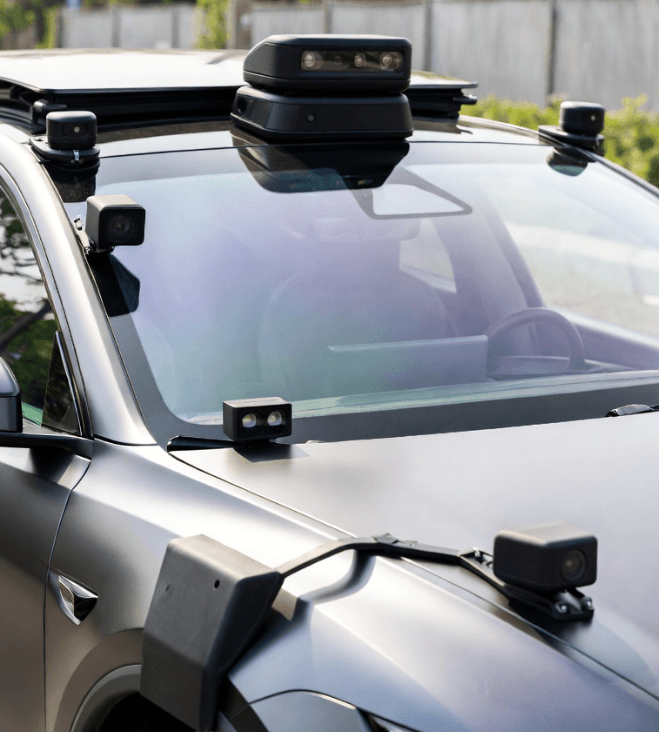
Overview: The Development of Multi-Sensor Integration
Multi-sensor fusion has become the standard method for obtaining dependable environmental awareness in contemporary autonomous driving, robotics, and intelligent perception systems. Although cameras and LiDAR (Light Detection and Ranging) are excellent at providing high-resolution spatial data and semantic recognition, they are still limited in some situations. With its distinct physical characteristics (wavelength 1–10 mm, frequency 30–300 GHz), millimeter wave radar (mmWave Radar) provides efficient compensation, guaranteeing stable detection even in situations where other sensors are scarce.
Perception systems can increase accuracy, dependability, and safety by integrating data from various modalities. The ensuing sections describe how mmWave radar improves system performance by working in tandem with LiDAR and cameras.
1. The Improvement of LiDAR Performance by mmWave Radar
1.1 Consistent Results in Unfavorable Weather
LiDAR uses laser pulses to create high-resolution 3D point clouds for accurate spatial mapping. However, laser beams are readily dispersed or absorbed in rain, fog, snow, or dust, producing sparse or noisy point clouds. On the other hand, mmWave radar waves can measure distance and speed accurately in low visibility situations because they can pass through dust, rain, and fog.
For instance, mmWave radar can cover several hundred meters, guaranteeing that cars or pedestrians are detected in time, whereas LiDAR may only detect nearby obstacles in dense fog.
1.2 Advantages of Cost and Deployment
High-end LiDAR (e.g., 64-line or higher) is costly, frequently costing tens of thousands of dollars, and its size restricts deployment flexibility. Compact, affordable, and well-developed, mmWave radar is simple to install on car grilles, sides, or rear sections to provide 360° coverage. This adaptability makes multi-sensor fusion systems affordable.
1.3 Quick Dynamic Object Recognition
Although LiDAR can identify both static and dynamic objects, multi-frame fusion is typically required for real-time tracking of rapidly moving targets, which increases computation and latency. mmWave radar quickly predicts object trajectories by using the Doppler effect to measure radial velocity directly (with an accuracy of up to 0.1 m/s) along with distance and angle data. This is particularly important on highways, helping to avoid obstacles or vehicles that are approaching quickly.
2. How Camera Systems Benefit from mmWave Radar
2.1 Robust Adaptability in Lighting
Although cameras are very sensitive to lighting, they are excellent at object classification and semantic recognition. Backlight, dynamic lighting (such as tunnel entrances and exits), and nighttime can all lower image quality and result in missed or inaccurate detections. mmWave radar can provide reliable object detection and tracking data around-the-clock and is light-independent.
For instance, radar can detect pedestrians at night by first locating the target and then guiding the camera to confirm it, increasing accuracy in low light.
2.2 Precise Measurement of Distance and Depth
Stereo cameras increase depth but need extra hardware, while monocular cameras rely on algorithms for depth estimation that have limited accuracy. mmWave radar achieves centimeter-level precision by directly measuring angle and distance using time-of-flight (TOF). Accurate depth maps and environment modeling are enhanced when radar and camera data are combined, particularly in complex or long-range situations.
2.3 Detection of Small Objects and Occlusion
When objects are partially obscured (by cars, leaves, or pedestrians, for example) or for small, far-off targets (like bicycles), cameras may malfunction. In crowded urban settings, radar beams can reduce blind spots by detecting small objects and penetrating some non-metallic materials. They can also identify hidden targets behind occlusions.
3. mmWave Radar's Benefits for Multi-Sensor Integration
-
All-weather dependability: Consistent performance in dust, snow, rain, and fog.
-
Low cost and scalability: Allows for full coverage through multi-point deployment.
-
Accurately tracks dynamic obstacles with real-time speed and distance measurements.
-
Complementary to other sensors: Offsets the light dependence of cameras and the weather sensitivity of LiDAR.
In reality, LiDAR, camera, and radar data are combined into a single perception model using fusion frameworks (such as the Kalman filter or deep learning techniques). LiDAR provides high-resolution spatial data, cameras offer semantic information, and radar guarantees redundant, dependable detection, all of which improve safety and decision-making.
4. Prospects for the Future: 4D mmWave Radar
The role of mmWave radar in multi-sensor fusion will be further strengthened with the advent of 4D imaging radar. Denser point clouds and object shapes are produced by 4D radar, which provides greater angular resolution and vertical dimensional information. This maintains all-weather reliability while bringing radar performance closer to LiDAR.
Summarization
In order to compensate for LiDAR and camera limitations in weather, lighting, depth estimation, and occlusion, mmWave radar is an essential part of multi-sensor fusion systems. It is essential to contemporary autonomous vehicles and intelligent robotics due to its high accuracy, dependability, and affordability. Radar technology will play an even more important complementary role in fusion systems as it develops, offering strong and dependable perception.
FAQs
Q1: Can LiDAR be completely replaced by mmWave radar?
A1: Rather than taking the place of LiDAR, mmWave radar enhances it. While radar guarantees reliable detection in challenging circumstances, LiDAR offers high-resolution 3D mapping.
Q2: How does radar enhance the performance of cameras at night?
A2: Radar can locate objects at night, directing the camera to focus on targets and enhancing the precision of low-light detection.
Q3: Can all kinds of vehicles use millimeter-wave radar?
A3: It is appropriate for consumer cars, commercial fleets, and robotics due to its small size and affordable price.
Q4: How will mmWave radar be used in multi-sensor fusion in the future?
A4: Denser point clouds and higher resolution from 4D radar will improve fusion accuracy and give autonomous systems richer environmental data.