






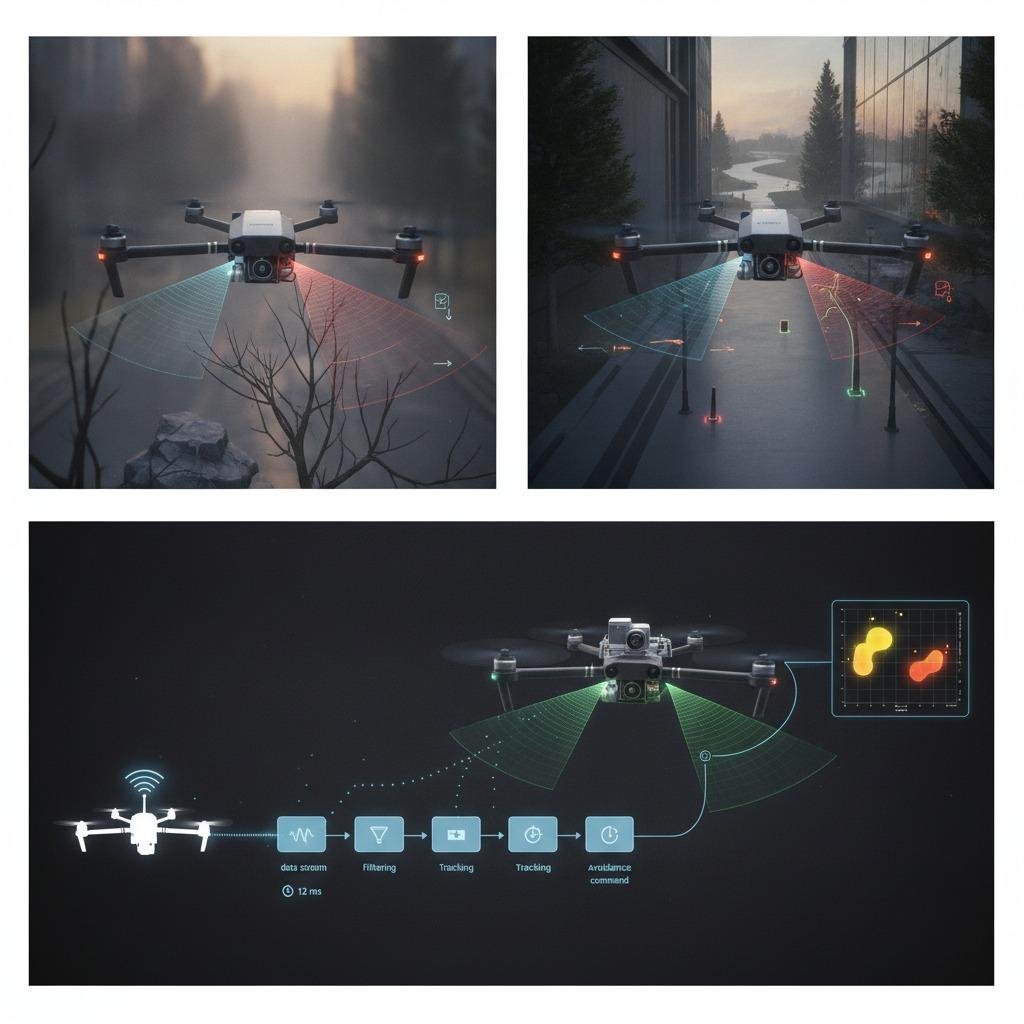
Why mmWave radar keeps showing up in drone design reviews
For teams working on autonomous flight, mmWave radar has become hard to ignore. Cameras can be blinded by glare, dust, fog, and low light. Ultrasonic sensors are compact, but they do not always give the spatial detail engineers want at speed. That gap is where radar earns its place: it can support obstacle detection when the environment is messy and the drone cannot afford hesitation.
That matters because drone collision avoidance is no longer a nice-to-have feature reserved for premium platforms. It is a design decision that affects safety, flight envelope, payload integration, and the amount of software work needed to make the vehicle trustworthy. The trade-off is not simple. A sensor may look good on paper and still fail the weight, power, or processing budget once it is placed on a real airframe.
What mmWave radar is good at, and where it is not
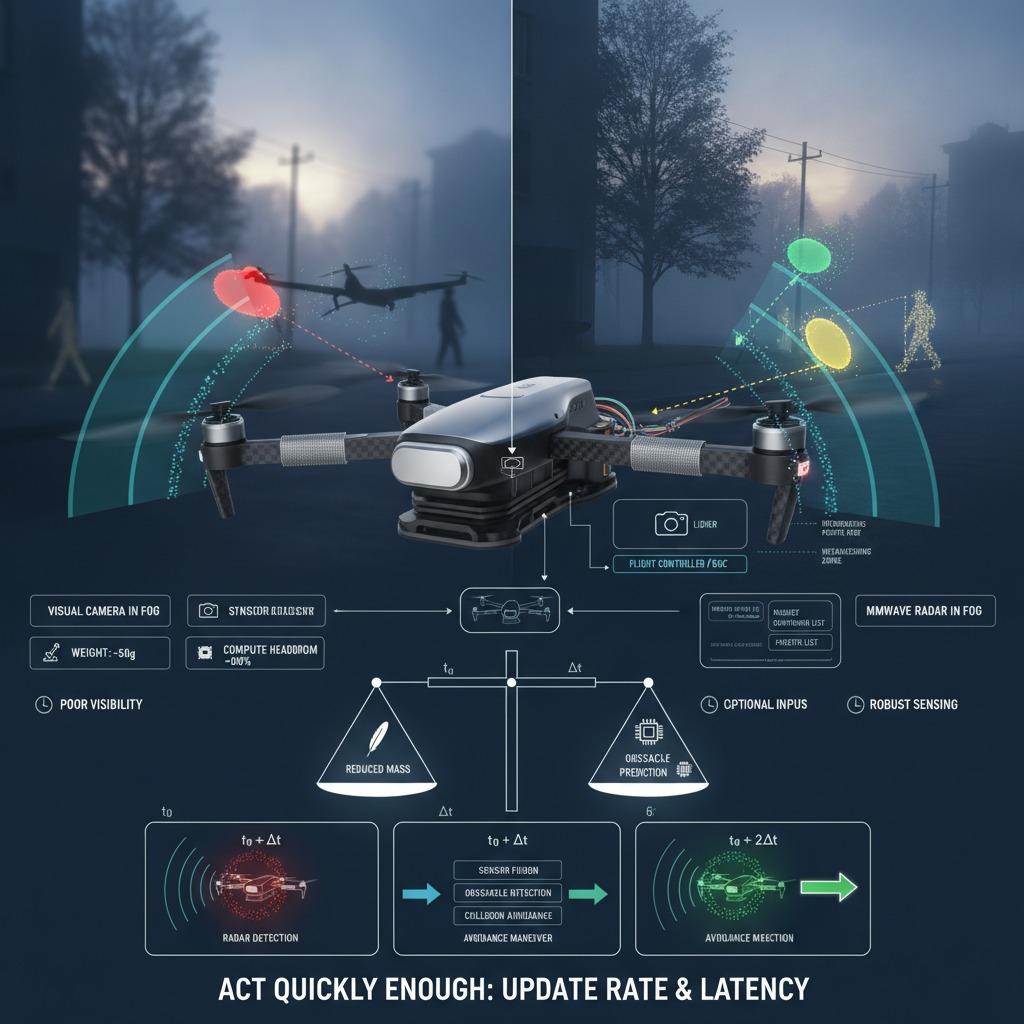
Millimeter-wave radar operates at high frequencies and is valued for sensing in conditions that make optical systems struggle. In practical terms, it can help a drone detect objects without depending on visible light. That is the headline advantage, but the more useful point is that radar gives the engineering team another layer of environmental awareness when the mission cannot wait for perfect conditions.
It is also worth being realistic. Radar is not a magic replacement for vision. It usually needs more interpretation than a camera image, and the output is rarely as intuitive for operators or product managers. In many systems, radar works best as part of a sensor stack rather than a lone answer.
Quick reference: how the trade-offs usually look
Lightweight sensor priorities
For drone projects, weight is never an abstract specification. A Lightweight sensor can protect flight time, reduce motor load, and keep the payload architecture manageable. But light hardware that creates noisy data or demands heavy compute can still be expensive in the wrong way. Engineers often have to decide whether the mass savings are real once shielding, mounts, wiring, and processing are counted.
Range-Doppler mapping and what it buys you
One of the more useful radar outputs is Range-Doppler mapping, which helps separate distance and relative motion. For moving platforms, that distinction is not academic. A drone trying to avoid another aircraft, a tree line, or a wire needs to know not just that something is present, but whether it is approaching, stationary, or crossing the flight path. The better the interpretation of that data, the more reliable the autonomy layer becomes.
Obstacle detection is the real buying question
Many teams start by asking which sensor is best. A better question is what kind of obstacle detection the drone actually needs. Indoor navigation, low-altitude inspection, perimeter monitoring, and last-meter landing assistance all ask different things of the sensor. One mission may need short-range precision; another may value broader awareness more than pinpoint measurement.
For example, a drone operating near metal structures or in variable weather may benefit from radar because the sensing modality is less dependent on ambient light. But if the job is to distinguish fine visual details, radar alone is unlikely to be enough. That is where platform architecture matters more than component enthusiasm.
How to think about drone collision avoidance in system terms
Drone collision avoidance is not just a sensor selection exercise. It is a system problem that includes detection range, update rate, processing latency, mounting location, interference management, and software logic. A radar module may be technically capable of detecting hazards, but if the flight controller cannot act on the data quickly enough, the practical result is disappointing.
Buyers should also watch the integration burden. Some sensors are described as compact or easy to add, yet they still require careful tuning, calibration, and filtering. That extra work is normal, but it should be visible in the project plan from the start rather than discovered during late-stage flight testing.
Common mistakes engineers and sourcing teams still make
One common mistake is treating radar as a drop-in substitute for a camera or lidar unit. It is not. Each modality has its own strengths, and the integration logic should respect that.
Another frequent issue is underestimating how the sensor performs on a moving drone. Airframe vibration, mount position, and surrounding electronics can all affect data quality. Even a well-chosen module can produce less useful outputs if it is placed carelessly or paired with weak signal processing.
There is also a procurement trap: choosing a sensor based only on headline range. Range matters, but so do field of view, motion detection behavior, power draw, and compatibility with the rest of the stack. A long-range number does little good if the sensor cannot support the flight profile the customer actually needs.
Practical buyer advice before you commit
If you are sourcing for a drone platform, start with the mission. Define the environments, the obstacle types, the flight speeds, and the latency budget. Then ask whether radar is meant to lead the sensing stack or support it. That distinction will shape both cost and integration complexity.
For engineering teams, it helps to test with realistic targets, not just clean lab setups. For sourcing managers, it helps to ask vendors how the module behaves in mixed conditions and what kind of software effort is typically required. Those questions may sound basic, but they reveal whether the product fits a production program or only a demo.
FAQ: a few questions teams ask late in the project
Can mmWave radar replace cameras?
Usually no. It is better viewed as complementary sensing, especially when visibility is poor or motion detection matters.
Is it always the best choice for collision avoidance?
No. The best choice depends on airframe limits, environment, compute resources, and the quality of the autonomy software.
Why do teams keep considering it anyway?
Because it solves a real operational problem: sensing in conditions where optical tools may not be reliable enough.
A sensible next step
If your team is evaluating sensing options for autonomous flight, start by mapping the mission requirements against the sensing stack you already have. From there, compare mmWave radar against the weight budget, processing headroom, and obstacle detection needs of the platform. That comparison usually makes the right direction clearer than a spec sheet ever will.