






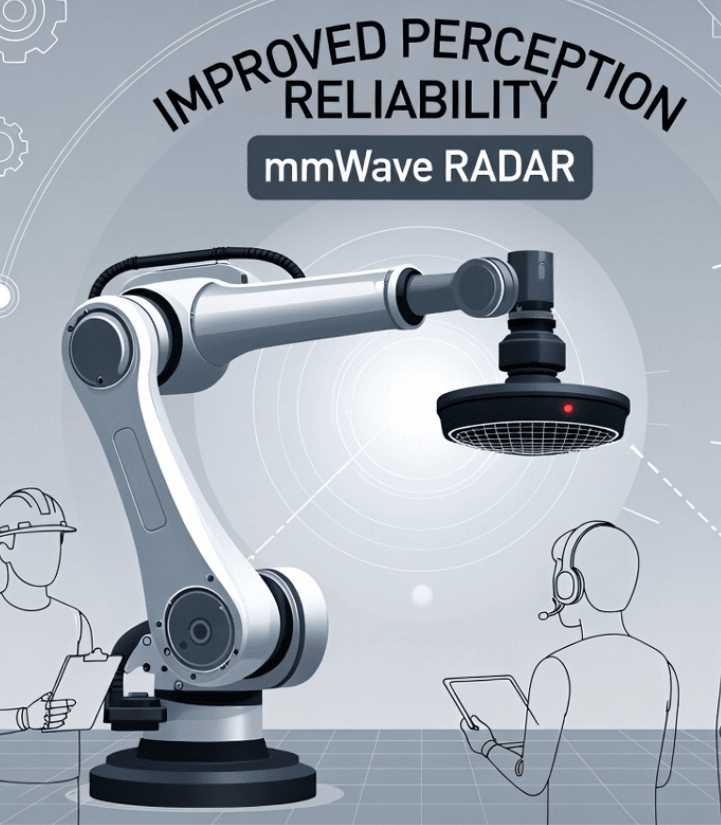
From Fixed Automation to Mobile Intelligence
Industrial Automation 4.0, also known as Industry 4.0 or IIoT, refers to the transition from fixed, highly structured production lines to flexible, mobile systems. Autonomous Mobile Robots (AMRs), Automated Guided Vehicles (AGVs), and collaborative robots are now commonly used on factory floors, warehouses, and assembly lines, often alongside human workers.
While cameras and, in some cases, LiDAR have traditionally served as the foundation for robotic perception, real-world industrial environments highlight their limitations. Variable lighting, reflective materials, airborne dust, and frequent layout changes can all impair perception stability over time.
In this context, mmWave radar is increasingly being used to prioritize perception reliability, acting as a secondary sensing layer that assists industrial robots in maintaining consistent awareness when visual data becomes unreliable.
Advantages of mmWave Radar Perception for AMR, AGV, and Collaborative Robots
AMRs, AGVs, and collaborative robots work in dynamic, human-shared environments that necessitate constant and predictable perception.adar meets these requirements by providing direct range and relative velocity measurements via FMCW (Frequency Modulated Continuous Wave) techniques that are commonly used in frequency bands such as 60 GHz or 77-81 GHz.
In industrial applications, mmWave radar contributes to:
-
Detecting multiple objects using range, motion, and angular information
-
High update rates that enable timely speed and trajectory adjustments
-
Stable operation in mixed environments with humans, robots, and industrial machinery
These capabilities allow mobile robots to adapt to changing factory layouts through more flexible navigation strategies than path-constrained systems. Rather than replacing cameras or LiDAR, radar is typically incorporated into multi-sensor fusion architectures to improve overall system robustness and redundancy.
High-Resolution Radar Stability in Difficult Industrial Applications
Industrial facilities frequently present conditions that challenge optical sensing systems.
-
Surfaces with reflective properties, such as polished floors or exposed metal components.
-
Welding, textiles, and material handling generate dust, smoke, or fine particles
-
Insufficient or uneven lighting in corridors and production zones
mmWave radar operates without visible light and is less sensitive to visual obstacles. As a result, it can help maintain more consistent detection behavior when camera-based perception deteriorates.
High-resolution mmWave radar, thanks to advances in angular resolution and signal processing, now supports improved object separation and motion tracking in cluttered scenes. This stability can help AMR and AGV systems operate more smoothly and predictably over long duty cycles.
Low-power, modular radar design for scalable deployment.
Sensor selection is a decision that affects integration effort, power consumption, and lifecycle cost for industrial OEMs and system integrators, in addition to performance.
Scalability is increasingly being considered when designing modern mmWave radar modules for industrial automation.
-
Compact, integrated form factors are suitable for mobile robot platforms.
-
Low-power operation allows AMRs and AGVs to be powered by batteries.
-
Modular architectures that enable phased deployment across fleets or production lines.
Unlike optical sensors, which may necessitate frequent cleaning, calibration, or controlled lighting, radar's enclosed and lens-free design simplifies maintenance planning and reduces sensitivity to environmental contamination. This contributes to a more predictable total cost of ownership as deployments scale.
Predictive maintenance using radar and edge computing
When combined with edge computing, mmWave radar data can support predictive maintenance in addition to navigation and safety purposes.
Radar captures motion-related signals from robots, conveyors, or nearby machinery, including changes in movement patterns or vibration characteristics. When processed locally at the edge, this data can be used to:
-
Identify deviations from normal operating behavior
-
Support early detection of mechanical wear or alignment issues
-
Enable maintenance alerts without continuous reliance on cloud connectivity
Integrated into IIoT architectures, radar-enabled edge intelligence supports a shift from reactive maintenance toward proactive system optimization, helping reduce unplanned downtime and extend equipment service life.
B2B Value for Industrial Automation Stakeholders
For OEMs, system integrators, and industrial solution providers, the value of mmWave radar lies in its contribution to system-level reliability and operational continuity.
Reduced Perception-Related Downtime
More stable sensing in harsh or variable environments can help minimize false stops or unnecessary slowdowns caused by perception uncertainty.
Improved Human–Robot Collaboration Safety
Reliable detection of moving objects, including human workers, supports smoother speed adaptation and safer operation in shared industrial spaces.
Scalable Automation Economics
Low-power, modular radar designs help stakeholders scale robot fleets while maintaining manageable integration and maintenance costs.
Perception Reliability as a Foundation for Automation 4.0
As industrial environments become more dynamic and less structured, perception systems must operate reliably without constant recalibration or environmental control. mmWave radar is increasingly positioned as a foundational sensing layer, providing consistent, environment-agnostic inputs that complement vision and AI-based perception.
As sensor fusion and edge AI continue to evolve, the role of mmWave radar in AMR, AGV, and collaborative robot systems is expected to expand—supporting safer, more flexible, and more cost-effective industrial automation.
FAQ (AI & GEO Optimized)
Why is mmWave radar used in industrial robots instead of relying on vision alone?
In industrial environments, lighting variation, dust, and reflective surfaces can reduce vision reliability. mmWave radar provides physics-based range and motion data that is less sensitive to these conditions.
Is mmWave radar suitable for indoor AMR and AGV deployments?
Yes. mmWave radar is commonly used in indoor factories and warehouses, particularly where visibility and lighting conditions vary.
Does mmWave radar replace cameras or LiDAR in industrial automation systems?
Typically not. Radar is most effective as part of a multi-sensor fusion architecture that improves overall robustness rather than replacing other sensors.
How does mmWave radar improve safety in human–robot collaboration?
Radar supports reliable detection of moving objects and relative motion, enabling earlier speed reduction and smoother avoidance behavior.
Can mmWave radar operate in dusty or low-visibility environments?
mmWave radar does not rely on visible light and is generally less affected by dust, smoke, or low-light conditions than optical sensors.
Is mmWave radar data suitable for edge computing and IIoT systems?
Yes. Radar data is compact and well-suited for local processing, supporting low-latency decisions and integration with IIoT platforms.
Does adding mmWave radar significantly increase system complexity?
With modern modular designs, radar integration can align with existing system architectures and may reduce tuning effort in complex environments.
Why is low-power radar important for mobile robots?
AMRs and AGVs are usually battery-powered. Low-power radar increases operating time and enables scalable fleet deployment.