






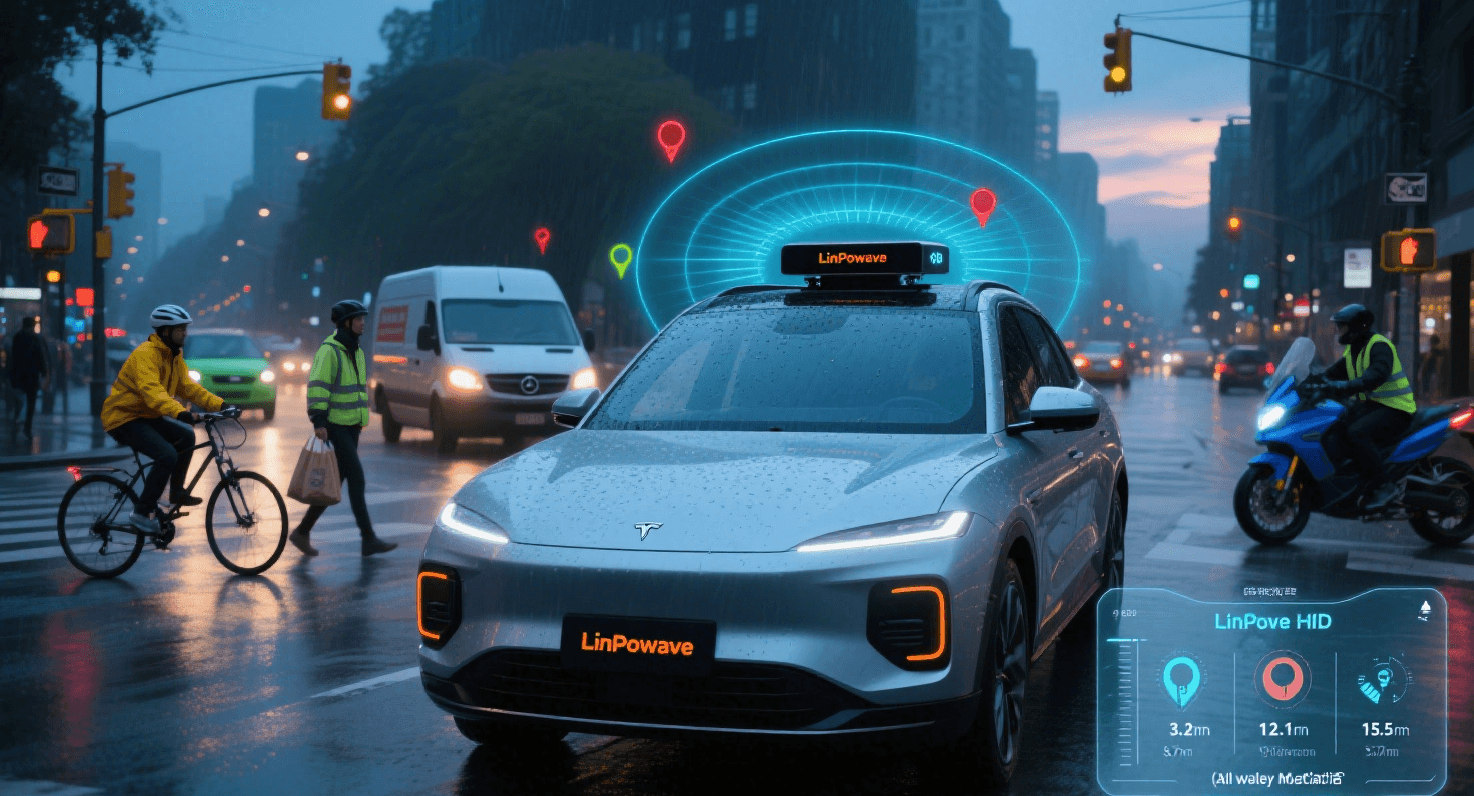
Millimeter-Wave Radar in Smart Traffic Systems: Enhancing Safety and Efficiency
Introduction
As urban populations grow, traffic congestion and pedestrian safety have become critical challenges for city planners. Traditional monitoring systems, such as cameras and induction loops, often struggle with accuracy, environmental constraints, and maintenance costs. Millimeter-wave (mmWave) radar offers a revolutionary solution for smart traffic systems, providing precise detection of vehicles, cyclists, and pedestrians under all weather and lighting conditions.
Linpowave, a leading mmWave radar technology provider, delivers compact and modular radar solutions that integrate seamlessly into intelligent transportation infrastructures, supporting safer and more efficient urban mobility.
The Challenges in Urban Traffic Monitoring
-
Adverse Weather and Low Visibility
Rain, fog, snow, and nighttime conditions reduce camera effectiveness. mmWave radar penetrates these conditions, offering reliable detection regardless of external factors. -
Mixed Traffic Flow
Urban roads often include vehicles, bicycles, and pedestrians sharing space. Distinguishing between these moving objects is essential for collision prevention and adaptive traffic management. -
Data Volume and Real-Time Processing
Conventional video systems generate large amounts of data requiring heavy processing. Radar provides compact and precise information about range, velocity, and movement trajectories, reducing computational load while maintaining high accuracy.
Advantages of mmWave Radar for Smart Traffic
-
High-Resolution Multi-Target Detection
Linpowave’s radar modules can simultaneously track multiple objects, differentiating pedestrians, vehicles, and cyclists even in crowded urban environments. -
Real-Time Speed and Trajectory Analysis
Radar sensors measure both distance and velocity, enabling predictive traffic control and early collision warnings for vehicles and pedestrians. -
All-Weather Operation
Unlike cameras, radar performs reliably in poor lighting, heavy rain, or fog, making it ideal for continuous traffic monitoring and safety systems. -
Compact and Modular Deployment
Linpowave’s radar boards can be integrated into streetlights, traffic signals, or roadside units, allowing scalable deployment across the city without extensive infrastructure modifications.
Real-World Applications
-
Intersection Safety
Radar detects approaching vehicles and pedestrians, adjusting traffic signal timings to minimize collisions and enhance traffic flow. -
Speed Monitoring and Enforcement
Continuous radar tracking allows authorities to monitor vehicle speeds accurately, even under low-visibility conditions, improving enforcement efficiency. -
Pedestrian Crossing Protection
Smart crosswalks equipped with radar can detect pedestrians and activate warning lights or traffic signals, preventing accidents in busy urban areas. -
Integration with Autonomous Vehicles
mmWave radar can communicate with connected vehicles, providing early warnings of obstacles and contributing to cooperative traffic management systems.
Linpowave’s Contribution
Linpowave specializes in high-performance radar modules designed for smart city and transportation applications. Key features include:
-
77 GHz radar for long-range detection, capable of tracking vehicles up to 200 meters.
-
60 GHz radar for short-range detection, ideal for pedestrian monitoring and micro-mobility applications.
-
Customizable signal processing algorithms for precise multi-target tracking.
By providing robust and scalable radar solutions, Linpowave helps cities implement safer, more intelligent traffic systems that reduce accidents, optimize traffic flow, and enhance the overall urban experience.
Conclusion
Millimeter-wave radar is rapidly becoming an essential technology for smart traffic systems. Its ability to provide accurate, real-time detection of vehicles and pedestrians in all conditions makes it indispensable for modern urban mobility. Linpowave’s innovative radar solutions enable cities to create safer, more efficient, and future-ready transportation networks, ensuring that traffic management evolves alongside urban growth.