






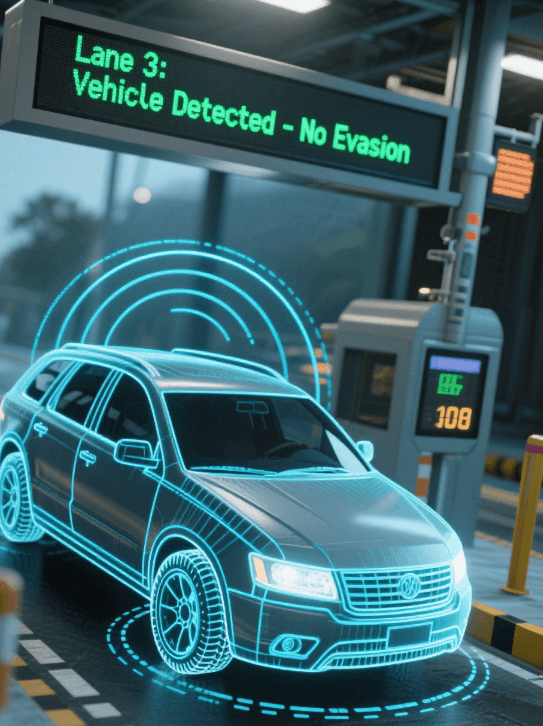
Tackling Lane Merging, Toll Evasion, and Efficiency Challenges
As intelligent transportation systems evolve, toll station management has become a critical bottleneck. The challenge is clear: how to maintain traffic efficiency while ensuring accurate and fair toll collection. For years, toll operators have struggled with vehicle separation errors, toll evasion, and reduced detection accuracy during adverse weather.
Now, millimeter-wave (mmWave) radar is emerging as a game-changing technology that addresses these long-standing problems. With its high precision, all-weather performance, and robustness in complex environments, radar is helping toll stations transition toward smarter, more reliable operations.
Limitations of Traditional Toll Station Detection Methods
For decades, toll stations have relied on inductive loops and video surveillance for vehicle detection and lane separation. While effective to some extent, these methods face notable shortcomings:
-
Inductive loops require heavy construction
Embedded in the pavement, loops are costly to install and difficult to maintain. Any malfunction requires lane closures and expensive repairs. -
Video cameras suffer from environmental interference
Recognition accuracy drops significantly at night, in rain, fog, or snow. License plate issues—such as dirt, damage, or intentional concealment—make toll evasion difficult to catch. -
Poor precision in vehicle separation
During peak hours, vehicles often pass in close succession (“tailgating”), which conventional systems fail to distinguish, leading to overcharging or undercharging.
These limitations highlight the urgent need for a more advanced and resilient sensing solution at toll stations.
Why Millimeter-Wave Radar Excels
Operating in the 77–81 GHz band, mmWave radar offers several unique advantages over legacy systems:
-
Accurate Vehicle Separation: Radar distinguishes multiple vehicles passing closely within the same lane, solving the “tailgating” problem.
-
All-Weather Operation: Works seamlessly in rain, fog, snow, or complete darkness, ensuring continuous tolling accuracy.
-
High Robustness: Less affected by environmental clutter or reflections, reducing false alarms and missed detections.
-
Flexible Deployment: Compact radar modules can be mounted on gantries, ceilings, or lane-side poles without major roadwork.
For example, Linpowave’s mmWave radar solutions support detection ranges from 0.4 m to 300 m with centimeter-level accuracy, making them highly suitable for toll station applications.
Key Applications and Scenarios
1. Lane Separation and Vehicle Counting
mmWave radar continuously tracks vehicle trajectories. Even when two cars pass a toll booth bumper-to-bumper, radar can distinguish them accurately, ensuring one vehicle equals one transaction.
2. Lane Merging and Violation Detection
Some drivers attempt to evade tolls by merging into a paid lane behind another vehicle. While cameras often miss this due to angle or lighting limitations, radar detects speed vectors and movement patterns to identify improper merging.
3. Toll Evasion and Overload Detection
By integrating radar with video and AI analytics, operators can identify abnormal vehicle behavior such as toll evasion, illegal merging, or overloaded trucks. Pilot projects abroad have already demonstrated radar’s ability to measure axle count and vehicle size, further improving billing accuracy.
4. Traffic Efficiency Optimization
Real-time traffic flow data from radar enables toll operators to adjust lane assignments, signal control, and barrier timing, reducing congestion during rush hours.
For industry-grade deployments, Linpowave’s product portfolio offers radar models tailored for both vehicle detection and smart tolling infrastructure.
Technology Integration and Future Trends
Toll station management is moving toward multi-sensor fusion, where radar plays a central role:
-
Radar + Video Fusion: Cameras handle license plate recognition, while radar ensures accurate vehicle separation.
-
Radar + ETC Systems: Radar validates the physical presence of vehicles, preventing fraudulent ETC transactions.
-
Radar + V2X Communication: As vehicle-to-infrastructure (V2X) expands, radar will act as a reliable perception node, feeding real-time data into cooperative traffic systems.
The International Road Federation (IRF) envisions tolling systems evolving toward “seamless, intelligent, and integrated” operations. mmWave radar is widely recognized as a cornerstone technology for this transition.
Economic and Social Benefits
-
Lower Maintenance Costs: No need for frequent road excavation or sensor replacement.
-
Fair and Transparent Tolling: Effectively prevents toll evasion, ensuring stable highway revenue.
-
Improved User Experience: Reduces disputes caused by incorrect tolling or mischarges.
-
Enhanced Safety: Detecting vehicle flow accurately helps prevent rear-end collisions at toll plazas.
In the long run, mmWave radar is not just a detection tool but a foundational sensing technology for the next generation of smart highways.
Conclusion
The application of mmWave radar in toll stations goes far beyond replacing legacy systems—it redefines the future of tolling management. By solving tailgating, lane merging, and toll evasion challenges, radar ensures both operational efficiency and revenue accuracy.
With the continuous integration of ETC, V2X, and intelligent transportation platforms, mmWave radar will play an increasingly vital role in shaping seamless, automated tolling systems.
To explore mmWave radar products designed for intelligent tolling and highway applications, visit Linpowave’s product page.
Frequently Asked Questions (FAQ)
Q1: Can radar completely replace video cameras?
A1: Not recommended. The best approach is radar + video fusion: radar provides precise separation, while cameras identify license plates.
Q2: Will radar misjudge vehicles in heavy traffic?
A2: Modern MIMO radar can track multiple vehicles simultaneously, with significantly lower error rates compared to conventional video systems.
Q3: Is radar deployment too costly?
A3: Compared to loop replacement and repeated roadwork, radar is cost-effective. Its flexible installation and low maintenance reduce long-term operational costs.
Q4: Will radar become standard in all toll stations?
A4: The trend is undeniable. Future tolling systems will integrate radar with ETC and cameras to build a reliable, intelligent tolling ecosystem.