






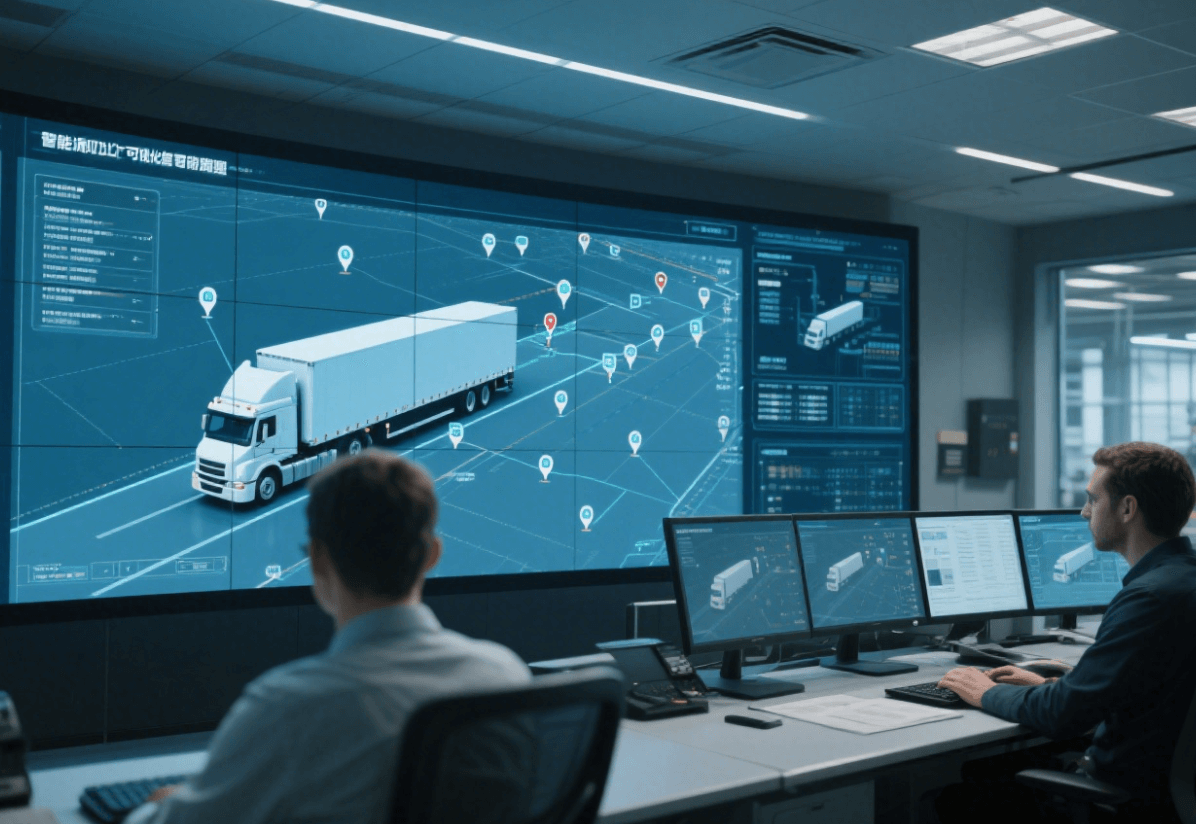
Accurate Vehicle Localization and Dispatching in Complex Metal Environments
In global ports, container yards rely heavily on trucks to transport and transfer goods. With the rise of automated terminals and smart ports, one critical challenge has emerged: how to achieve accurate truck positioning and efficient dispatching in complex metal environments.
Traditional positioning methods such as GPS or BeiDou work well in open areas. However, in yards filled with stacked metal containers, gantry cranes, and heavy machinery, satellite signals are often blocked or reflected. This results in reduced positioning accuracy or even “drifting.” In contrast, millimeter-wave (mmWave) radar, with its strong anti-interference capability, all-weather performance, and centimeter-level accuracy, is becoming a key sensing technology for smart ports.
For example, at Shanghai Yangshan Deep-Water Port, one of the world’s most advanced automated terminals, engineers are already exploring fusion solutions that integrate GPS, LiDAR, and mmWave radar to improve truck positioning and operational safety.
Challenges in Container Yard Environments
-
Severe Metal Reflections: Large metal surfaces create multipath propagation, making conventional wireless signals unstable.
-
High Environmental Dynamics: Trucks, cranes, and reach stackers move constantly, complicating localization and route planning.
-
24/7 Operations: Ports operate around the clock, often in rain, fog, or low-light conditions, requiring systems that remain reliable in poor visibility.
These challenges highlight the limitations of relying solely on satellite-based positioning or camera-based vision systems.
Why mmWave Radar Excels
Operating in the 77–81 GHz band, mmWave radar provides distinct advantages:
-
Resilience to Interference: Radar can differentiate between real targets and multipath reflections caused by metal surfaces.
-
High-Precision Localization: With FMCW and MIMO technologies, mmWave radar achieves centimeter-level accuracy.
-
All-Weather Operation: Performance is unaffected by darkness, fog, or heavy rain.
-
Object Classification: Radar detects trucks, personnel, and obstacles—data that supports both dispatching and safety management.
Linpowave, for example, has developed compact mmWave radar solutions for smart transportation, which can be adapted for container yards to deliver reliable detection even in highly reflective metal environments.
Application Scenarios in Container Yards
-
Truck Positioning: Radar sensors track truck positions in real time, avoiding blind spots and false detections.
-
Intelligent Dispatching: When integrated with yard management platforms, radar data supports optimized route planning, reducing waiting times and boosting throughput.
-
Collision Avoidance and Safety Monitoring: Radar provides early warnings for vehicles or workers in congested areas, minimizing accident risks.
-
Support for Autonomous Trucks: As an essential perception layer, mmWave radar enables unmanned container trucks to operate safely and efficiently.
For operators seeking scalable solutions, Linpowave’s product portfolio offers multiple radar models designed for logistics, automotive, and infrastructure applications.
Industry Outlook
Several ports are now piloting fusion systems combining mmWave radar, GPS, and LiDAR. Among these, mmWave radar has proven especially valuable in overcoming metal interference and weather-related challenges. According to the International Association of Ports and Harbors (IAPH), digitalization and automation are key strategies for future port competitiveness, and robust sensing technologies like radar will be at the center of this transformation.
Conclusion
As ports worldwide accelerate their shift toward automation and digital transformation, mmWave radar is evolving from its traditional automotive applications into port logistics. Its adaptability to complex metal environments and precise sensing capabilities make it a critical enabler of smart ports. Looking ahead, the integration of 5G and V2X communications with radar will further enhance truck dispatching, autonomous driving, and port safety supervision.
Frequently Asked Questions (FAQ)
Q1: Why does GPS perform poorly in container yards?
A1: Metal containers and cranes block and reflect satellite signals, causing significant positioning errors or “drifting.”
Q2: How does mmWave radar handle metal interference?
A2: By using MIMO antenna arrays and advanced algorithms, radar distinguishes multipath reflections from the actual target.
Q3: Can mmWave radar work alone for localization?
A3: In practice, radar is often combined with GPS, LiDAR, or UWB for higher accuracy and robustness. Linpowave offers such multi-sensor fusion solutions that improve reliability in demanding port environments.
Q4: Is deploying mmWave radar in ports cost-effective?
A4: With chip-level integration and mass adoption, radar costs have dropped significantly. Considering the safety improvements and operational efficiency gains, investment in radar-based solutions is highly cost-effective.