







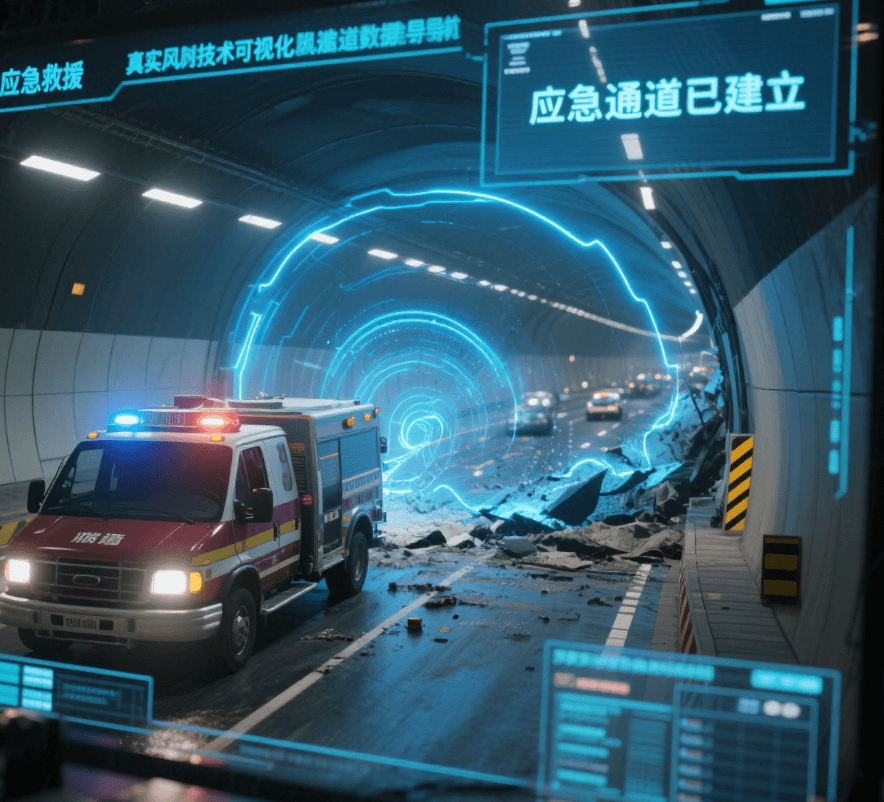
Enhancing Emergency Management and Preventing Secondary Accidents
Highway tunnels are critical infrastructures that ensure connectivity in mountainous, urban, and coastal regions. However, they also pose unique safety challenges. Accidents, stalled vehicles, or traffic congestion inside tunnels can quickly escalate into secondary disasters such as fires, pile-ups, or suffocation risks due to limited ventilation.
Traditional monitoring systems—primarily CCTV cameras and inductive loops—are widely deployed in tunnels, but their reliability decreases under complex tunnel conditions. In contrast, millimeter-wave (mmWave) radar is emerging as a crucial sensing technology, providing robust and precise detection of vehicles in tunnels to improve emergency response and operational safety.
Limitations of Conventional Tunnel Monitoring
-
CCTV Cameras
While cameras offer visual monitoring, they struggle in low-light or smoke-filled conditions. Dust, exhaust, or fire can easily obscure visibility, leaving critical events undetected. -
Inductive Loops
Embedded sensors detect vehicle presence but cannot provide detailed spatial information. They are also prone to wear and failure due to constant heavy traffic and challenging tunnel maintenance. -
Delayed Emergency Response
In accidents or breakdowns, detection delays often result in slow response times, allowing minor incidents to escalate into severe multi-vehicle collisions.
Given the high risks in tunnel environments, a more resilient sensing solution is urgently needed to protect lives and maintain efficient traffic flow.
Advantages of Millimeter-Wave Radar
Operating in the 77–81 GHz band, mmWave radar offers features that make it highly suitable for tunnel monitoring:
-
All-Weather and All-Visibility Operation
Radar is unaffected by lighting conditions, smoke, fog, or exhaust gases, ensuring reliable detection even during fires or heavy pollution. -
High Precision and Range
Capable of centimeter-level accuracy across detection ranges from 0.4 to 300 meters, radar can identify vehicle presence, movement, and speed with exceptional clarity. -
Real-Time Tracking
Radar continuously monitors vehicle trajectories, allowing operators to detect stalled or slow-moving vehicles instantly. -
Robustness Against Interference
Radar performance is not degraded by reflective tunnel walls or metal structures, overcoming multipath challenges common in enclosed spaces.
Solutions like Linpowave’s mmWave radar products have been specifically optimized for complex traffic environments, making them a strong fit for tunnel applications.
Key Applications in Tunnel Safety
1. Stalled Vehicle Detection
Radar can identify vehicles that stop unexpectedly inside tunnels, triggering instant alerts for traffic control centers. Early detection prevents chain collisions and secondary hazards.
2. Accident Recognition and Classification
By analyzing speed vectors and trajectories, radar can distinguish between normal traffic congestion and potential accidents, helping operators prioritize emergency response.
3. Congestion Monitoring and Dynamic Control
Real-time vehicle flow data enables adaptive traffic management, such as adjusting ventilation, variable message signs (VMS), or lane closures to manage congestion.
4. Integration with Emergency Systems
Radar can interface with fire alarms, ventilation systems, and automated incident detection platforms, ensuring coordinated emergency management.
5. Support for Autonomous Vehicles
As autonomous driving expands, radar will provide critical sensing in GPS-denied environments like tunnels, enabling safe navigation and collision avoidance.
Case Studies and Industry Trends
-
In Europe, several smart tunnel projects are testing radar-based monitoring to enhance incident detection rates and reduce response times.
-
In China, where expressways feature some of the world’s longest tunnels, authorities are exploring radar + AI analytics to detect accidents more accurately than traditional video systems.
-
According to the World Road Association (PIARC), integrating resilient sensing systems such as radar is key to future tunnel safety strategies.
These examples underscore a global trend: multi-sensor fusion systems where radar plays a central role.
Technical Integration for Tunnel Monitoring
-
Radar + Video Fusion: Cameras provide visual verification, while radar ensures reliable detection even in poor visibility.
-
Radar + IoT Sensors: Combined with air quality, fire, and ventilation sensors, radar enables comprehensive tunnel safety management.
-
Radar + V2X Communication: In the future, radar-equipped tunnels will communicate directly with vehicles, issuing real-time warnings about congestion or accidents ahead.
This integrated approach ensures not only vehicle detection but also holistic tunnel safety management.
Economic and Social Impact
-
Enhanced Safety: Early detection reduces casualties and prevents large-scale accidents.
-
Lower Maintenance Costs: Radar deployment avoids frequent roadwork required by inductive loops.
-
Increased Reliability: Unlike cameras, radar functions consistently across environmental conditions.
-
Future-Readiness: Supports the growing needs of autonomous driving and smart highways.
For tunnel operators, investing in radar is both a safety necessity and a cost-effective strategy for long-term traffic management.
Conclusion
Tunnels represent one of the most challenging traffic environments, where small incidents can quickly escalate into life-threatening disasters. Traditional monitoring methods are no longer sufficient to guarantee safety. Millimeter-wave radar, with its precision, resilience, and all-weather capability, provides a next-generation solution for vehicle detection and incident response in tunnels.
As smart transportation advances, radar will become a cornerstone of intelligent tunnel management, supporting everything from congestion control to emergency evacuation systems.
For more insights into mmWave radar applications in intelligent transportation, explore Linpowave’s solutions.
Frequently Asked Questions (FAQ)
Q1: Why are cameras unreliable in tunnels?
A1: Cameras are affected by low light, smoke, and dust. Radar overcomes these challenges by operating independently of visibility conditions.
Q2: Can radar replace inductive loops completely?
A2: Yes. Radar provides richer data with easier deployment and lower maintenance compared to loops.
Q3: How fast can radar detect stalled vehicles?
A3: Detection is instantaneous—radar continuously monitors motion vectors, flagging abnormal stops in real time.
Q4: Is radar integration expensive?
A4: Initial installation may cost more than cameras, but reduced maintenance, improved safety, and prevention of accidents make it highly cost-effective.
Q5: How does radar contribute to future smart tunnels?
A5: By integrating with IoT and V2X systems, radar will enable tunnels to “communicate” with vehicles, guiding traffic proactively and enhancing safety.