






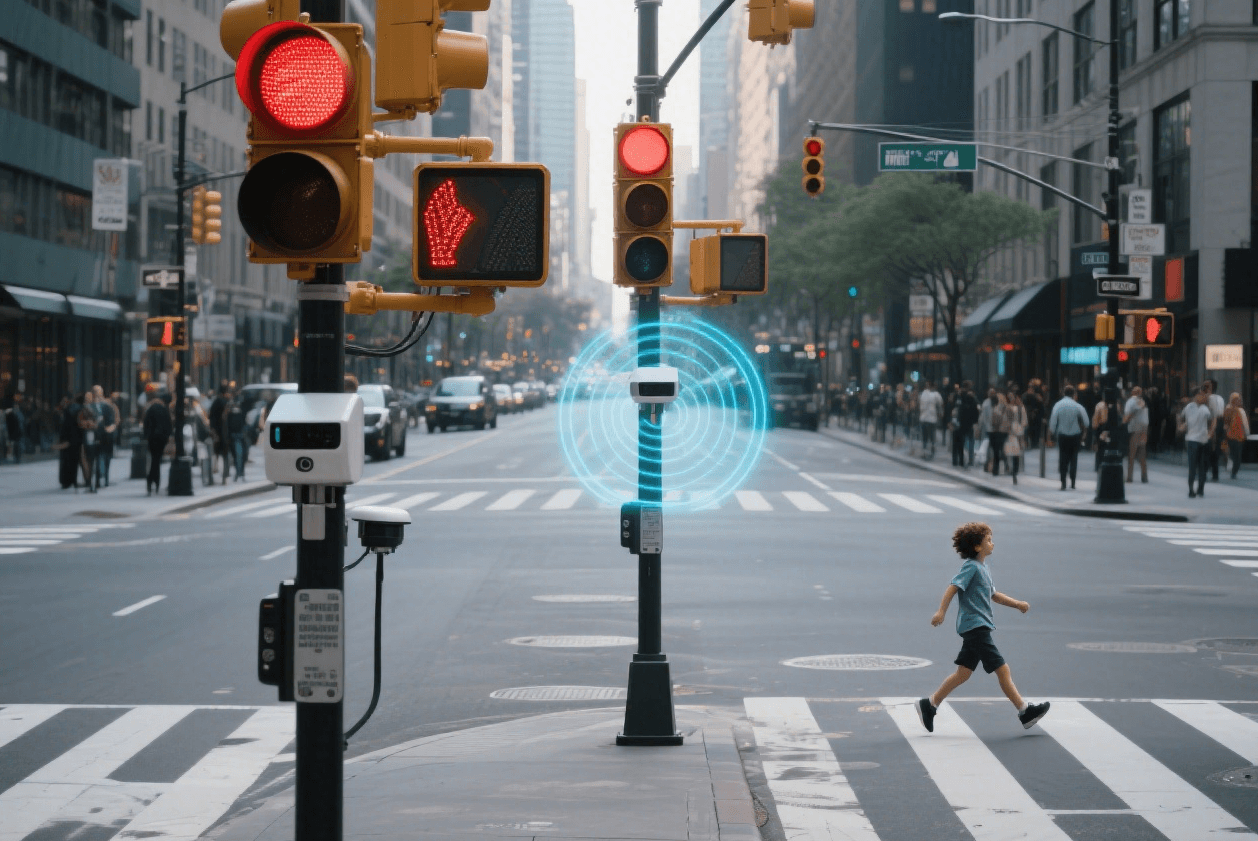
Smart Traffic Evolution: Multi-Lane Management Powered by mmWave Radar
Traffic congestion is one of the most pressing challenges faced by modern cities. According to global mobility studies, urban commuters spend hours every week stuck in traffic, costing billions of dollars in lost productivity and fuel consumption. Traditional traffic monitoring solutions—such as loop detectors, video cameras, and infrared sensors—often fall short in reliability, accuracy, and all-weather performance.
This is where millimeter-wave (mmWave) radar technology enters the scene. With its ability to deliver real-time, high-resolution, and lane-level detection, mmWave radar is transforming intelligent transportation systems (ITS) from reactive traffic monitoring to predictive traffic optimization. Companies like Linpowave, with years of expertise in radar system design and deployment, are pioneering solutions that enable multi-lane management at scale.
Why mmWave Radar Outperforms Conventional Traffic Sensors
Unlike cameras that rely on light or infrared sensors that are sensitive to weather conditions, mmWave radar uses electromagnetic waves in the 76–81 GHz band. This allows radar systems to:
-
Operate in all weather and lighting conditions – unaffected by fog, rain, snow, or direct sunlight.
-
Achieve lane-level accuracy – differentiating vehicles in adjacent lanes with minimal error.
-
Measure speed and direction precisely – essential for detecting lane changes, overtaking, and sudden braking.
-
Track multiple objects simultaneously – supporting real-time monitoring in dense, multi-lane traffic.
These advantages make mmWave radar particularly valuable for urban expressways, highway interchanges, and congested intersections where multiple vehicle interactions happen every second.
Multi-Lane Traffic Management: A Step Beyond Vehicle Counting
Traditional traffic sensors are often limited to vehicle counting or simple speed estimation. mmWave radar, however, enables multi-dimensional analysis, unlocking insights such as:
-
Lane-specific vehicle flow – knowing exactly how many vehicles occupy each lane and their speeds.
-
Queue length detection – identifying congestion build-up in real time.
-
Incident detection – recognizing stopped vehicles, accidents, or wrong-way driving.
-
Adaptive traffic light control – feeding accurate data to traffic signal systems for optimized green-light timing.
This level of granularity is critical for smart city traffic operations centers, where traffic flow data can be integrated into dynamic management systems to reduce congestion, improve road safety, and minimize environmental impact.
Case Example: Radar-Powered Urban Expressway Monitoring
Imagine a six-lane urban expressway during rush hour. A traditional camera system might struggle with vehicle occlusion, glare, or poor visibility. By contrast, Linpowave’s V200 radar can cover up to 200 meters, tracking multiple vehicles in adjacent lanes with high precision and minimal interference.
The system can automatically detect:
-
A vehicle making an abrupt lane change.
-
A slow-moving truck blocking faster lanes.
-
An accident or breakdown on the shoulder.
Such real-time insights allow traffic management centers to trigger automated alerts, re-route traffic, and even control variable message signs (VMS) to keep drivers informed instantly.
Integration with Smart Traffic Ecosystem
The true value of mmWave radar emerges when integrated into a connected ITS ecosystem.
-
With V2X communication: radar data can be transmitted to connected vehicles, warning them of hazards ahead.
-
With AI-powered traffic platforms: predictive models can anticipate congestion before it happens.
-
With cloud-based analytics: authorities can access historical data to plan road expansions, signal redesigns, or speed limit adjustments.
In this ecosystem, mmWave radar acts as the “eyes” of the traffic network, continuously feeding accurate and reliable data.
Why Linpowave?
Linpowave’s radars are designed with:
-
Compact modular design – easy deployment across highways and intersections.
-
Long-range detection – up to 200 meters for large-scale coverage.
-
Multi-object tracking – essential for real-world dense traffic scenarios.
-
Flexible SDK and API support – enabling integration with existing ITS platforms.
This makes Linpowave a trusted partner for cities aiming to move from reactive traffic management to proactive smart mobility solutions.
Conclusion
As urban populations continue to grow, multi-lane traffic management powered by mmWave radar will be a cornerstone of future mobility. From improving safety at complex intersections to enabling AI-driven traffic control, radar technology is paving the way toward smarter, safer, and more sustainable cities.
Linpowave’s cutting-edge radar solutions stand at the forefront of this transformation, ensuring that tomorrow’s roads are not only more efficient but also far more intelligent.