






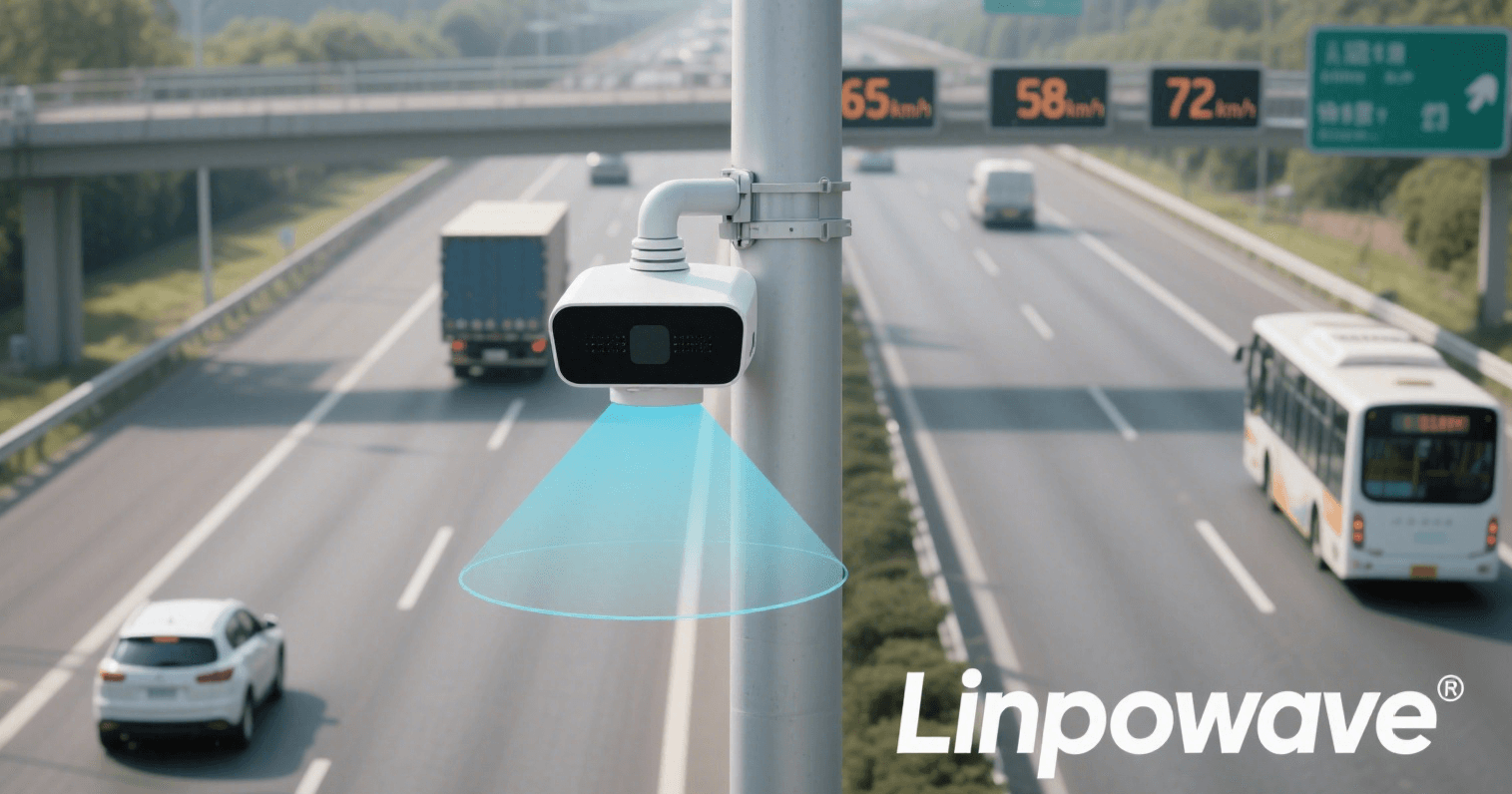
Millimeter-Wave Radar for Multi-Lane Vehicle Detection and Classification
Introduction
Urban roads are becoming increasingly congested, and accurate traffic monitoring is essential for improving safety, enforcing speed regulations, and optimizing traffic flow. Traditional camera-based systems often face challenges under poor lighting, weather conditions, or high traffic density. Millimeter-wave (mmWave) radar offers a robust alternative, providing real-time, high-precision vehicle detection and classification across multiple lanes.
Linpowave’s radar solutions are compact, high-resolution, and capable of integrating with existing traffic management systems to enhance urban mobility and safety.
Specific Applications in Multi-Lane Traffic
1. Highway Speed Enforcement
-
Real-Time Speed Measurement: Radar measures vehicle speed accurately across multiple lanes simultaneously, even under rain, fog, or nighttime conditions.
-
Lane-Specific Detection: Each lane can be monitored independently, preventing speed measurement errors caused by adjacent vehicles.
-
Integration with Enforcement Systems: Radar data can trigger automatic alerts or fines for overspeeding vehicles.
2. Vehicle Classification
-
Type Detection: mmWave radar distinguishes between motorcycles, cars, trucks, and buses based on size, speed, and radar cross-section.
-
Traffic Flow Analysis: Classifying vehicles helps traffic engineers analyze congestion patterns and optimize lane usage.
-
Accident Prevention: By identifying heavy vehicles, traffic systems can adjust lane guidance and prevent collisions in high-density traffic.
3. Adaptive Traffic Control
-
Signal Timing Optimization: Radar provides real-time vehicle counts per lane, enabling adaptive traffic lights to reduce congestion.
-
Dynamic Lane Management: Detecting vehicle type and density allows authorities to adjust lane allocation dynamically, e.g., opening HOV lanes during peak hours.
-
Incident Detection: Radar identifies stopped or slow-moving vehicles in real time, allowing rapid response to accidents or breakdowns.
4. All-Weather and Low-Light Operation
-
Fog, Rain, and Snow: Radar penetrates adverse weather conditions that typically degrade camera performance.
-
Nighttime Monitoring: Performance is unaffected by low light, ensuring 24/7 reliable traffic surveillance.
-
Dust and Pollution Resistance: Radar remains functional in environments with heavy dust or pollution, common in urban highways.
Technical Highlights from Linpowave
-
Frequency Bands:
-
77–81 GHz: Optimized for long-range, high-accuracy vehicle detection on highways.
-
60 GHz: Suitable for short-range, urban multi-lane applications.
-
-
4D Radar Imaging: Captures distance, velocity, angle, and trajectory for precise multi-vehicle tracking.
-
Compact Form Factor: Easily integrates into roadside units, traffic lights, or smart poles.
-
AI-Ready Output: Radar data can feed traffic management AI for predictive modeling, accident prevention, and vehicle classification.
Benefits for Smart Traffic Systems
-
Enhanced Safety: Real-time vehicle detection reduces the risk of collisions and supports enforcement of traffic laws.
-
Optimized Traffic Flow: Adaptive signal and lane management reduce congestion and improve commute times.
-
Reliable Data Collection: High-resolution radar ensures accurate speed measurement and vehicle classification.
-
Operational Cost Reduction: Reduced dependency on cameras and manual monitoring lowers maintenance and operational costs.
Conclusion
Millimeter-wave radar is transforming multi-lane traffic monitoring by providing accurate, real-time detection and classification of vehicles in all conditions. Linpowave’s radar solutions enable safer, more efficient, and intelligent traffic management systems, ensuring smoother traffic flow, better enforcement, and enhanced urban mobility.