






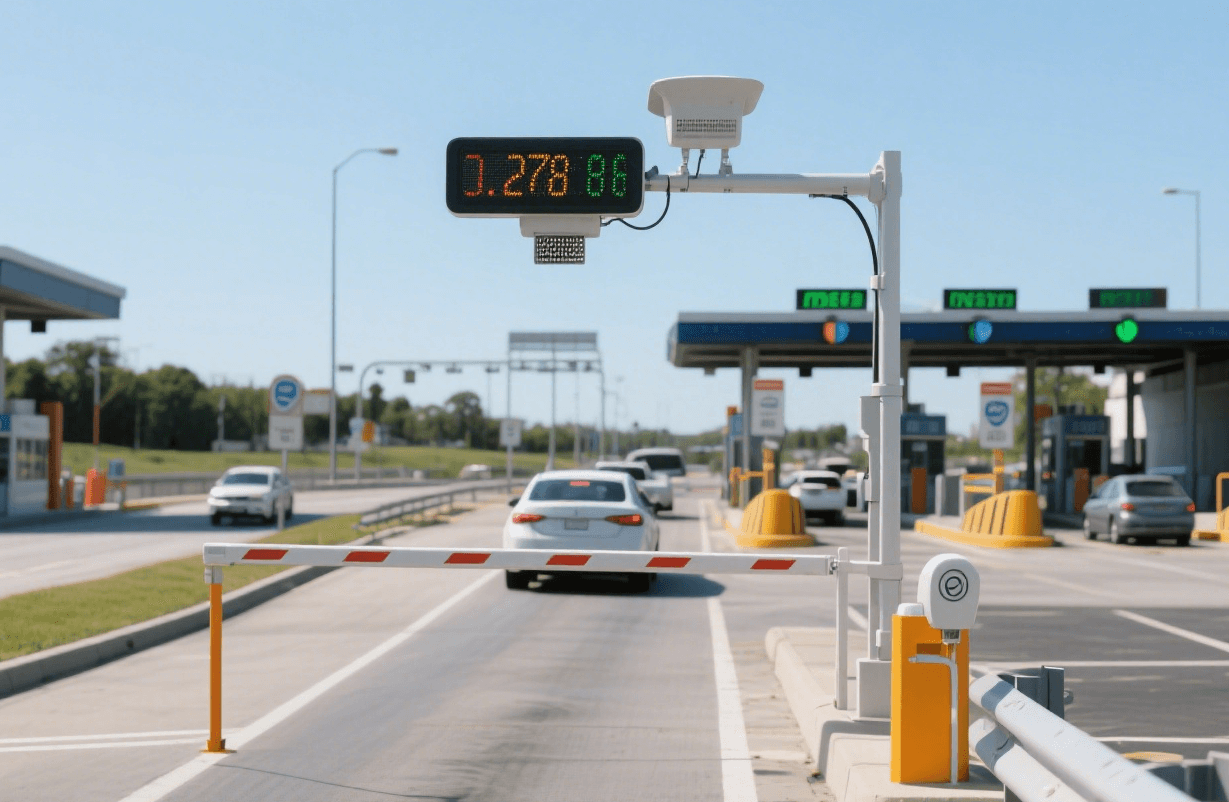
In many real-world scenarios—such as toll booths, parking lot entrances, campus gates, temporary construction zones, and narrow side lanes—precise single-lane speed measurement is a hard requirement. Typically, the target conditions are
-
Distance range: 20–30 meters
-
Lane width: ~3.0–3.5 m
-
Requirement: Detect only the target lane, avoiding cross-lane interference
-
Operation environment: All-weather, outdoor, 24/7
This article explores how 77–81 GHz mmWave radar can meet this challenge, from sensor selection and installation geometry to signal processing and interference mitigation.
1. Why Narrow Gate Speed Detection Is Challenging
Achieving precise single-lane measurement is not trivial. Common issues include:
-
Beam leakage—Antenna sidelobes may capture returns from adjacent lanes.
-
Cross-lane entry—Vehicles cutting in at an angle may confuse lane separation.
-
Multipath reflections—Guardrails, water films, and road signs can generate false peaks.
-
Low-speed ambiguity—Near-stationary vehicles are difficult to separate from static clutter.
-
Large vehicle occlusion—Trucks or buses can shadow smaller vehicles, causing missed detections.
2. Sensor and Waveform Selection
-
Frequency band: 77–81 GHz
-
Bandwidth: ≥ 1 GHz for fine distance resolution (ΔR ≈ c / 2B)
-
Antenna FOV: Horizontal 8–12° main lobe, vertical 8–15°
-
Frame rate: ≥ 20 Hz (urban), ≥ 40 Hz (highway)
-
Angle estimation: Minimum 3 Rx channels; better with 4–6 Rx and high-resolution algorithms (MUSIC, MVDR, or 3D FFT)
-
Waveform: FMCW with dual-slope modulation (near-range clutter suppression + far-range SNR boost)
Equation for radial velocity:
vr=c⋅fd2fcv_r = \frac{c \cdot f_d}{2 f_c}
For fc=77 GHzf_c = 77 \, \text{GHz} and Doppler shift fd=1000 Hzf_d = 1000 \, \text{Hz}, we get vr≈1.95 m/s≈7 km/hv_r \approx 1.95 \, \text{m/s} \approx 7 \, \text{km/h}.
3. Recommended Installation Geometry
To minimize cross-lane interference:
-
Mounting height: 3.2–3.8 m
-
Tilt angle: −10° to −15° downward
-
Yaw angle: 0–5°, aligned with lane direction
-
Lateral offset: 1.0–1.5 m from lane centerline (mounted roadside)
-
Effective target zone: Centered at ~25 m from installation point
This setup ensures the radar’s main lobe covers only the target lane.
4. Region of Interest (ROI) Design
Define a data ROI mask to filter out unwanted detections:
-
Range gate: 18–32 m
-
Angle gate: Center ±(FOV/2 – 1°)
-
Velocity gate: 1–150 km/h
-
Trajectory consistency: Δθ/Δt < 3°/s; distance/velocity continuity enforced
Practical tip: Start with a wide ROI during initial data collection, then gradually narrow it down based on offline analysis.
5. Signal Processing and Tracking
Processing chain:
Mixing → Range FFT → Doppler FFT → CFAR → Angle spectrum → Point cloud → Tracking
Enhancements for single-lane reliability:
-
Lane-prior tracking: Penalize detections far from the lane centerline.
-
Multi-frame confirmation: Require trajectory continuity before reporting.
-
Consistency checks: Reject objects with unstable RCS or fluctuating size.
-
Background map: Learn static clutter patterns and subtract them.
6. Interference Mitigation
-
Rain/fog: Raise CFAR thresholds, and apply multi-frame confirmation.
-
Multipath: Use narrow vertical FOV, optimize tilt angle.
-
Occlusion: Predict hidden targets for 0.3–0.6 s to avoid sudden loss.
-
Radar-to-radar interference: Stagger frame timing and modulation slopes.
7. Deployment and Calibration Checklist
Before mounting: Survey location, confirm power supply (12–24 VDC), and communication interface (RS485/CAN/Ethernet).
After mounting:
-
Place the corner reflector at the 25 m lane center for calibration.
-
Verify FOV by driving test vehicles along lane edges.
-
Run wide ROI for 30 minutes, then tune ROI.
-
Synchronize time (NTP) and coordinate frames with the backend system.
8. Evaluation Metrics
-
Speed error (MAE): ≤ ±1.5 km/h (20–80 km/h), ≤ ±2.5 km/h (>80 km/h)
-
Lane accuracy: ≥ 98%
-
False alarm rate: ≤ 0.5% per 1000 vehicles
-
Miss rate: ≤ 1.0%
-
Time-to-first-lock: ≤ 200 ms for >20 km/h targets
-
24h stability: Continuous operation without resets or dropouts
9. Comparison with Other Technologies
-
Vision-based systems: Weaker in night/rain/fog; sensitive to lighting.
-
Inductive loops: Accurate but require road excavation; less flexible.
-
Best practice: Use radar for speed + lane separation, vision for license plate recognition.
10. Integration with ITS and VMS
-
Interfaces: RS485, CAN, Ethernet (UDP/TCP/MQTT/REST)
-
Data fields:
{lane_id, timestamp, speed_kmh, range_m, snr_db, track_id, confidence} -
Applications: Overspeed warning, adaptive traffic lights, congestion management
11. FAQs
Q1: Can it handle narrow 2.8 m lanes?
Yes, with a narrower horizontal FOV (~8°) or a tighter ROI.
Q2: What about motorcycles or bicycles?
Radar can separate them using RCS, trajectory, and velocity patterns; fusion with vision improves classification.
Q3: Why is accuracy lower at <10 m?
Near-range leakage and sidelobes dominate; solved by tilt adjustment and near-range suppression.
Q4: Why does speed fluctuate in heavy rain?
Increase CFAR thresholds, use multi-frame validation, and adapt parameters for rain conditions.
Conclusion
Precise single-lane narrow gate speed detection is possible with well-configured 77–81 GHz mmWave radar. By carefully controlling installation geometry, ROI design, and signal processing, integrators can achieve high accuracy (≥98% lane separation) even in challenging outdoor conditions.
This technology is already being deployed at toll stations, smart parking, and traffic monitoring points, offering flexible, reliable, and all-weather speed detection without costly road modifications.