






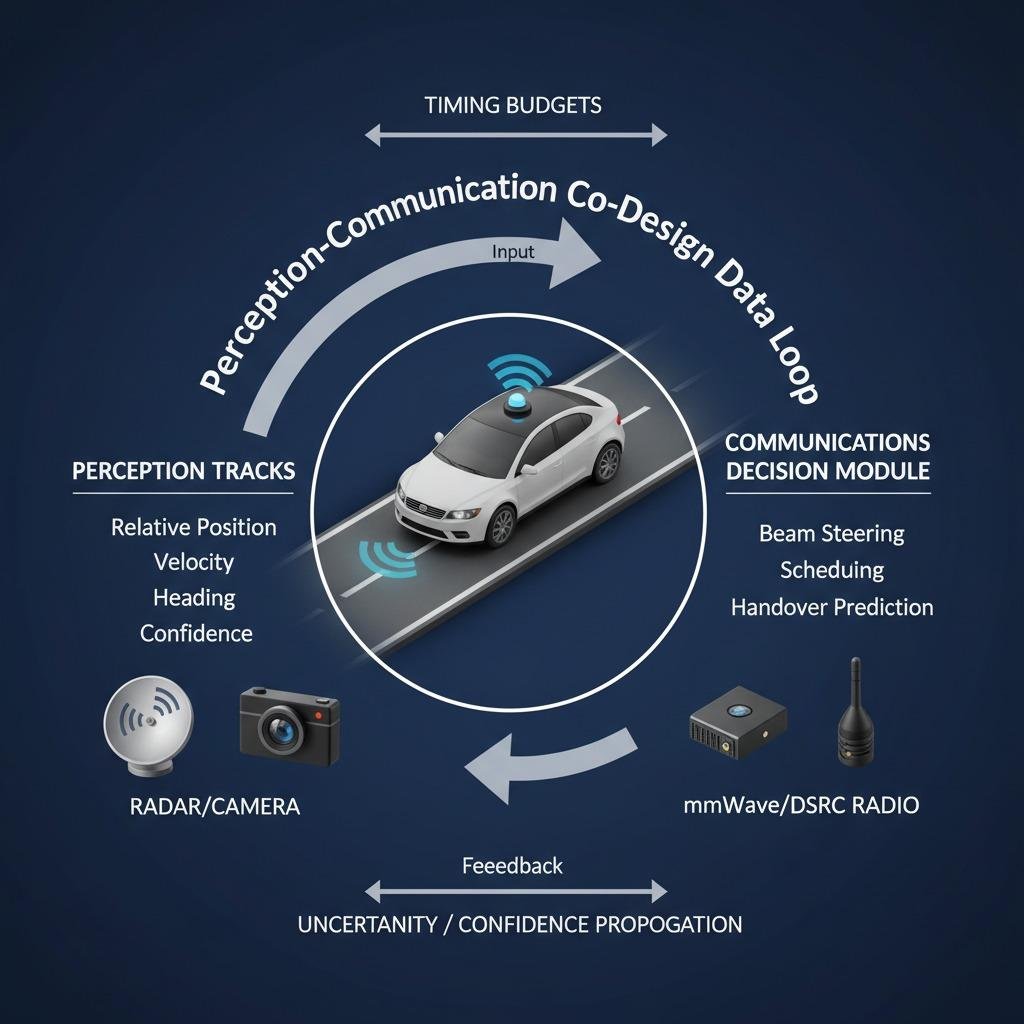
Perception-Communication Co-Design: Building More Useful Vehicle Networks
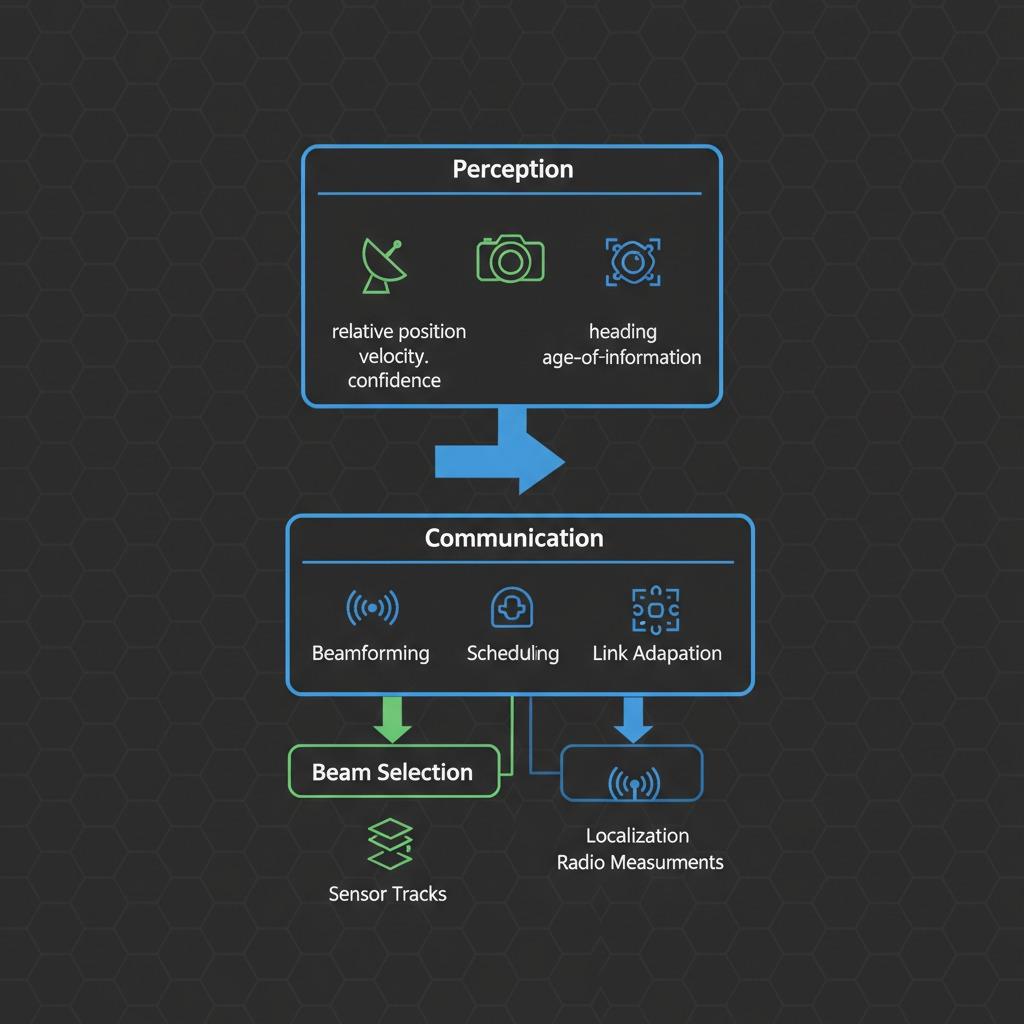
Perception-communication co-design is becoming an important engineering approach for connected vehicles, robotics, and other mobile systems that must both understand their surroundings and exchange data reliably. Traditionally, sensing and wireless communication have been designed as separate functions: radar or cameras collect environmental information, while a radio handles the data link. That separation is convenient during early development, but it can leave performance on the table. A vehicle may sense a nearby object without knowing which information another vehicle needs, or maintain a communication link without using available spatial and motion data to improve it.
The practical question for a product team is not whether sensing and communication should be “combined” in the abstract. It is where shared information can reduce system cost, improve link availability, or support safer decisions—and where the added software, timing, and validation burden is not justified.
What the approach changes
In a conventional architecture, a perception subsystem estimates objects, position, speed, and motion. A communication subsystem then manages scheduling, beam selection, link adaptation, and packet delivery. In a co-designed architecture, these functions exchange useful state information. The communications layer may use object position and velocity to select a beam or predict a handover. The sensing layer may use radio measurements to improve localization or detect a communication partner that is difficult to observe with another sensor.
This does not necessarily mean that one waveform, antenna, or processor must perform every task. Co-design can exist at several levels:
- Shared data, such as position, velocity, orientation, and confidence values.
- Shared scheduling, in which sensing and communication resources are allocated together.
- Shared radio hardware or waveforms, where transmitted signals support both data exchange and environmental measurement.
- Joint decision logic, allowing the system to trade sensing quality against throughput, latency, or energy use.
Where the engineering value appears
Faster and more predictable link management
Highly directional links can deliver useful capacity, but they are sensitive to blockage, vehicle motion, and antenna orientation. A perception system that already estimates the relative position of a truck, robot, or roadside unit can provide an early indication that the current path is becoming unreliable. This supports radar-assisted handover, in which sensing information supplements radio measurements before a link has degraded severely.
The benefit is predictive rather than magical. Environmental sensing will not remove interference or guarantee uninterrupted service. It can, however, give the network more time to prepare an alternative beam, relay, or access point. The quality of that benefit depends on sensor update rate, coordinate accuracy, processing delay, and the reliability of the association between a sensed object and a communication node.
More informed beam selection
Beam-steering for data link management is another direct application. Relative angle and motion estimates can narrow the search space for candidate beams, reducing the time spent on exhaustive training. In a vehicle platoon or warehouse fleet, the system may also use route and trajectory information to anticipate how the link geometry will change.
Designers should be cautious about treating beam prediction as a substitute for radio feedback. Multipath reflections, partial blockage, antenna calibration errors, and unexpected maneuvers can still cause a predicted beam to underperform. A robust design uses perception to prioritize candidates, then confirms the choice with communication-layer measurements.
Key applications at a glance
| Application | Shared information | Primary engineering objective |
|---|---|---|
| Vehicle-to-vehicle links | Relative position, speed, heading | Faster beam selection and link continuity |
| Roadside or cellular handover | Road geometry, blockage, trajectory | Earlier preparation for a new access point |
| Fleet robotics | Robot location and local occupancy | Coordinated coverage and reduced contention |
| Network planning | Traffic density and sensing observations | Joint sensing for network optimization |
| Cooperative localization | Time, angle, and range measurements | Improved relative positioning |
Inter-vehicle ranging and cooperative perception
Inter-vehicle ranging for communication can help estimate the distance between moving nodes and support formation control, localization, or link budgeting. Range information may be derived from dedicated sensing, radio timing, angle measurements, or a combination of methods. Each method has different error sources. Timing-based estimates depend on synchronization and processing assumptions; angle-based estimates depend strongly on antenna geometry and calibration; radar-style measurements can be affected by reflections and target interpretation.
For product teams, the key issue is not simply the nominal range accuracy. Ask how the estimate behaves during partial blockage, multiple nearby vehicles, lane changes, and loss of one sensor input. A co-designed system needs confidence indicators and fallback behavior. If a ranging estimate is uncertain, the network should be able to widen its beam search, reduce the aggressiveness of a handover decision, or request additional measurements rather than acting on false precision.
How to evaluate an architecture
Start with the operational failure that matters. Is the current system losing links during turns? Spending too much airtime on beam training? Carrying separate sensing and connectivity hardware that increases packaging or power demand? The answer determines whether co-design should focus on algorithms, scheduling, hardware integration, or data interfaces.
Several evaluation criteria deserve attention:
- Latency: Measure the complete path from sensing observation to network action, not only processor runtime.
- Uncertainty: Pass confidence and age-of-information values with position or object tracks.
- Failure behavior: Define what happens when sensing is blocked, delayed, spoofed, or unavailable.
- Resource sharing: Check whether sensing activity competes with the data traffic it is intended to improve.
- Validation coverage: Include motion, blockage, multipath, dense traffic, and imperfect calibration.
- Interface ownership: Decide which subsystem controls beam choice, handover timing, and safety-relevant decisions.
One common mistake is to compare a co-designed prototype with an unrealistically weak baseline. The baseline should be properly tuned, with reasonable beam training, link adaptation, and sensor fusion. Otherwise, measured gains may disappear in a production implementation.
Common implementation mistakes
Another frequent error is assuming that more sensor data automatically produces a better network. High-rate data can increase processor load, internal bandwidth, and synchronization demands. In many systems, compact features—predicted position, relative velocity, object identity, and confidence—are more useful than raw point clouds or images.
Teams should also avoid hiding safety-critical assumptions inside a communications optimization module. A beam decision may use perception data, but the consequences of a missed or delayed packet must still be handled by the vehicle or robot control architecture. Security deserves similar attention: shared perception data can be stale or manipulated, so authentication, plausibility checks, and graceful degradation should be considered early.
A practical buyer and development checklist
When reviewing a platform or technical proposal, ask for the data path and timing budget. What measurements are available to the radio? How are coordinate frames aligned? Can the system report confidence and timestamp information? Does it support independent fallback operation for sensing and communication? Are tests available for blockage, high relative speed, and multiple targets?
Also request clear boundaries around claimed performance. A supplier may demonstrate improved throughput in a controlled setting, while the production challenge is maintaining the benefit across weather, traffic density, antenna placement, and software updates. The most credible proposals explain both the gain and the conditions under which it may be reduced.
FAQ
Is co-design the same as integrated sensing and communication?
No. Integrated sensing and communication often refers to shared radio resources or waveforms. Perception-communication co-design is broader and may use separate sensors, provided their information is coordinated with network decisions.
Does the approach require millimeter-wave hardware?
No. Directional high-frequency links make spatial prediction especially attractive, but the same principles can apply to lower-frequency vehicle networks, industrial wireless systems, and mobile robots.
What is the best first project?
A focused pilot is usually more useful than a complete architectural rewrite. Predictive beam selection, handover assistance, or cooperative ranging are measurable starting points. Establish a strong baseline, log uncertainty and timing, and test failure cases before expanding the scope.
Next step
Map the moments when your current network loses capacity, spends excessive time on discovery, or lacks reliable relative-position data. Then identify which perception outputs could address those specific failures. A disciplined interface, explicit confidence handling, and realistic field validation will usually matter more than claiming that every sensing and communication function is fully unified.