






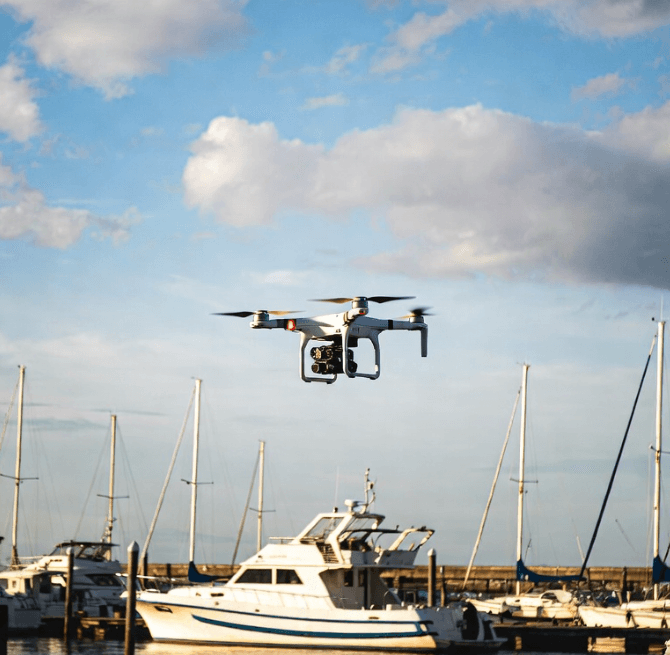
As smart port construction accelerates, drone-based ship-port collaborative logistics has emerged as a key scenario for improving cargo turnover efficiency by facilitating emergency spare-part delivery, port inspection, and container data collection. However, low-altitude operations encounter a number of difficulties, including complex electromagnetic environments, dense metal equipment, high humidity and salinity close to the sea, and 24-hour missions. According to data, port logistics drone operations had an early-stage failure rate of 8.7%.
This article focuses on 60–81 GHz millimeter-wave radar, which has emerged as a crucial enabler to secure the smart port low-altitude logistics ecosystem due to its penetration capability, robust anti-interference performance, and centimeter-level precision.
1. Resolving Metal Interference, Salt Fog, and High Humidity in Ports with 60–81GHz Millimeter-Wave Radar
The wavelength of 60-81GHz radar (approx. 3.7-5 mm) ensures superior performance in harsh coastal environments—essential for ensuring continuous drone logistics operations.
-
Resistance to salt-fog attenuation: Under extreme lab conditions, detection performance drops by less than 10%, outperforming infrared and visual sensors (near total failure).
-
Real-world benefit: At Ningbo-Zhoushan Port, which has an average of 120 salt-fog days per year, drones equipped with this radar increased operational uptime from 45% to 92%.
To eliminate strong reflections from containers and quay cranes, the radar uses MIMO antenna technology and CFAR algorithms to distinguish between valid targets and metal clutter.
Case: At the Yangshan Automated Terminal, a 16-channel antenna array and adaptive signal processing reduced false alarm rates from 23% to 1.8%, ensuring stable detection in metal-dense environments.
2. Centimeter-Level Accuracy: Allowing for Precision Navigation in Small Port Areas
Precision operation within narrow container aisles is essential for low-altitude port logistics. To meet this requirement, 60-81GHz radar offers centimeter-level resolution (5 cm distance resolution and 0.5° angular resolution).
-
Drones at Shenzhen Yantian Port use accurate path correction to navigate through 3-meter gaps between containers. With 360° scanning at 20 fps, path correction accuracy stays within ±10 cm, ensuring precise drop-off to container roofs.
-
Comprehensive monitoring: Fixed radars at Guangzhou Nansha Port cover a 500-meter radius, eliminating visual blind spots and preventing collisions with ground vehicles.
Data indicates that precision delivery success increased from 88% to 99.5%, and narrow-space safety increased by 3×.
3. All-Weather Anti-Interference: Ensuring 24/7 Port Operations In Complex EM Environments
Ports require dependable sensors that operate around the clock.
-
Nighttime missions.
-
Rain, fog, and dust
-
Low visibility conditions
During Typhoon Doksuri in 2023, despite strong winds (level 8), heavy rain, and <50 m visibility, radar allowed for uninterrupted emergency drone deliveries in Xiamen Port.
To deal with electromagnetic interference from quay communications, vessel navigation, and power equipment, the radar employs frequency-hopping and IEC 61000-4-3 Level 3 EM shielding techniques.
Even with an EM intensity of 40 V/m, detection accuracy at Tianjin Port remained above 99.2%.
4. Kalman Filtering and Dynamic Tracking: Early Prediction of Vessel and Vehicle Collisions
The port's low-altitude zone contains a variety of dynamic targets, including drones, vessels, ground vehicles, and personnel. Radar employs Kalman filtering to forecast movement trajectories over the next three seconds.
-
Qingdao Port collision avoidance: Radar tracks vessel berthing speeds (0.1-0.3 m/s) and crane rotation angles in real time, triggering automatic UAV avoidance maneuvers in 0.3 seconds.
-
At Guangzhou Nansha Port, collision rates decreased from 0.3% to <0.01%, and dynamic target pre-warning accuracy reached 99.8%.
5. Increase UAV Payload and Endurance with Lightweight and Low-Power Design
Payloads for port logistics drones must be lightweight and low-powered. 60-81GHz radar meets all of these requirements perfectly.
-
Compact design: Port modules typically weigh less than 20 grams.
-
Installation costs are low. Power consumption is only 5 W, which supports 24-hour continuous operation.
At Ningbo-Zhoushan Port, 100 drones were upgraded in 15 days, with costs 60% lower than LiDAR solutions.
6. Multi-Sensor Fusion: Developing a Comprehensive Safety Network for Port UAV Collaboration
Single sensors cannot handle all possible port conditions. Radar and optical/infrared sensors work together to ensure overall safety.
-
Radar + Vision: At Shenzhen Yantian Port, radar handles long-range detection and dynamic tracking, while camera sensors handle close-range identification; when it rains or fogs, radar takes over.
-
Improved system stability: Perception redundancy has increased by 30%, allowing for 99.9% operational reliability even in extreme weather.
Conclusion: Key Technological Trends in Smart Port Low-Altitude Logistics
The core technology for smart port logistics is now 60-81GHz millimeter-wave radar, which allows for all-weather, high-precision UAV operations.
It guarantees:
✔ Accurate sensing for high-humidity salt fog.
✔ Protects against metal reflection interference.
✔ Enables centimeter-level localization in tight spaces.
✔ Improves dynamic obstacle tracking by avoiding electromagnetic interference.
The technology will accelerate scaled, automated, unmanned deployment of smart port logistics with future advancements (higher resolution, deeper AI integration, collaboration with 5G).