






What OEMs need to consider beyond pure performance metrics
Introduction
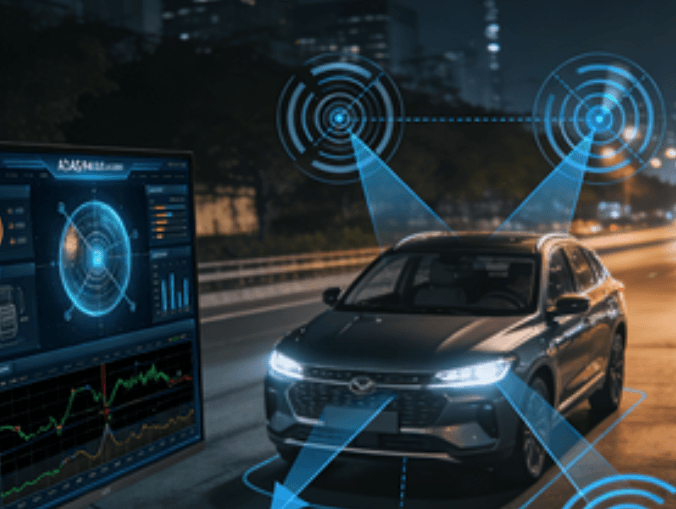
In 2026, the automotive industry will witness a shift in ADAS (Advanced Driver Assistance Systems) perception architectures from single-sensor dominance to multi-modal sensor fusion. When designing perception systems, OEMs must consider performance, cost, production stability, functional safety, and all-weather reliability. In this context, fusion-first approaches have emerged as the preferred strategy for large-scale L2/L2+ systems and higher-level automated driving functions. Radar, particularly 4D imaging radar, is critical for stabilizing perception and providing redundancy under all conditions, rather than replacing cameras.
System design based on radar, cameras, and fusion.
Camera-First
Cameras remain indispensable for perception due to their high resolution and rich semantic understanding, which allows for precise recognition of lane markings, traffic signs, and various objects. However, cameras are extremely sensitive to lighting conditions, rain, fog, snow, and occlusions. In low-light or poor weather conditions, depth estimation becomes unreliable. Early L1/L2 features like lane keeping and traffic sign recognition relied heavily on camera-first approaches, but as the operational design domain (ODD) has become more complex, camera-only systems have proven inadequate.
Radar-First
In challenging environments, radar offers distinct advantages. It measures distance and velocity directly, and 4D imaging radar incorporates elevation data to produce high-resolution point clouds for accurate long-range detection and dynamic object tracking. Radar continues to perform well in rain, fog, night, or dusty conditions. While traditional radar has limitations in terms of object classification and semantic understanding, combining it with AI algorithms provides dependable support for features like automatic emergency braking (AEB), adaptive cruise control (ACC), and low-speed urban driving.
Fusion-First
Modern ADAS production increasingly relies on deep camera-radar fusion, whether at the early (feature-level), mid-level, or late (object-level) stages. Cameras provide detailed semantic and appearance information, whereas radar ensures stability and redundancy in adverse conditions. This fusion approach enhances overall perception accuracy and robustness by lowering lateral errors and increasing mean average precision (mAP). Fusion-first systems have become the norm for mass-produced L2+ ADAS, providing 360° coverage, functional safety, and scalability. ODD constraints limit single-sensor approaches, preventing them from being scaled efficiently.
Why Has Radar Redundancy Become Standard in Mass-Production ADAS?
Radar redundancy has become standard in L2/L2+ and higher systems, which typically combine a front long-range radar with corner or short-range radars (3-6 units per vehicle). The key drivers are as follows:
functional safety and redundancy
Euro NCAP, GSR, NHTSA, and ISO 26262 regulations all call for independent sensor channels to handle single-sensor failures. Radar offers an independent perception path, significantly reducing validation efforts while ensuring a safe fallback in critical scenarios.
Robustness in all weather conditions and scenarios.
Millimeter-wave radar penetrates rain, fog, snow, and low-light conditions, allowing for accurate detection and velocity tracking where cameras and LiDAR may fail. According to studies, radar-integrated systems are significantly more reliable in adverse weather conditions.
Cost effectiveness and scalability
Radar is mature and inexpensive (far less than LiDAR), and adding redundancy increases system reliability without significantly increasing BOM costs. It facilitates the progression from L2+ features like highway assist and traffic jam assist to higher levels of automation.
Market Trends
By 2025-2026, OEMs will widely use radar redundancy as a cornerstone for perception stability. China's regulations, including the MIIT 2025 L2 ADAS standards, have accelerated this trend.
The engineering value of 4D radar in rain, fog, night, and occlusion scenarios
4D imaging radar, which adds the height dimension and produces high-resolution point clouds, provides significant benefits in real-world ODDs. Millimeter-wave signals can penetrate optical interference in rain, fog, or snow, allowing for stable point clouds, distance, and velocity measurements where cameras and LiDAR fail frequently. In low-light or nighttime conditions, radar performance remains consistent, allowing for features such as night-view AEB. It can also penetrate partial occlusions, such as dust or preceding vehicles, allowing for long-range tracking and object separation up to 200-300 meters. These capabilities make 4D radar essential for stable perception, enabling AEB, lane-change assistance, and urban NOA capabilities.
Radar Selection Based on ROI, Production Stability, and Long-Term Supply
OEMs should assess radar beyond specifications, focusing on total lifecycle value. Low unit cost and redundancy lower validation and accident risk while allowing for cost-effective expansion to L2+/L3 functionalities. Mature supply chains guarantee mass production and local manufacturing, thereby reducing supply risks. The scalability of 4D radar technology and multi-supplier strategies ensure future higher-level automation capabilities while mitigating supply chain uncertainties.
FAQ
Q1: Can radar be used for high-speed automated driving?
The radar-first approach is insufficient. High-speed scenarios necessitate deep fusion with cameras in order to provide semantic information and reliability. Radar-first automation is better suited to low-speed scenarios, urban complexity, and adverse weather conditions.
Q2: Will 4D radar completely replace cameras?
Radar is superior in terms of distance, velocity, and robustness, whereas cameras provide semantic and classification information. The consensus approach is to use complementary applications.
Q3: Does radar redundancy result in significant cost increases?
Initial costs rise slightly, but lower computing demand, validation effort, and accident risk result in a higher long-term return on investment. Costs are rapidly diluted in mass production.
Q4: How should manufacturers select radar suppliers?
Prioritize production stability, long-term supply commitments, functional safety certifications (e.g., ASIL-B/D), local support, 4D imaging capability, and compatibility with fusion architectures.