






Empowering Robotics with Millimeter-Wave Radar: Precision, Safety, and Autonomy
Robotics has become one of the fastest-growing industries in the age of intelligent automation. From industrial automation to service robots and healthcare assistance, the demand for smarter, safer, and more reliable robotic systems is increasing every year. However, many traditional sensing technologies such as cameras, infrared, or ultrasonic sensors face limitations when applied to complex environments. This is where millimeter-wave (mmWave) radar technology steps in, providing high-precision sensing and robust adaptability across diverse robotic applications.
At Linpowave, our advanced radar modules (60 GHz for indoor IoT and monitoring, and 76–81 GHz for automotive, robotics, and UAVs) are designed to meet the challenges of modern robotics. By enabling accurate perception and autonomous decision-making, these radars empower robots to interact more seamlessly with humans and their environment.
1. Why Robots Need Millimeter-Wave Radar
Robots are often deployed in environments where uncertainty is high. A mobile service robot in a crowded mall, for example, must detect people, obstacles, and fast-moving objects in real time. Similarly, collaborative robots in factories must work safely around human operators while maintaining efficiency.
Conventional sensors like cameras provide detailed visuals but are highly dependent on lighting conditions. Ultrasonic sensors offer proximity detection but lack spatial resolution. mmWave radar overcomes these challenges by delivering:
-
All-weather performance: Radar is unaffected by lighting, fog, dust, or smoke, ensuring reliable operation in industrial and outdoor settings.
-
High-precision ranging: With detection accuracy down to centimeters, robots can maneuver through narrow spaces without collisions.
-
Velocity measurement: Unlike cameras, mmWave radar measures Doppler shifts to calculate speed, which is crucial for dynamic environments.
-
Contactless sensing: Ideal for detecting human presence and gestures without physical interaction, enhancing safety and usability.
2. Applications of mmWave Radar in Robotics
The integration of mmWave radar into robotic platforms opens up a wide range of possibilities. Some of the most promising applications include:
a) Autonomous Mobile Robots (AMRs)
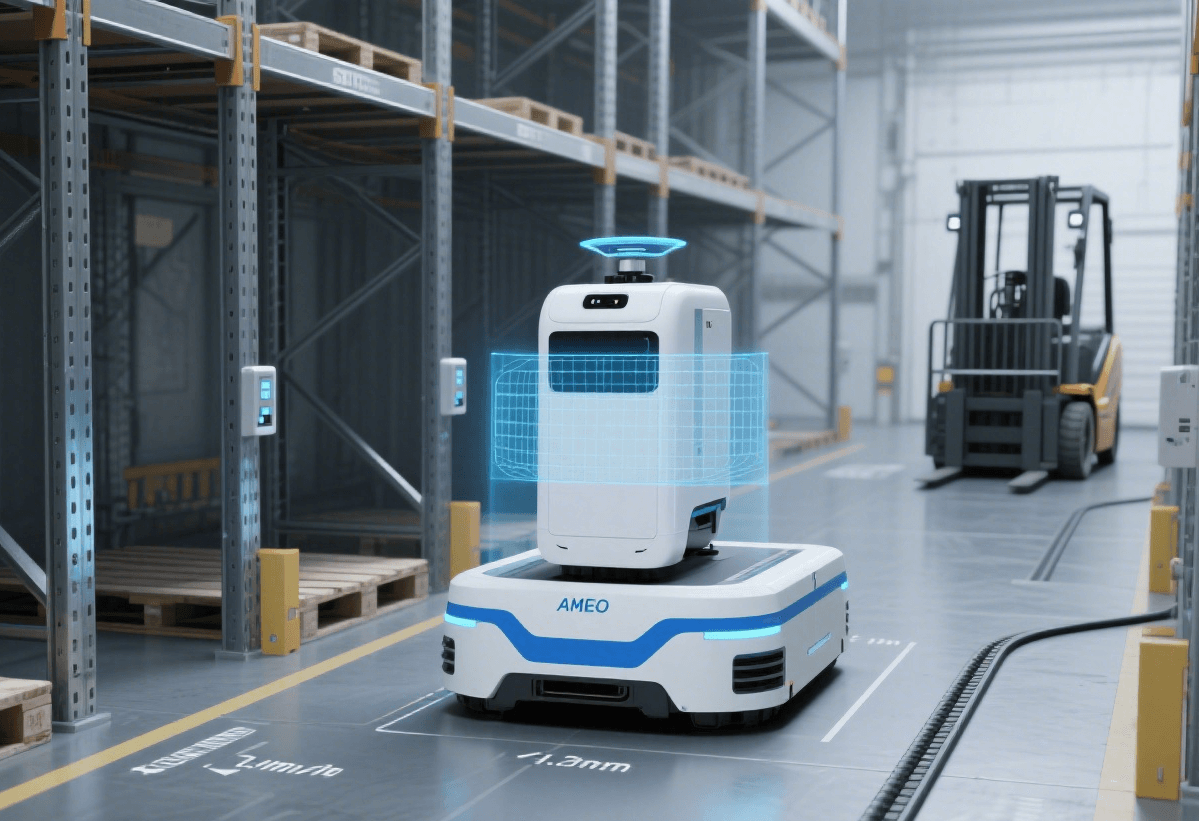
For logistics and warehouse automation, AMRs need reliable navigation even when visual markers are blocked or lighting is poor. Linpowave’s radar systems enable precise mapping and obstacle detection, ensuring efficient and safe transport.
b) Collaborative Robots (Cobots)
In manufacturing, cobots must operate in close proximity to humans. Radar sensors provide a safety layer by detecting worker positions and movements in real time, preventing accidents without halting production lines unnecessarily.
c) Service and Social Robots
From customer service robots in airports to delivery robots on city streets, mmWave radar enhances environmental awareness. By recognizing humans and distinguishing them from static obstacles, robots can interact more naturally and responsively.
d) Healthcare and Assistive Robotics
Elderly care robots and rehabilitation robots require non-invasive monitoring of human motion and respiration. Radar modules at 60 GHz can track vital signs and movements, enabling safe and continuous health monitoring.
3. Linpowave’s Radar Solutions for Robotics
Linpowave’s modular radar boards combine compact design with powerful processing capabilities. The boards are available in form factors as small as 50×50 mm, making them easy to integrate into robotic platforms without adding significant weight or volume.
Our solutions support both short-range high-resolution sensing (for indoor service robots and healthcare monitoring) and longer-range detection (for outdoor navigation and industrial automation). With edge processing capabilities, data can be analyzed directly on the radar board, reducing latency and dependence on external computing.
Key benefits include:
-
Multi-target tracking: Robots can distinguish between multiple moving humans or objects in real time.
-
Programmable SDK: Developers can customize radar behavior through Linpowave’s software toolkit, accelerating integration into robotic ecosystems.
-
Scalable performance: From single radar modules to multi-radar fusion systems, solutions can be scaled based on application requirements.
4. The Future of Robotics with Radar Integration
The integration of mmWave radar is not just a technological upgrade—it represents a paradigm shift in how robots perceive and interact with the world. As robotics expands into public environments, human-centric applications, and collaborative tasks, the need for sensors that provide safety, reliability, and accuracy becomes even more critical.
By leveraging radar alongside AI-driven decision-making, future robots will be capable of adaptive perception, understanding their surroundings with unprecedented precision. This will unlock new applications, from smart factories to healthcare monitoring, and make robots more trustworthy companions in our daily lives.
Conclusion
Millimeter-wave radar technology bridges the gap between robotic intelligence and real-world uncertainty. Linpowave’s compact, customizable, and high-performance radar solutions empower robots to achieve greater autonomy, safety, and adaptability across industries. Whether in logistics, healthcare, or personal service, radar-enabled robotics represents the next step toward a smarter and safer future.
For more information on Linpowave’s radar modules and integration options, explore our official website