






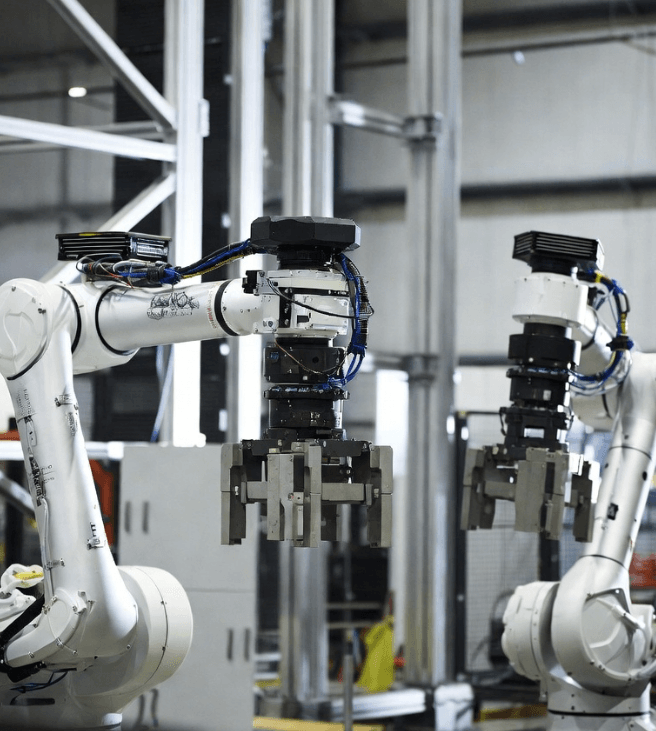
In an era of widespread deployment of smart warehousing, industrial automation, and service robots, robots are transforming from "fixed-route executors" into autonomous intelligent agents. They must operate in unpredictable environments, including those with people moving around, forklifts moving rapidly, shelves constantly being adjusted, and environments with drastic changes in lighting. In this dynamic environment, the robot's perception system faces enormous pressure.
Traditional camera and LiDAR solutions work effectively in many situations, but they are prone to misidentification or inaccurate distance measurement in environments with dust, smoke, strong light, backlight, low light, or transparent objects. Today, thanks to millimeter-wave radar, robots can "clearly observe, stably perceive, and quickly react" in dynamic environments, making millimeter-wave radar an indispensable component.
1. Coping with and avoiding obstacles: Maintaining stability in complex environments
For safe and efficient navigation, AGVs and AMRs must continuously perceive their surroundings in places such as factories, warehouses, hospitals, and shopping malls. Millimeter-wave radar can detect stationary and moving obstacles in real time, providing precise direction, speed, and distance information. Robots use this data to predict the trajectory of moving targets and plan optimal paths, maintaining efficient operation even in crowded or rapidly changing environments.
Multi-robot collaboration and path conflict handling
When multiple robots are running simultaneously, radar can detect each other and predict path conflicts, thereby preventing collisions and improving the overall efficiency and stability of the system.
All-weather navigation capability
Thanks to its millimeter-wave radar, which is unaffected by light, dust, smoke, or precipitation, the robot can reliably navigate in environments such as dusty factories, cold chain warehouses, nighttime inspections, or outdoor delivery, thus achieving true all-weather operation capability.
2. Safer human-computer interaction: dynamic obstacle avoidance and real-time perception
As robots increasingly collaborate with humans, safety becomes paramount. Millimeter-wave radar excels at safely interacting with and detecting human presence. To effectively avoid collisions, it can detect the location of nearby operators in real time and automatically decelerate, stop, or change course when someone approaches.
Reliable perception can be obtained even in dimly lit or poorly lit environments.
Because millimeter-wave signals can be strongly reflected by the human body, the robot can maintain accurate detection even in dimly lit, backlit, obstructed, and smoky environments.
Millisecond-level dynamic response
Warehouses and factories may encounter unexpected challenges. Millimeter-wave radar enables millisecond-level response times, allowing robots to dynamically adjust their paths in complex environments, thus achieving safe and flexible navigation.
3. Improve operational efficiency through easy integration, high performance, and high energy efficiency.
Millimeter-wave radar has significantly improved operational efficiency and safety in practical applications. By reducing unnecessary driving, emergency stops, and idling, precise environmental perception reduces energy consumption and improves overall production efficiency. Radar modules and algorithms are adaptable to various application scenarios, including warehousing and logistics, industrial inspection, service delivery, medical transportation, and cleaning robots, ensuring high-precision detection in diverse environments.
System integration and interoperability
Millimeter-wave radar supports standardized interfaces and multi-platform SDKs, enabling large-scale deployment and seamless integration with existing control systems without major hardware changes.
4. The main advantage of millimeter-wave radar: enhanced adaptability to constantly changing environments.
In dynamic environments, millimeter-wave radar significantly outperforms cameras, lidar, and ultrasonic sensors. It reduces false alarms, preventing downtime, misoperation, and collisions; it is durable and has low long-term maintenance costs; it has strong anti-interference capabilities, unaffected by light, dust, or smoke; and it is insensitive to material type, reliably detecting transparent or smooth surfaces. Due to these characteristics, millimeter-wave radar has become an important component of robot perception systems.
5. System-level functionality: Linpowave's unique advantages
Beyond hardware, Linpowave offers complete system-level solutions to ensure robots achieve stable and reliable spatial awareness. From signal acquisition to algorithm processing, radar modules and algorithms are tightly integrated, achieving optimal navigation, obstacle avoidance, and human-robot interaction performance. The products are industrially tested, support large-scale deployment, and meet the long-term operational needs of autonomous mobile robots (AMRs) and automated guided vehicles (AGVs). Dedicated algorithms for different scenarios ensure optimal performance in real-world applications. Linpowave's solutions perfectly balance performance, cost, and reliability, making them ideal for scalable deployments.
In conclusion, millimeter-wave radar will become the primary means of perception for future robots.
As robotic applications become increasingly complex, the reliable perception capabilities provided by millimeter-wave radar are crucial for ensuring the safety, efficiency, and intelligence of robots. With system-level radar solutions, robots can achieve safe collaboration, efficient navigation, and stable operation in dynamic environments, laying a solid foundation for next-generation autonomous intelligent systems.