








Why reliability under GNSS-denied conditions is no longer a niche requirement
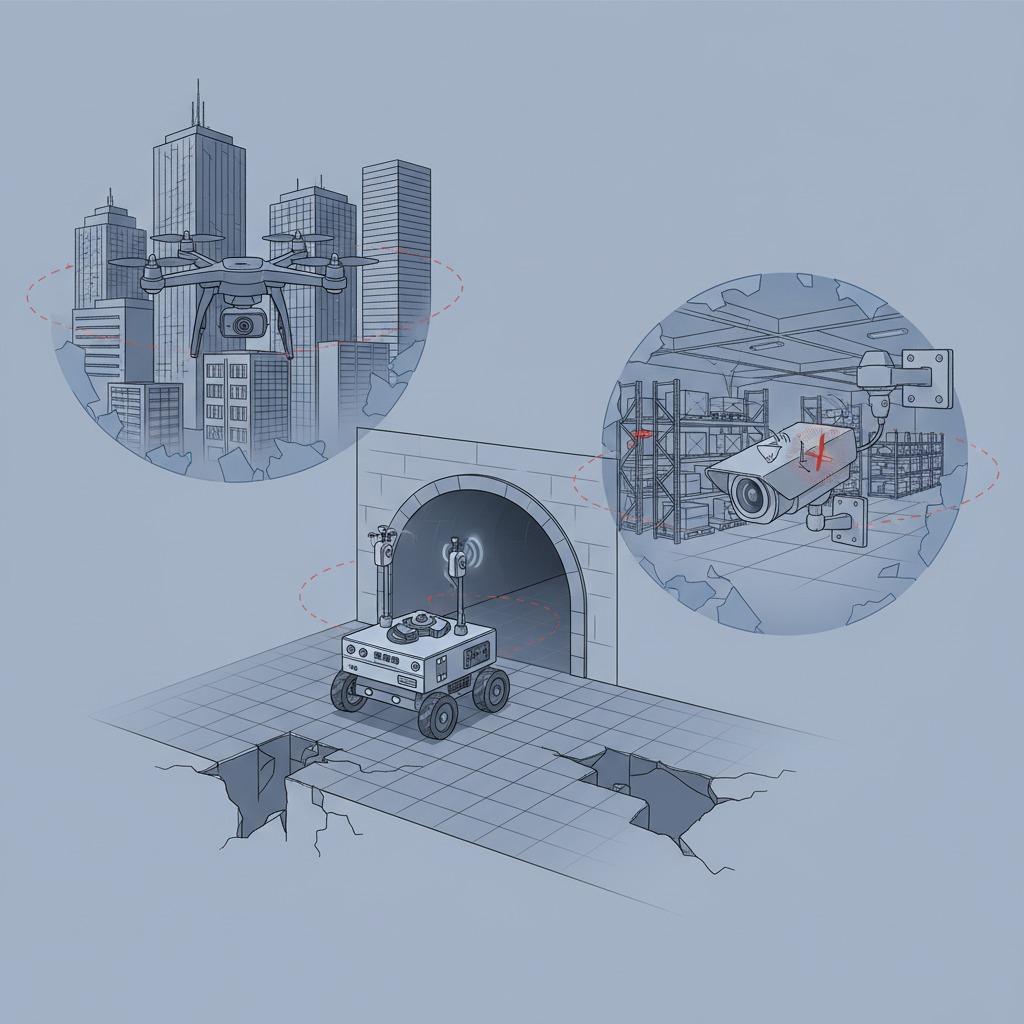
Reliability under GNSS-denied conditions has moved from an edge-case concern to a real design requirement for aerospace, industrial automation, and security systems that must keep working when satellite signals are degraded, blocked, spoofed, or simply unavailable. Engineers who once treated GNSS as the default positioning layer now have to ask a harder question: what happens when the reference disappears?
That question matters because a system can look fine in a lab and still fail in the field. Urban canyons, indoor facilities, tunnels, tree cover, deliberate interference, and reflective structures can all disrupt satellite-dependent sensing. For product teams, the issue is not just accuracy. It is whether the system can maintain safe control logic, preserve Airspace compliance where relevant, and continue making defensible decisions when external positioning is uncertain.
The practical problem: what breaks first when GNSS drops out
In many products, GNSS is woven into more than navigation. It can support geofencing enforcement, route adherence, event logging, and automated boundary checks. Once that signal weakens, upstream assumptions start to collapse. A drone may lose its position reference. A fixed installation may misclassify movement. A surveillance system may lose context for intruder detection. Even if the equipment does not stop outright, its decisions can become less trustworthy than operators expect.
That is why fail-safe sensing matters. A good design does not simply detect GNSS loss and raise an alarm. It decides what the system should do next: hold position, transition to another sensor set, restrict motion, or enter a safe operating mode. The right response depends on the application, but the principle is the same. If the positioning source becomes unreliable, the machine should degrade in a controlled way rather than improvise.
What buyers should look for first
For sourcing managers and engineers, the quickest way to narrow the field is to separate “signal availability” from “system reliability.” Those are not the same thing.
A component can work well when GNSS is present and still be a poor choice if it has no clear fallback behavior. Look for systems that combine multiple sensing inputs, health monitoring, and explicit fault handling. In plain terms, the product should know when it does not know enough.
- Sensor diversity: Can the platform use inertial, visual, radar, or other reference data when GNSS degrades?
- State awareness: Does it detect uncertainty early, or only after the output has already drifted?
- Boundary logic: Can it support geofencing enforcement without relying on a single positioning source?
- Operational continuity: Does it preserve safe behavior during outages, or does it simply fail closed in a way that stops the mission?
- Auditability: Can the system explain what happened during a loss of reference?
How to think about solution architecture
The most robust systems are usually built in layers. GNSS may still be useful, but it is only one layer. Secondary sensors provide continuity, while onboard logic handles uncertainty. This layered approach is especially important in airspace-related applications, where compliance cannot depend on one fragile input. It also helps in security and industrial settings where intruder detection or access control may need to remain active even if the external reference degrades.
Common architecture patterns
One pattern is to pair GNSS with inertial sensing so the system can bridge short outages. Another is to use environmental cues or local infrastructure to maintain a usable reference in constrained areas. In more safety-critical products, designers may combine multiple inputs and then require agreement before taking an action. That can reduce false positives, though it sometimes slows response. There is no perfect answer; the right balance depends on whether the main risk is overreaction or missed detection.
A practical caution: some teams overestimate what software alone can fix. If the sensing stack has weak data quality, even elegant algorithms will struggle. Reliable hardware input still matters.
Selection criteria by use case
For drone and mobility systems, the central concern is usually graceful degradation during navigation loss. For security systems, intruder detection may be the priority, especially if the device must continue monitoring a zone without clean satellite visibility. For industrial platforms, the issue may be safer control around restricted areas and equipment boundaries. In each case, the buyer should ask how the system behaves under partial information, not just under ideal conditions.
A useful test is to ask the vendor or engineering team to describe the failure path in plain language. If the answer is vague, that is a warning sign. If the answer includes detection thresholds, fallback modes, and operator notification, you are closer to a system you can trust.
Common mistakes teams still make
The first mistake is assuming GNSS denial is rare enough to ignore. It is not. The second is treating geofencing enforcement as a software feature instead of a reliability problem. A boundary rule is only as good as the location data feeding it. The third is buying for normal conditions and discovering too late that the product cannot explain its own uncertainty.
Another mistake, and an expensive one, is focusing only on location precision while overlooking continuity. A system that is highly precise for 90% of the time but useless during the other 10% may be the wrong fit for safety-sensitive work.
What a good buyer should ask next
Before you shortlist a solution, ask how it handles GNSS loss, spoofing suspicion, and temporary occlusion. Ask what inputs support fail-safe sensing and how the system signals degraded confidence. Ask whether the design supports Airspace compliance requirements in your operating context, and whether it can preserve intruder detection or boundary monitoring when the primary reference is compromised.
If the answers are specific and grounded, you are probably dealing with a serious platform. If the answers drift into generalities, keep looking.
FAQ
Is GNSS-denied operation the same as full autonomy?
No. A system can be resilient without being fully autonomous. The key is controlled behavior when the positioning source is degraded.
Does every application need multi-sensor fusion?
Not every one, but many benefit from it. The more safety-critical the task, the more valuable redundancy becomes.
What is the simplest way to improve reliability?
Start with uncertainty detection and safe fallback logic. If the system cannot recognize degraded input, downstream improvements will only do so much.
A practical next step
If your product roadmap depends on location-aware operation in difficult environments, make reliability under GNSS-denied conditions a formal requirement rather than a late-stage test item. Review the sensing stack, define the safe-state behavior, and compare suppliers on how clearly they handle degraded positioning. That single exercise often reveals more than a long feature list ever will.